

• Welcome to Photrio!
    Registration is fast and free. Join today to unlock search, see fewer ads, and access all forum features.
    Click here to sign up

Developing film in fermented oak gall solution ...

Recent Classifieds

Forum statistics

Threads
201,881
Messages
2,831,713
Members
101,002
Latest member
Jim R
Recent bookmarks
0

pdeeh

Member
Allowing Ads
Joined
Jun 8, 2012
Messages
4,770
Location
UK
Format
Multi Format
This probably sits halfway between alt process and b&w chemistry really ... thought it might be of interest, perhaps even might trigger some technical speculation by the Chymists.

Anyway ... I have been experimenting with making Iron Gall Ink for a friend. The first step is to crush some oak galls and set them to ferment in rainwater in a jar for a couple of months.

(The theory seems to be - if I am paraphrasing accurately - that the combination of hydrolysis and enzyme action from fermentation will turn some or much of the Tannic acids and Gallotannic acids in the galls to Gallic acid; the subsequent step is to add Ferrous sulfate to the mixture, which reacts with the gallic acid present to form a pigment, which is the basis of the ink. IG ink is extremely robust once on paper, and does not fade)

Now, from my (dangerously superficial) understanding of photochemistry I know that Gallic acid can be used as a toner for cyanotypes and other alt-processes, and that it is a precursor for the production of Pyrogallic acid, which (as any skoolboy kno) is a developing agent for Silver halides.

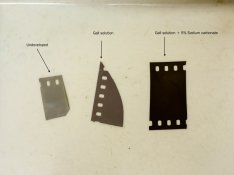
SO, thought I, let's dunk a bit of exposed 35mm leader in some of this fermenting goo for an hour, just to see what happens. Results in attachment.

Clearly something's gone on ... but of course we know that all sorts of macerated plant materials with a bit of alkali added will develop film, so there's no conclusion as to what the developing agent is here.

Anyone interested in IG ink might want to have a look at this rather beautiful little site, by the way: www.irongallink.org
 

Attachments
  • a20150122-1.jpg
    a20150122-1.jpg
    150.1 KB · Views: 291
Last edited by a moderator:

NedL

Subscriber
Allowing Ads
Joined
Aug 23, 2012
Messages
3,421
Location
Sonoma County, California
Format
Multi Format
Google Chrome reports that the site in your link contains malware.... :sad:

I'd have to go digging through my old email, but I think I have a film developer recipe somewhere that uses fermented oak galls..... my memory ( might be wrong!! ) is that it also had sodium carbonate and potassium bromide.

Edit: I want to try making gall ink too! Rusty iron nails and fermented oak galls!
 
OP
OP
pdeeh

pdeeh

Member
Allowing Ads
Joined
Jun 8, 2012
Messages
4,770
Location
UK
Format
Multi Format
No problems reported by any of my browsers Ned, or by AVG.
 

Old-N-Feeble

Member
Allowing Ads
Joined
Feb 22, 2012
Messages
6,805
Location
South Texas
Format
Multi Format
I get a warning also as follows...

"The site ahead contains malware"

"Attackers currently on www.irongallink.org might attempt to install dangerous programs on your computer that steal or delete your information (for example, photos, passwords, messages, and credit cards)."
 
OP
OP
pdeeh

pdeeh

Member
Allowing Ads
Joined
Jun 8, 2012
Messages
4,770
Location
UK
Format
Multi Format
Well I've been looking at it for months without problems.

It would be a shame if a thread about interesting chemistry got sidetracked into a list of who does and doesn't get warnings about a perfectly safe site though ...
 

Gerald C Koch

Member
Allowing Ads
Joined
Jul 12, 2010
Messages
8,131
Location
Southern USA
Format
Multi Format
You have rediscovered gallic acid, an ester of pyrogallol. :smile: The extract may stain emulsions.
 
Last edited by a moderator:
Joined
Oct 29, 2006
Messages
4,883
Location
İstanbul
Format
35mm
These Inks are very corrosive againts their paper , they eat the paper in time and after a long time , there is only scissor cut paper remains.
All the ink goes to eat paper. Museum Conservators having hard time with these inks , for example van gogh drawings going degraded every year and there is no solution to save them. Monastic papers been eaten and there is thousands of manuscripts completely eaten by the ink , at last years there is a solution invented and you soak the inked paper and it slows the degradation.
 

Gerald C Koch

Member
Allowing Ads
Joined
Jul 12, 2010
Messages
8,131
Location
Southern USA
Format
Multi Format
These Inks are very corrosive againts their paper , they eat the paper in time and after a long time , there is only scissor cut paper remains.
All the ink goes to eat paper. Museum Conservators having hard time with these inks , for example van gogh drawings going degraded every year and there is no solution to save them. Monastic papers been eaten and there is thousands of manuscripts completely eaten by the ink , at last years there is a solution invented and you soak the inked paper and it slows the degradation.

All too true. The first things to go are loop letters like the O's which just fall out. Chinese and Japanese inks based on lampblack are much better.
 

gone

Member
Allowing Ads
Joined
Jun 14, 2009
Messages
5,504
Location
gone
Format
Medium Format
I got the same warning w/ my AVG antivirus. If you just need black ink, as Gerald mentioned, lamp black is the way to go. It's made just as you would think it is. For more (way more) about inks than you would ever wish to know, see here

http://www.inkblazers.com/blogs/Think-Ink-1-Types-of-Ink/detail-page/5213

Or, just give me a bottle of whatever you have, and a clean white t-shirt. If it's a permanent ink, I will figure out a way to ruin the shirt in a nano second.
 
OP
OP
pdeeh

pdeeh

Member
Allowing Ads
Joined
Jun 8, 2012
Messages
4,770
Location
UK
Format
Multi Format
How corrosive ig ink is to paper appears to be dependent on the recipe used, whether it contains mineral acid and the ratio of Ferrous sulfate used.

Certainly no one will know what recipe a mediaeval document that has suffered damage was written with.
 
Last edited by a moderator:
OP
OP
pdeeh

pdeeh

Member
Allowing Ads
Joined
Jun 8, 2012
Messages
4,770
Location
UK
Format
Multi Format
You have rediscovered gallic acid, an ester of pyrogallol. :smile: The extract may stain emulsions.

I certainly don't think I've rediscovered anything, Gerald, as I knew the theory before I started (as stated in the OP :wink:)
 
Last edited by a moderator:
OP
OP
pdeeh

pdeeh

Member
Allowing Ads
Joined
Jun 8, 2012
Messages
4,770
Location
UK
Format
Multi Format
Oh I'm perfectly well aware that this is nothing new :smile:
But I hadn't known about FT's exciting liquid - that's a marvellous phrase! - so thank you for that Alan.
I really ought to read up on him more than I have; I remember cliveh mentioning that his notebooks are interesting, but they seem to be rather expensive.

once I get done with the ink, and if I can find enough galls, I might have a further play with the photographic possibilities - just for the fun of it.

oh, and I've emailed the webmasters at irongallink.org to let them know that some people are experiencing problems. they can sort it out with google. i'm confident it's a false positive.
 

railwayman3

Member
Allowing Ads
Joined
Apr 5, 2008
Messages
2,816
Format
35mm
oh, and I've emailed the webmasters at irongallink.org to let them know that some people are experiencing problems. they can sort it out with google. i'm confident it's a false positive.

FWIW, my Avira Pro antivirus (in UK) is also blocking the link for reasons of possible malware. As you say, maybe a false positive, but needs sorting.
 
OP
OP
pdeeh

pdeeh

Member
Allowing Ads
Joined
Jun 8, 2012
Messages
4,770
Location
UK
Format
Multi Format
As I say, it's not going to help this thread stay on track by endless reports about irongallink.org.
I can't do anything about it, it's not my website and I have no control over it, and nor does anyone else here (unless they happen to be responsible for that particular domain).
 

railwayman3

Member
Allowing Ads
Joined
Apr 5, 2008
Messages
2,816
Format
35mm
As I say, it's not going to help this thread stay on track by endless reports about irongallink.org.
I can't do anything about it, it's not my website and I have no control over it, and nor does anyone else here (unless they happen to be responsible for that particular domain).

I just thought that it might help, if you were emailing the webmaster, for them to have full information on what seemed to be happening. I know I appreciate any feedback if my own business website is giving problems for users, even if false. I won't bother next time, guess it's not worth trying to be helpful these days. :sad:
 
OP
OP
pdeeh

pdeeh

Member
Allowing Ads
Joined
Jun 8, 2012
Messages
4,770
Location
UK
Format
Multi Format
I'd already emailed them, and, as you quoted me saying, it's not my website.

I'm not going to mail them every time someone adds another report about their website to this thread.

What I'd hoped to be a potentially interesting thread has been resolutely derailed, as so many are at APUG. It just seems a shame.
 

Alan Johnson

Subscriber
Allowing Ads
Joined
Nov 16, 2004
Messages
3,381
The Calotype developer is a physical developer, ie the silver comes from the solution.

To develop modern film a chemical developer using gallic acid with alkali accelerator would appear to work as your example shows.
Gallic acid works faster in combination with phenidone derivatives ,with which it is superadditive, as in this patent:
http://www.google.com/patents/US2685516
 
OP
OP
pdeeh

pdeeh

Member
Allowing Ads
Joined
Jun 8, 2012
Messages
4,770
Location
UK
Format
Multi Format
Two interesting links Alan, thank you.
 

NedL

Subscriber
Allowing Ads
Joined
Aug 23, 2012
Messages
3,421
Location
Sonoma County, California
Format
Multi Format
The Calotype developer is a physical developer, ie the silver comes from the solution.

I've been confused about what "physical development" means. In historical accounts of the calotype process, it seems common to try development with gallic acid first, watch how quickly the image comes up, and then add acetonitrate of silver to speed it up and increase density if necessary. Also I've seen mentioned the idea that you can balance the AgNO3 and acetic acid, the AgNO3 to increase development and the acid to restrain it.... giving great control over development. Some Authors implying that this is where the real control over the negative is. ( In this way, it's similar to how people talk about modern film development. )

So I guess if I develop a calotype only using gallic acid, it is "chemical" development and if I add a little AgNO3 it is "physical"? Is this related in any way to lith printing? Is the "infectious development" in lith printing a kind of "physical development"?

I find calotypes difficult and time consuming enough that I probably will stick with purchased gallic acid, but it would be interesting to see if a calotype could be developed in the gall oak solution, with no other additives. In water, gallic acid is a saturated solution at something like 0.8%, I suspect if you let enough evaporation occur in the fermented gall oak solution, it might get close to this?
 

Gerald C Koch

Member
Allowing Ads
Joined
Jul 12, 2010
Messages
8,131
Location
Southern USA
Format
Multi Format
I certainly don't think I've rediscovered anything, Gerald, as I knew the theory before I started (as stated in the OP :wink:)

I apologize, my intent was to point out that oak galls contain gallic acid and its esters and it can be a natural source for a developer. Many people would be unaware of this had you not posted.
 
OP
OP
pdeeh

pdeeh

Member
Allowing Ads
Joined
Jun 8, 2012
Messages
4,770
Location
UK
Format
Multi Format
Is this related in any way to lith printing? Is the "infectious development" in lith printing a kind of "physical development"?

there are much better authorities than me to answer your question, so I'll quote one:

"In [physical development] the silver ions for reduction at the latent image specks are originally supplied from the developer solution"
(LFA Mason, Photographic Processing Chemistry 2nd Ed. p14)

As I understand it, "Infectious development" is a catalytic reaction triggered by the oxidation products of hydroquinone during development, so is not related to physical development (my source is Mason again

But we'll need a Gerald or a PE or indeed an Alan to confirm or correct this.
 
OP
OP
pdeeh

pdeeh

Member
Allowing Ads
Joined
Jun 8, 2012
Messages
4,770
Location
UK
Format
Multi Format
There's a lovely site devoted to Albumen printing (http://albumen.conservation-us.org) that contains an electronic version of "The Silver Sunbeam" by John Towler M.D., first published in 1864 as a "A Practical and Theoretical Text-Book ON SUN DRAWING AND PHOTOGRAPHIC PRINTING ..."

The Silver Sunbeam said:
Preparation of Gallic Acid.

As before observed, gallic acid exists in minute quantity in nutgalls; but it is rather a product of the decomposition of tannin, than a naturally existing substance. Mix powdered nutgalls into a thin paste, and expose it to the air for two or three months, taking care to replace the water as it evaporates. The mass becomes mouldy, and darker in color by this exposure; it is then pressed in a cloth; afterward, the residue is boiled in water and filtered whilst hot. On cooling, crystals of gallic acid are deposited, which are purified by boiling in eight parts of water and one fifth of their weight of animal charcoal. After filtration and cooling, pure crystals of gallic acid are deposited, in the form of long silky needles. During exposure to the atmosphere, moist tannic acid absorbs oxygen, and liberates carbonic acid, so that gallic acid is altogether a definite and distinct compound. When quite purified, it has no effect upon a solution of gelatine; it has an acid and astringent taste. The solution is soon decomposed. Gallic acid is soluble in one hundred parts of cold water, and in three of boiling water. It has no effect upon the solution of salts of the protoxide of iron, but upon those of the sesquioxide, it produces a deep bluish-black precipitate, which disappears when the liquid is heated, the sesquioxide being converted into the protoxide by the decomposition of the gallic acid. Gallic acid meets with an extensive application in photography, in various processes, as in the Tannin Process of Major Russell, the Dry Process of Taupenot, etc., and in the process of Positive Printing by Development.

Preparation of Pyrogallic Acid.


The etymology of the word indicates the origin of this substance. When gallic acid is heated to the temperature of 410° Fahrenheit, and kept at this temperature, in an oil-bath, a volatile substance sublimes of a beautiful white color, in crystalline plates. This is pyrogallic acid, which is soluble in water, alcohol, and ether. The solution of pyrogallic acid soon turns brown when exposed to the air, by becoming oxidized. It communicates a blackish-blue color to the solutions of the salts of the protoxide of iron, and reduces those of the sesquioxide to the state of the protoxide. When mixed with an alkaline solution, it absorbs a large quantity of oxygen from the atmosphere, and has been used in the analysis of air for this special purpose. When gallic acid is raised to a higher temperature than 410° Fahrenheit, that is, to 480° Fahrenheit, it is decomposed into carbonic acid, water, and a new substance denominated metagallic acid, being the black shining residue left in the retort. Pyrogallic acid, at the proper temperature, is in like manner decomposed into metagallic acid and water.

Owing to the property possessed by pyrogallic acid of absorbing oxygen from bodies with which it is in contact, it is as yet the second best developer of the latent image in the collodion process; and taking into consideration the nature of the image produced, where the time of exposure is not important, it certainly is the most easy and reliable developer. There is no doubt that a solution of protosulphate of iron acts more quickly; or, what is meant, requires a much shorter time of exposure. From the experiments in ordinary landscape photography, I have frequently observed a difference of three to one in the time in favor of the sulphate of the protoxide of iron.

(http://albumen.conservation-us.org/library/monographs/sunbeam/)

PS None of these links throw up errors or warnings for me, but if they do for you, please contact the relevant webmasters directly :smile:
 
Photrio.com contains affiliate links to products. We may receive a commission for purchases made through these links.
To read our full affiliate disclosure statement please click Here.

PHOTRIO PARTNERS EQUALLY FUNDING OUR COMMUNITY:


Ilford ADOX Freestyle Photographic Stearman Press Weldon Color Lab Blue Moon Camera & Machine
Top Bottom
