• Welcome to Photrio!
    Registration is fast and free. Join today to unlock search, see fewer ads, and access all forum features.
    Click here to sign up

Developers Question for Dry Plate Positives

Wet weekend

A
Wet weekend

  • 3
  • 1
  • 24
Riverview grounds 1

H
Riverview grounds 1

  • 4
  • 3
  • 139

Recent Classifieds

Forum statistics

Threads
202,374
Messages
2,839,827
Members
101,299
Latest member
djj82
Recent bookmarks
0

Jessxi

Subscriber
Allowing Ads
Joined
May 19, 2024
Messages
53
Location
MN
Format
Medium Format
Hi All!

I have a question regarding developers for creating dry plate positives that I would like to ask of our members that are more knowledgeable and experienced in this area than I. The most I have used is 510 Pyro when developing positives. i think it's a good developer but I am wondering if there may be something that might give a little bit better pop.

What developer would everyone recommend for the final product of an Orotone or Curt-tone?

Thank you!
Jess
 

Chromium VI

Member
Joined
Jan 10, 2026
Messages
62
Location
Tomar, Portugal
Format
Multi Format
Hi All!

I have a question regarding developers for creating dry plate positives that I would like to ask of our members that are more knowledgeable and experienced in this area than I. The most I have used is 510 Pyro when developing positives. i think it's a good developer but I am wondering if there may be something that might give a little bit better pop.

What developer would everyone recommend for the final product of an Orotone or Curt-tone?

Thank you!
Jess
Hi Jess!
I have done quite a few orotones in the past, most of them where just developed in Ilford's Multigrade developer, but I have also tried Rodinal at 1+15, with very very good results. You may also try sepia tone the plates, they will look wanderfull with the gold backing. I used to make my positives with Durst condenser enlarged for the extra kick on the contrast, and my best results came from Adox HR-50 film negs, wich have high contrast and definition. I did my gold backing with vintage bronze powder (the real stuff, not micas), but best results are achieved by water gilding with gold leaf (the fake stuff works as well).
 

koraks

Moderator
Moderator
Joined
Nov 29, 2018
Messages
27,855
Location
Europe
Format
Multi Format
For positives and assuming a reversal process, a staining developer as first developer would definitely not be a good idea since you'd be left with the stain after the reversal. So the question right off the bat is whether these assumptions are correct: are you indeed doing a chemical reversal process, and have you indeed been using 510 pyro for the first developer as well?

Or are you referring to 'positives' in the sense of a very thin negative image that shows up as a positive against a dark background, like a tintype etc.?

What developer would everyone recommend for the final product of an Orotone or Curt-tone?
I honestly don't think it would matter all that much, but if this is going to be a black/dark silver image on top of a gold background, you'd want something that yields sufficient density. I'm thinking along the lines of Dektol or ID62; something fairly clean-working that will build lots of density. Btw, I've done pretty effective (albeit somewhat 'blingy') 'orotones' by transferring carbon prints onto glass and then backing the glass with a mica faux-gold pigment.

1771788509428.png
1771788535874.png

This is a test print made as outlined above. Not exactly what you're looking for since it's not a silver image, but black pigment in gelatin. The end result looks similar though.
 
OP
OP
Jessxi

Jessxi

Subscriber
Allowing Ads
Joined
May 19, 2024
Messages
53
Location
MN
Format
Medium Format
Hi Jess!
I have done quite a few orotones in the past, most of them where just developed in Ilford's Multigrade developer, but I have also tried Rodinal at 1+15, with very very good results. You may also try sepia tone the plates, they will look wanderfull with the gold backing. I used to make my positives with Durst condenser enlarged for the extra kick on the contrast, and my best results came from Adox HR-50 film negs, wich have high contrast and definition. I did my gold backing with vintage bronze powder (the real stuff, not micas), but best results are achieved by water gilding with gold leaf (the fake stuff works as well).

Thank you for replying!

I have some experience with copper gilding on wood pillars but not glass. I am assuming perhaps there is a larger learning curve on glass? I used gold spray paint on the plates I just produced and I do believe it is missing that visual glow and luster of the real thing.

I will look into sepia toning the plates.
 

Chromium VI

Member
Joined
Jan 10, 2026
Messages
62
Location
Tomar, Portugal
Format
Multi Format
Thank you for replying!

I have some experience with copper gilding on wood pillars but not glass. I am assuming perhaps there is a larger learning curve on glass? I used gold spray paint on the plates I just produced and I do believe it is missing that visual glow and luster of the real thing.

I will look into sepia toning the plates.
It's a completely different approach, serch on Youtube for «water gilding of old school reversed gilded signs» (like this one. The finish, if you're carefull, is a perfect gold mirror.
 
OP
OP
Jessxi

Jessxi

Subscriber
Allowing Ads
Joined
May 19, 2024
Messages
53
Location
MN
Format
Medium Format
For positives and assuming a reversal process, a staining developer as first developer would definitely not be a good idea since you'd be left with the stain after the reversal. So the question right off the bat is whether these assumptions are correct: are you indeed doing a chemical reversal process, and have you indeed been using 510 pyro for the first developer as well?

Or are you referring to 'positives' in the sense of a very thin negative image that shows up as a positive against a dark background, like a tintype etc.?


I honestly don't think it would matter all that much, but if this is going to be a black/dark silver image on top of a gold background, you'd want something that yields sufficient density. I'm thinking along the lines of Dektol or ID62; something fairly clean-working that will build lots of density. Btw, I've done pretty effective (albeit somewhat 'blingy') 'orotones' by transferring carbon prints onto glass and then backing the glass with a mica faux-gold pigment.

View attachment 418755View attachment 418757
This is a test print made as outlined above. Not exactly what you're looking for since it's not a silver image, but black pigment in gelatin. The end result looks similar though.

Hello Koraks,

I am not doing a reversal process, just making a print on a dry plate. Sorry, I thought about how to phrase making a print on glass and I should have just said print but that seemed like an incorrect term when I typed it out.

If this is too much background info on the process I used please forgive me for adding it in but I am not very experienced with alternative processes, so maybe extra background info may help.

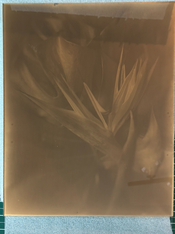
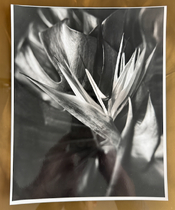
I was experimenting with a new petzval lens that came in the mail shot on 4x5 Ilford Delta 100 developed with F76+. I made a couple of traditional prints of a bird of paradise taken with it on Ilford Multigrade glossy that I think developed well and had a satisfactory amount of contrast for my taste.

Seeing the results, I decided to develop the image on a couple 11x14 dry plates that I have had stored in the dark for around 2 years. I made 4 test images on 6th plates at the distance I'd be projecting for my 11x14 on and the final image developed fine in a pyro solution of 200+1 and has contrast. The final prints however lack a bit of that contrast that the test 6th plates have. Having typed this out I am wondering if my plates had lost a bit of sensitivity having been stored for so long?


Even though the prints didn't quite work out it did remind me that I have had the question in my mind for sometime of if there is a developer that I could use that would give the brown tone of pyro but get a little more contrasty pop without introducing too much black into the final print.

That is a beautiful image and print! I will look into transfering carbon prints onto glass are they very difficult to produce?
 

Attachments

  • IMG_2962.jpeg
    IMG_2962.jpeg
    558.6 KB · Views: 5
  • IMG_2961.jpeg
    IMG_2961.jpeg
    415.6 KB · Views: 4
Photrio.com contains affiliate links to products. We may receive a commission for purchases made through these links.
To read our full affiliate disclosure statement please click Here.

PHOTRIO PARTNERS EQUALLY FUNDING OUR COMMUNITY:


Ilford ADOX Freestyle Photographic Stearman Press Weldon Color Lab Blue Moon Camera & Machine
Top Bottom