• Welcome to Photrio!
    Registration is fast and free. Join today to unlock search, see fewer ads, and access all forum features.
    Click here to sign up

Developers for sharp grain?

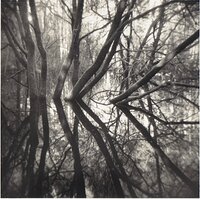
102391040027-2.jpg

A
102391040027-2.jpg

  • 6
  • 4
  • 91
Just a Sparrow

D
Just a Sparrow

  • 1
  • 0
  • 49

Recent Classifieds

Forum statistics

Threads
201,780
Messages
2,830,024
Members
100,942
Latest member
juksuon
Recent bookmarks
1

Lachlan Young

Member
Allowing Ads
Joined
Dec 2, 2005
Messages
5,082
Location
Glasgow
Format
Multi Format
poor highlights :sad:

Not an really an issue - point is to create a relatively tonally condensed negative that needs printed on a hard grade of paper. It's essentially the not-secret-at-all technique that Ralph Gibson used. Some of Michael Kenna's work bears hallmarks of the same approach.
 

Craig75

Member
Allowing Ads
Joined
May 9, 2016
Messages
1,234
Location
Uk
Format
35mm
I agree and its how i like to print 35mm street shooting but it should be underdeveloped not overdeveloped surely. Overdeveloped and a hard grade and its a loong day burning in all those highlights that have gone beyond scale of paper.
 

Lachlan Young

Member
Allowing Ads
Joined
Dec 2, 2005
Messages
5,082
Location
Glasgow
Format
Multi Format
I agree and its how i like to print 35mm street shooting but it should be underdeveloped not overdeveloped surely. Overdeveloped and a hard grade and its a loong day burning in all those highlights that have gone beyond scale of paper.

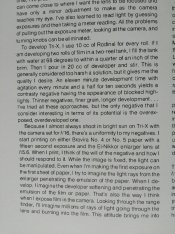
What you describe is a standard 'pull' process. That is not what I am describing - here is Gibson explaining his approach in the Lustrum Press 'Darkroom' book:
IMG_20170720_124256.jpg
 

Craig75

Member
Allowing Ads
Joined
May 9, 2016
Messages
1,234
Location
Uk
Format
35mm
Not a pull per se just reducing contrast so that it prints on a higher grade.

Thank you for taking time to attach the scan -appreciated!

I am def. Confused by his explanation tho- i dont understand how one can have thinner negs with overexposure and overdevelopment as he describes. I have no idea how when he says negs have appearance of blocked highlights he can then go on to print at such a high contrast paper and not end up with a lot of burning in of highlights at a very soft grade

Id have thought a stop underexposure would create thinner negs not a stop over. Clearly his technique works with his equipment as his prints are not to be trifled with but his explanation doesnt make much sense to me unless im being really stupid here (which cannot be discounted!)
 

Lachlan Young

Member
Allowing Ads
Joined
Dec 2, 2005
Messages
5,082
Location
Glasgow
Format
Multi Format
Not a pull per se just reducing contrast so that it prints on a higher grade.

Thank you for taking time to attach the scan -appreciated!

I am def. Confused by his explanation tho- i dont understand how one can have thinner negs with overexposure and overdevelopment as he describes. I have no idea how when he says negs have appearance of blocked highlights he can then go on to print at such a high contrast paper and not end up with a lot of burning in of highlights at a very soft grade

Id have thought a stop underexposure would create thinner negs not a stop over. Clearly his technique works with his equipment as his prints are not to be trifled with but his explanation doesnt make much sense to me unless im being really stupid here (which cannot be discounted!)

Try the following: rate TX (or HP5 or whatever) at 2 stops over box speed (EI 100 in this case) and process for what is suggested for an EI of 400-800. One stop over, & a bigger push is another approach. You'll essentially get the sort of negatives Gibson describes. Useful technique, but you'll need a reasonably powerful enlarger to get your exposure times in a good range. Don't even think about scanning the negs on an Epson, you'll need something much more serious.
 

Craig75

Member
Allowing Ads
Joined
May 9, 2016
Messages
1,234
Location
Uk
Format
35mm
I will def try it. Looking at his prints (on my phone which is hardly best way) he favours big swathes of black so he's just printing down until his highlights are where he wants them and devil take the shadow im assuming.

For the life of me i cant see how he can get what he calls thin negs out of this process. But i will get involved and see what happens as i like his work.
 

Lachlan Young

Member
Allowing Ads
Joined
Dec 2, 2005
Messages
5,082
Location
Glasgow
Format
Multi Format
For the life of me i cant see how he can get what he calls thin negs out of this process. But i will get involved and see what happens as i like his work.

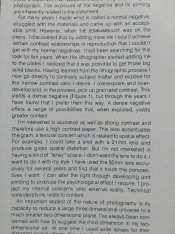
Re-read what he says - Gibson states he doesn't like thin negs, and the process creates quite dense negs which he prefers - here's another pull quote from the same source:
IMG_20170720_124211.jpg
 

Craig75

Member
Allowing Ads
Joined
May 9, 2016
Messages
1,234
Location
Uk
Format
35mm
Re-read what he says - Gibson states he doesn't like thin negs, and the process creates quite dense negs which he prefers - here's another pull quote from the same source:
View attachment 183119
ah yes.i misread it first time round. Now it makes sense!

so overexposed overdeveloped highlights to get grain and the presumably printing down losing shadow detail along the way until highlights are in place. Yes I can see how that would work now.

Surely the only catch is that one would have to be willing to lose shadow detail to get the highlights in place as one prints down. If one wants to preserve shadow detail tho its going to need a lot of burning to get highlights in place.

I will def try it tho as it sounds like night shooting during the day and will create an interesting look - big blacks and grainy highlights
 

Andrew O'Neill

Moderator
Moderator
Allowing Ads
Joined
Jan 16, 2004
Messages
12,918
Location
Coquitlam,BC Canada
Format
Multi Format
The problem is all these developers give fine grain and overall image sharpness which is not what the OP is asking about.

Out of this list I've used 3 extensively Rodinal, Xtol (replenished0 and Pyrocat HD and I hate grain so can assure people that the negatives I produce(d) with them, 35mm and upwards, are sharp (good definition), tonal, and low grain even with the 35mm films I use.

I've used Beutler, FX1 & FX2 etc and plenty of other developers over the yearsand in all honesty the best commercially available developer for tight crisp grain like the OP's asking about is Microphen (ID-68) and a film like HP5. Probably the most exaggerated grain would be Paterson's long discontinued Acutol S, followed by Acutol.

Ian

Dilute Pyrocat-HD for semi-stand does NOT give fine grain.
 

trendland

Member
Allowing Ads
Joined
Mar 16, 2012
Messages
3,398
Format
Medium Format
I do agree that MCM 100 is a very sharp surface developer and if it weren't a pain to mix or get(no Meritol anymore) I might even use it myself. It's neat in how it really etches the emulsion of the film and it's really hard to tell which is the emulsion side because they are both very shiny. You have to hold the negative o an angle toward a light source to see the etching and then you can determine the emulsion side. This is a very good developer none the less.

Realy? Form my understanding MCM100
is a type of extreme finest grain developer.
As I would expect its characteristics I would compare it as "hyper Perceptol"
and this should be in also concern with
less contrast.
Lost of speed is the same as with Perceptol or lets better say : a litte speed is remaining:wink:.....
But I might be wrong :smile:.....
Yes in addition it is hard to get ppd.
In a some years more we could see the same with methol.
There might be some people who are always trying to drink this stuff - therefore
officials want to protect us from danger
and very "evil " developer compounds but same officials allowed companies to use same compound to wash your hair with (ppd):D:happy::cool::laugh::D:laugh:......

with regards
 

Alan Johnson

Subscriber
Allowing Ads
Joined
Nov 16, 2004
Messages
3,374
Try the following: rate TX (or HP5 or whatever) at 2 stops over box speed (EI 100 in this case) and process for what is suggested for an EI of 400-800. One stop over, & a bigger push is another approach. You'll essentially get the sort of negatives Gibson describes. Useful technique, but you'll need a reasonably powerful enlarger to get your exposure times in a good range. Don't even think about scanning the negs on an Epson, you'll need something much more serious.
This technique appears to deal only with negatives of the special case no9 detailed here:
http://unblinkingeye.com/Articles/Mortensen/mortensen.html
 

Paul Howell

Subscriber
Allowing Ads
Joined
Dec 23, 2004
Messages
10,097
Location
Scottsdale Az
Format
Multi Format
Realy? Form my understanding MCM100
is a type of extreme finest grain developer.
As I would expect its characteristics I would compare it as "hyper Perceptol"
and this should be in also concern with
less contrast.
Lost of speed is the same as with Perceptol or lets better say : a litte speed is remaining:wink:.....
But I might be wrong :smile:.....
Yes in addition it is hard to get ppd.
In a some years more we could see the same with methol.
There might be some people who are always trying to drink this stuff - therefore
officials want to protect us from danger
and very "evil " developer compounds but same officials allowed companies to use same compound to wash your hair with (ppd):D:happy::cool::laugh::D:laugh:......

with regards


The version I use from Photographer's Formulary uses Catchol with ppd, it is full speed, no loss of contrast, development times are on the longish side. I also have Photo Formulary's version of Edwal 12, very sharp, good grain, no loss of speed, but high contrast, easy to blow out the highlights. PPD is toxic, need to use good gloves, mask, not to be used in house with small children. Photographer's Formulary also sells PPD, or did, but prices have really gone up, a gallon of MCM 100 runs about $48.00, for that reason I'm moving back to D 76.
 

trendland

Member
Allowing Ads
Joined
Mar 16, 2012
Messages
3,398
Format
Medium Format
The version I use from Photographer's Formulary uses Catchol with ppd, it is full speed, no loss of contrast, development times are on the longish side. I also have Photo Formulary's version of Edwal 12, very sharp, good grain, no loss of speed, but high contrast, easy to blow out the highlights. PPD is toxic, need to use good gloves, mask, not to be used in house with small children. Photographer's Formulary also sells PPD, or did, but prices have really gone up, a gallon of MCM 100 runs about $48.00, for that reason I'm moving back to D 76.

Sure PPD has High price. And if I just could have it I remember equipment from army exercises.
I should have a look in my basement room perhaps I can find this stuff.
ABC equipment against atomic,biological,chemical contamination.
That should be quite enought against PPD. :cool:.....
with regards
 

zanxion72

Member
Allowing Ads
Joined
Oct 18, 2013
Messages
658
Location
Athens
Format
Multi Format
With slow to medium speed films mix your own FX-1. You will be amazed of the sharpness it delivers.
 

Paul Howell

Subscriber
Allowing Ads
Joined
Dec 23, 2004
Messages
10,097
Location
Scottsdale Az
Format
Multi Format
Sure PPD has High price. And if I just could have it I remember equipment from army exercises.
I should have a look in my basement room perhaps I can find this stuff.
ABC equipment against atomic,biological,chemical contamination.
That should be quite enought against PPD. :cool:.....
with regards

MCM Photographer's Formulary

Potassium bromide .5 gram mix with water to make solution, do not add raw
Sodium sulfite 88 grams
P-phenylenediamine 7 grams
Catehol 9 grams
Borax 23 grams
Sodium phosphate 3 grams

water to make 1 liter.
 

Lachlan Young

Member
Allowing Ads
Joined
Dec 2, 2005
Messages
5,082
Location
Glasgow
Format
Multi Format
This technique appears to deal only with negatives of the special case no9 detailed here:
http://unblinkingeye.com/Articles/Mortensen/mortensen.html

Mortensen (& Adams) are not the sole arbiters of what a 'suitable' negative looks like - it's a technique that's easy to try, and feel free to plot the subsequent curve if you really need to see what's happening.

Surely the only catch is that one would have to be willing to lose shadow detail to get the highlights in place as one prints down. If one wants to preserve shadow detail tho its going to need a lot of burning to get highlights in place

Yes & no - you can end up with some lengthy burns, but you can easily decide how much shadow detail to retain. It's not a technique that pretends to be about literal representation, thus stuff like intentional haloing may not be a bad thing aesthetically, if it serves what you want to say.
 

Craig75

Member
Allowing Ads
Joined
May 9, 2016
Messages
1,234
Location
Uk
Format
35mm
This technique appears to deal only with negatives of the special case no9 detailed here:
http://unblinkingeye.com/Articles/Mortensen/mortensen.html

yes exactly. yr shadows are off the toe and onto the straight portion of the curve while your highlights are approaching the shoulder. Putting your highlights that far up should create more grain than lower down. Then a hard grade paper to increase the grain definition and keep printing down until your highlight start falling into place. Meanwhile your shadows should be slowly blocking up during lengthy exposure needed for the highlights to create some deep blacks. If you check his prints out you will see how much he likes big swathes of black but still gets some really nice midtones.

At same time the negative has the shadows and highlights basically separated so you could split print if you liked or if you want to maximise yr grain then get the shadows in place and long burns of highlights.

I like the idea now I have got my head around it - thanks lachlan for taking the time to explain it
 

Pat Erson

Member
Allowing Ads
Joined
Dec 5, 2008
Messages
336
Format
35mm RF
Not an really an issue - point is to create a relatively tonally condensed negative that needs printed on a hard grade of paper. It's essentially the not-secret-at-all technique that Ralph Gibson used.

Yup the only disadvantage to this is an extended exposure time under the enlarger (up to "several minutes" if I quote Gibson rightly).
 

Lachlan Young

Member
Allowing Ads
Joined
Dec 2, 2005
Messages
5,082
Location
Glasgow
Format
Multi Format
Yup the only disadvantage to this is an extended exposure time under the enlarger (up to "several minutes" if I quote Gibson rightly).

Yeah - MG500 heads or similarly powerful systems come into their own here, especially if you like Fomatone... Toned ART300 works rather beautifully with the technique.
 

trendland

Member
Allowing Ads
Joined
Mar 16, 2012
Messages
3,398
Format
Medium Format
MCM Photographer's Formulary

Potassium bromide .5 gram mix with water to make solution, do not add raw
Sodium sulfite 88 grams
P-phenylenediamine 7 grams
Catehol 9 grams
Borax 23 grams
Sodium phosphate 3 grams

water to make 1 liter.

Thanks Paul - I am quite sure this formula has no need to hide away compared with Kodak Xtol.
Because of it's extraordinary characteristic in regard to finest grain.
But I also would expect the original meritol based formula (out of the 30th ?)
has also remarkable finest grain caused from special compounds.
The reason to this should be quite simple. Bw emulsions to that time wasn't
as sharp and with that great resolution as we noticed today as normal.
So there was a need to finest grain developers.But bigger formats to that time compensate disatvantages more as
one can imagine !!!!!
As a great photographer stated : In the past we used different formats related to the quality there was a need to.
So in cases of extraordinary quality (advertising shootings) we used large formats - and 4x5 was the smalest of it.
(5x7 in most cases - 8x10 for the maximum quatity)
In all cases were High quality was no need for - we used mid formats.
AND 135 format was all the time a format
to non proffessionals:cry:.....
This should be a reason for developers of this period with such "High Performance".

with regards
 

Old-N-Feeble

Member
Allowing Ads
Joined
Feb 22, 2012
Messages
6,805
Location
South Texas
Format
Multi Format
Not a pull per se just reducing contrast so that it prints on a higher grade.

Thank you for taking time to attach the scan -appreciated!

I am def. Confused by his explanation tho- i dont understand how one can have thinner negs with overexposure and overdevelopment as he describes. I have no idea how when he says negs have appearance of blocked highlights he can then go on to print at such a high contrast paper and not end up with a lot of burning in of highlights at a very soft grade

Id have thought a stop underexposure would create thinner negs not a stop over. Clearly his technique works with his equipment as his prints are not to be trifled with but his explanation doesnt make much sense to me unless im being really stupid here (which cannot be discounted!)

Back when I was still shooting I used a similar process. I overexposed approximately one f-stop then underdeveloped the film considerably to the point the images would require grade 4 paper for full tonal range in prints. Under white light inspection, I selenium toned negs to print on grade 3 Ilford Gallery FB. I found the overall tonality and acutance very pleasing... to me. Shadow detail was excellent, IMO. Prints were selenium toned also, to increase D-max and change the tone/hue of the prints from olive drab to neutral-plum.

The grain was extremely sharp and far more prevalent than with reduced exposure and solvent developers.
 
Last edited:

RalphLambrecht

Subscriber
Allowing Ads
Joined
Sep 19, 2003
Messages
14,921
Location
K,Germany
Format
Medium Format
Hello,
I didn't find any thread with deep information precisely on this...
I guess APUG is the right place for this question as here I've read tons of great information by real experts who have taken this seriously for a lifetime, and love and understand developers, films and chemistry...
When I've used Rodinal and Microphen, I've enjoyed beautiful tone, and totally crisp grain... Dillution matters sometimes, agitation sometimes, and temperature can be really relevant, or not that much... Some good for slow film, some for pushing...
I know some people prefer no grain (they call it fine grain, but it's dissolved and mushy, instead of fine...). I'd like to hear about all available developers that produce grain that's really sharp... Of course, even more enjoyable would be also knowing how they act, and how different visually and chemically they are and why, and which films seem to work better in which developers...
I hope this thread finds a good spirit to unite different members' perceptions, becoming a rich one in the long term... I find crisp grain is interesting for both tonality and perceived sharpness, and it's one of my favorite visual characteristics in a photograph, so I'll be checking this thread constantly, I hope every day for months... Thanks!
It may be worth to take a look at self-brew developers such as Crawleys FX36,37 or 38. You have to mix them yourself but at least you know that it will be always available and fresh and that at low cost to you.
 

Craig75

Member
Allowing Ads
Joined
May 9, 2016
Messages
1,234
Location
Uk
Format
35mm
Back when I was still shooting I used a similar process. I overexposed approximately one f-stop then underdeveloped the film considerably to the point the images would require grade 4 paper for full tonal range in prints. Under white light inspection, I selenium toned negs to print on grade 3 Ilford Gallery FB. I found the overall tonality and acutance very pleasing... to me. Shadow detail was excellent, IMO. Prints were selenium toned also, to increase D-max and change the tone/hue of the prints from olive drab to neutral-plum.

The grain was extremely sharp and far more prevalent than with reduced exposure and solvent developers.

Thats how i shoot an auto compact. That or underexpose a stop and develop normally. Then either way turn the contrast up on enlarger.

Lachlan describes over exposure, over development, and printing at high contrast so a trickier animal again
 
Photrio.com contains affiliate links to products. We may receive a commission for purchases made through these links.
To read our full affiliate disclosure statement please click Here.

PHOTRIO PARTNERS EQUALLY FUNDING OUR COMMUNITY:


Ilford ADOX Freestyle Photographic Stearman Press Weldon Color Lab Blue Moon Camera & Machine
Top Bottom