
• Welcome to Photrio!
    Registration is fast and free. Join today to unlock search, see fewer ads, and access all forum features.
    Click here to sign up

developer for micro-contrast

Indian ghost pipe plant.

H
Indian ghost pipe plant.

  • 3
  • 1
  • 28
2026-01-136.jpg

A
2026-01-136.jpg

  • 0
  • 0
  • 33

Forum statistics

Threads
202,940
Messages
2,847,824
Members
101,548
Latest member
mdlewingt
Recent bookmarks
0

Harold33

Member
Allowing Ads
Joined
Jan 15, 2012
Messages
76
Format
Multi Format
What is the best developer to enhance micro-contrast without altering (too much) the macro contrast ? (I use "classical" films, HP5+ or FP4+)

High-acutance developers are known to degrade micro-contrast, but what else ?
 
Me too. Rodinal. But with HP5+ it is not so nice in my opinion. Great with FP4+. A couple that might give you some sense of it with Rodinal:

ImageUploadedByTapatalk1337657323.860851.jpg

ImageUploadedByTapatalk1337657351.358828.jpg
 
What is the best developer to enhance micro-contrast without altering (too much) the macro contrast ? (I use "classical" films, HP5+ or FP4+)

High-acutance developers are known to degrade micro-contrast, but what else ?

You are right, a high acutance developer will increase the micro-contrast, using the edge effect. This will give a higher perceived sharpness. However, it will degrade the image quality. In 35 mm you really need the increase in micro-contrast, using the edge effect. But in 4x5" , you are better off without the edge effects. At least, many people don't like them. And you don 't need them. With 4x5" , I use a High Definition developer. With 35 mm I would use a High acutance developer. With medium format: it depends. A couple of years ago I published Higd Definition ( catechol and pyrogallol) developers on the APUG site.

Jed
 
Harold - it is the opposite. Acutance developers tend to enhance micro contrast through specific edge effects. Assuming the same macro contrast, an acutance developer will tend to give higher micro contrast than a fine grain developer. But remember that for any film or developer micro and macro contrast move in the same direction. Typically reduced agitation frequency will help maximize micro contrast. If you want high micro contrast, the balance is to find the right combination of development time and agitation routine to maximize edge effects without flattening macro contrast too much.


Luckily Rodinal isn't a high acutance developer, these tend to give very strong edge effects and slightly coarser grain at the expense of fine detail (micro contrast).

I used Rodinal for many years but now prefer Pyrocat HD which is very like Rodinal with better blance of sharpness, definition and tonal scale.

Ian
 
I used Rodinal for many years but now prefer Pyrocat HD which is very like Rodinal with better blance of sharpness, definition and tonal scale.

Ian

Ian, what films and times are you using with Pyrocat-HD? Just been fiddling some with it myself but decent times for many films not always easily found.
 
Ian, what films and times are you using with Pyrocat-HD? Just been fiddling some with it myself but decent times for many films not always easily found.

With Adox/EFKE 25, HP5, Delta 100 & 400, Tmax 100 & 400, Acros, my times are around 15 - 16 minutes at 1+1 + waterto make 100 @ 20°C in an inversion tank agitation every 30 secs first 2 mins, once a minute after that. I get very consistent results.

Fomapan 100 & 200 I cut the time to 10 - 11 minutes.

Ian
 
With Adox/EFKE 25, HP5, Delta 100 & 400, Tmax 100 & 400, Acros, my times are around 15 - 16 minutes at 1+1 + waterto make 100 @ 20°C in an inversion tank agitation every 30 secs first 2 mins, once a minute after that. I get very consistent results.

Fomapan 100 & 200 I cut the time to 10 - 11 minutes.

Ian

Cool. Thanks much Ian. I love Rodinal but it's not always best for everything plus I love experimenting.
 
Hey, how come you get away with this correct statement but every time I say it the Rodinal Defence Force comes after me :wink: Not fair!

Because we had High Acutance developers here in Europe that were never commercially available in the US :D

Kodak sold HDD, High Definition Developer, Ilford Hyfin, Paterson Acutol S etc. All gave very high acutance but were quite grainy with 35mm films.

Kodak even sold Kodinol their Rodinal clone in Europe, and Ilford introduced theirs Certinal in 1908 :smile: Mees had worked on Rodinal type developers in the early 1900's at Wrateen & Wainwright before Kodak bought the company.
So having used Hyfin and Acutol S the results with Rodinal are mild in comparison and a better all round blance.

Ian
 
Photographers Formulary's TFX-2 used in a reduced agitation scheme (2 inversions every 3 minutes) will do the job, too. It gives slightly increased film speed and markedly enhanced edge effects and as a result boosts micro-contrasts. Pretty amazing stuff. The downside is that it is a little expensive and has a 6-month shelf life once you open the bottle.

Peter Gomena
 
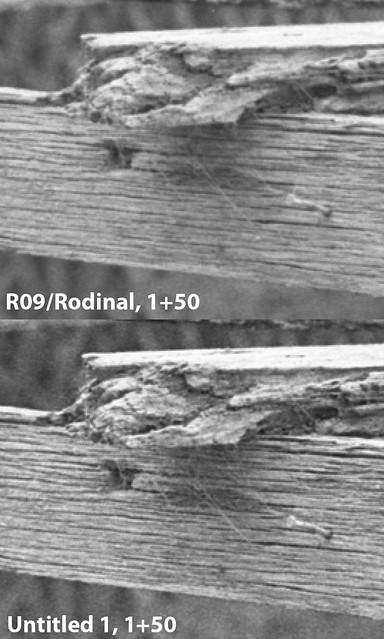
Rodinal difference vs custom developer on HP5+

The custom developer produced lower negative constrast (you would use higher grade in printing etc), but higher local contrast.


U1_v_Rodinal by athiril, on Flickr
 
You are right, a high acutance developer will increase the micro-contrast, using the edge effect. This will give a higher perceived sharpness. However, it will degrade the image quality. In 35 mm you really need the increase in micro-contrast

That's exactly how I understand the situation.

In 35 mm you really need the increase in micro-contrast, using the edge effect.

On this last statement, I disagree: a strong edge effect (as provided by high-diluted rodinal) may be disturbing, at least for me, specially with large prints. (that's why, in my opinion, the rendition of some nude photographs by Ralph Gibson looks better in printed books than original silver-prints).

I like PC-TEA very much because there is not edge effect at all, but it's also true that perceived sharpness with this developer is not always very impressive.
 
The term microcontrast is used in discussing lens resolution and digital images. Can someone provide a link to a scienfific definition as to its use in analog film processing.

I remain sceptical as to what the OP wants consideriing the films he uses.
 
The term microcontrast is used in discussing lens resolution and digital images. Can someone provide a link to a scienfific definition as to its use in analog film processing.

I remain sceptical as to what the OP wants consideriing the films he uses.

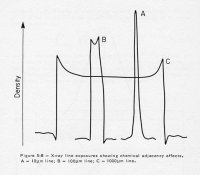
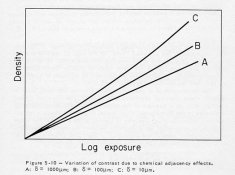
Here are examples of a fine line simulation with one developer considering a line in 4x5, 120 and 35mm formats. It is from the work of Kriss.

You will note that in this film/developer combination, as the line gets finer, the contrast goes up.

PE
 

Attachments

  • Edge Effects.jpg
    Edge Effects.jpg
    139.5 KB · Views: 247
  • Micro Contrast.jpg
    Micro Contrast.jpg
    126.5 KB · Views: 247
You will note that in this film/developer combination, as the line gets finer, the contrast goes up.

PE

Interesting the graph behaves just like the Dirac Delta function. As the interval along the x-axis (the line width) becomes smaller the apex of the distribution (density) becomes higher.
 
That's exactly how I understand the situation.


On this last statement, I disagree: a strong edge effect (as provided by high-diluted rodinal) may be disturbing, at least for me, specially with large prints. (that's why, in my opinion, the rendition of some nude photographs by Ralph Gibson looks better in printed books than original silver-prints).

I like PC-TEA very much because there is not edge effect at all, but it's also true that perceived sharpness with this developer is not always very impressive.

I do not mean that you need a strong edge effect with 35 mm. I mean: you need some edge effect. My approach is to start with a minimum edge effect ( a non distorting High Definition developer). And then I imodify the development if I need some edge effect. And, you have to realize that the amount of edge effect is not just determined by the film and developer. It depends also on the quality of the lenses. If you have an optical systerm that is good in rendering the details ( high MTF in the high spatial frequencies), you better avoid the edge effects. Many modern lenses are quite good in rendering details. Then, one has to becareful with the edge effect.
In a recent APUG meeting we could compare prints from Rodinal and pyrocat HD on medium format. I cetainly prefer the Rodinal. The edge effects were in the Rodinal better (less) than in de pyrocat HD. My personal preference for 4x5"however, is a developer with real low edge effects. A real HD developer ( low distortion in the high spatial frquencies).

Jed
 
Well, microcontrast is a popular topic of discussion and widely used term, slang or otherwise, here on APUG. Maybe enhanced local contrast would be a better term or more descriptive of the desired effect.

Peter Gomena
 
Micro and macro contrast are terms widely used in the industry and are illustrated in my earlier post. I think changing the terms arbitrarily or misunderstanding them would only confuse people.

PE
 
I'm easily confused.

Sorry to muddy the waters. Yes, local contrast on a minute scale. I get the concept, but it's not easy to communicate. I'm sure PE's graphs mean something to the scientists and engineers in the group, but they're a bit over my head.

Peter Gomena
 
Peter back before digital the photo magazines would run comparative tests of film/developer combinations, and show enlarged sections from images to illustrate the grain, sharpness (definition) etc.

So you could have a sharp looking image made with a developer like Acutol X which had great initial impact because of the high acutance but lacking very fine detail because of increased grain size, another developer might give excellent fine grain at the expense of slight apparent sharpness (Microdol-X/PerceptoL0 while a third gave a better overall balance of fine grain, sharpness rendering of fine detal, Xtol would fall into this category.

Ian
 
Peter;

In the example I posted, the edge effects control apparent sharpness. Due to the nature of emulsions and developers which can interact, edge effects can either cause lower or higher contrast as the size of an object decreases. As size decreases, one goes from the realm of macro contrast to micro contrast. Thus, you might take a picture of an object on 4x5 film and 35mm fim and make the image the same size in a print and have them appear different in contrast because the smaller image may have higher micro contrast.

PE
 
The concepts of edge effect and micro-contrast would seem to have slightly different nuances. I like
certain film/dev combinations for enhanced edge effect, like HP5 sheet film in PMK pyro, with expanded development. But after that, I might choose to enhance micro contrast per se, esp in the
highlights, by use of an unsharp mask. This significantly improves the ability to hold micro contrast
through the whole scale of the subject, esp in the highlights. But edge effect stays the same unless
geater diffusion is applied to the mask, which can also be used to fine-tune this very effect. It all
depends on the degree of the magnification in the print as well. In small format, I find that Pan F
gives the best edge acutance, provided the scene will accomodate its relative short straight line.
 
I maybe wrong here, but I always thought Rodinal was a high acutance developer, which would work better with films like HP5 as opposed to FP4. Also, surely still bath development will have a greater effect on micro contrast than developer formulation.
 
If you want micro contrast in your actual print, then devlop in PMK and print on graded paper such as Ilford Galerie. Not VC paper.
 
Photrio.com contains affiliate links to products. We may receive a commission for purchases made through these links.
To read our full affiliate disclosure statement please click Here.

PHOTRIO PARTNERS EQUALLY FUNDING OUR COMMUNITY:


Ilford ADOX Freestyle Photographic Stearman Press Weldon Color Lab Blue Moon Camera & Machine
Top Bottom