
• Welcome to Photrio!
    Registration is fast and free. Join today to unlock search, see fewer ads, and access all forum features.
    Click here to sign up

Developer Dilution Time Compensation

Recent Classifieds

Forum statistics

Threads
201,819
Messages
2,830,642
Members
100,971
Latest member
Tom Janu
Recent bookmarks
0

drpsilver

Subscriber
Allowing Ads
Joined
Oct 31, 2005
Messages
702
Location
Los Altos, CA
Format
Multi Format
05 July 2016

I have feeling that this topic has been discussed before, but here I go ...

If one has found a development time, for example using D76 (stock), that works for their process and style, is there a rule of thumb that would give a guess as to how long to develop to give the same overall negative density with D76 (1:1)? Could this rule be used for most developers, or are there limitations? Could this rule be used in reverse, i.e. D76(1:1) -> D76(stock)?

The developers I am most interested in are D76 and Perceptol.

Looking forward to the conversation/discussion.

Regards,
Darwin
 

Anon Ymous

Member
Allowing Ads
Joined
Feb 7, 2008
Messages
3,679
Location
Greece
Format
35mm
The short answer, but keep in mind that it is a rule of thumb, for D76:

Assuming you know the time for D76 stock, then multiply this development time by
1,4 for D76 1+1
1,75 for D76 1+2
2 for D76 1+3

Of course, you can "reverse" this process and get times for stronger dilutions by dividing by the aforementioned factors.
 

piu58

Member
Allowing Ads
Joined
May 29, 2006
Messages
1,545
Location
Leipzig, Germany
Format
Medium Format
You have to distinguish between developpers with redox system and such without. D76 has a redox system (the HQ, which reduces the oxidized Metol), and for such developers can be said: Half the concentration gives an 1.3...1.4-fold time.
Developers without redox system, with only one reducing agent, are nearly proportional: Half the concentration gives double the time. Examples are Rodinal (p-Aminophenol only) and Microdol X or CG-512 (Metol only).
 
OP
OP
drpsilver

drpsilver

Subscriber
Allowing Ads
Joined
Oct 31, 2005
Messages
702
Location
Los Altos, CA
Format
Multi Format
06 July 2016

Anon & Uwe:

Thanks for your insights on this question. I had not considered the difference between developers with, and without, a redox system. This also gives me some insight into the "chemical action" of developers.

Regards,
Darwin
 

gone

Member
Allowing Ads
Joined
Jun 14, 2009
Messages
5,504
Location
gone
Format
Medium Format
With D76, leaving aside the density issue, you're going to get a different look if you dilute it. A little more sharpness, some reduced tonality. At least that's how it plays out w/ my negs. I always use it at stock solution. Probably depends on which film too. I'm referring to Tri-X.
 

Bill Burk

Subscriber
Allowing Ads
Joined
Feb 9, 2010
Messages
9,465
Format
4x5 Format
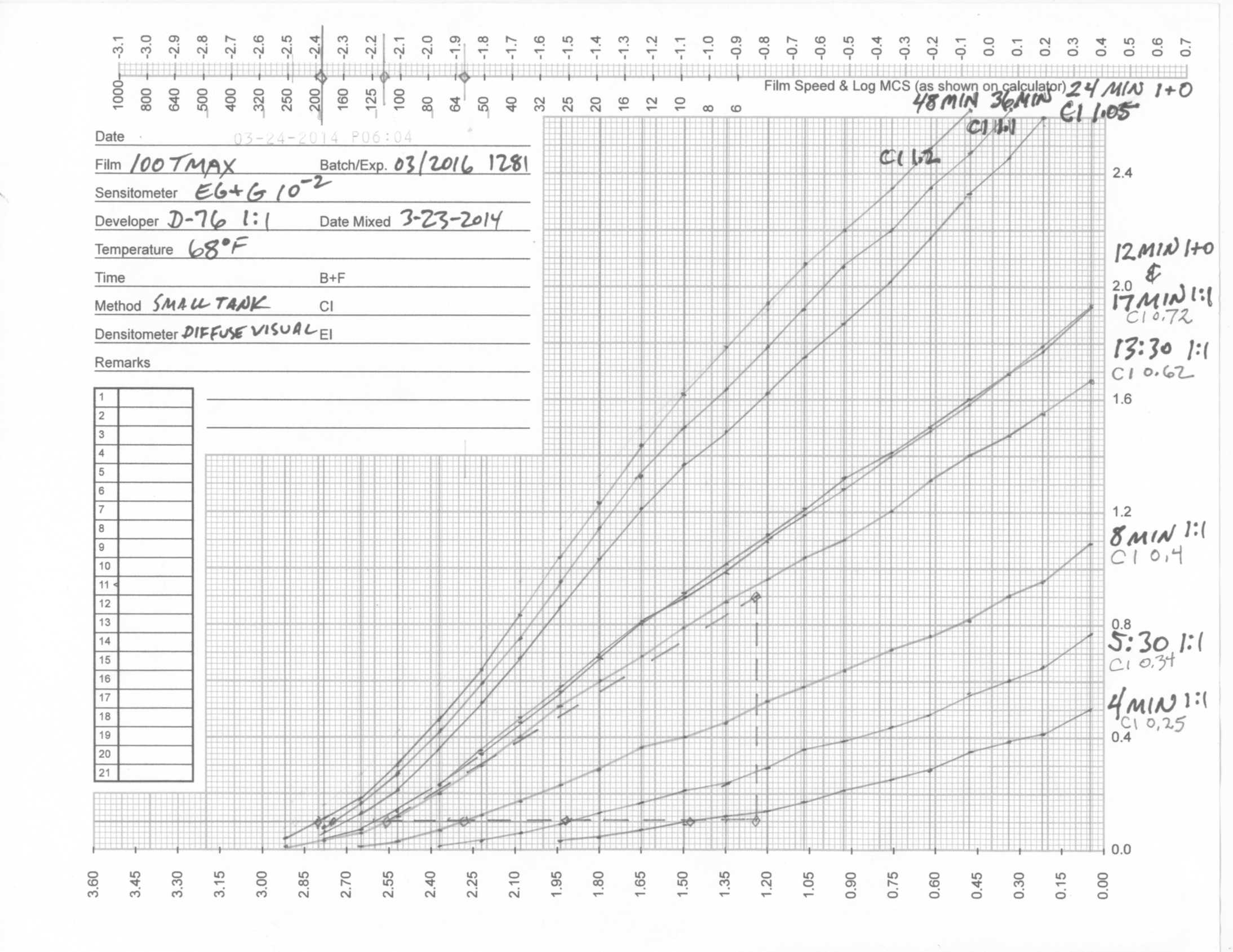
tmxfamily.jpg

I can provide one point of data to support the information already given...

12 minutes at D-76 straight, gives essentially the same characteristic curve for TMAX 100 as 17 minutes in D-76 1:1

This is close to 1.4 times longer development time in D-76 1:1 compared to D-76 straight.
 

Anon Ymous

Member
Allowing Ads
Joined
Feb 7, 2008
Messages
3,679
Location
Greece
Format
35mm
Now, if you'd like the not so short answer...

The development times for D76 seems to be proportional to the square root of the "dilution". D76 1+1 is twice as dilute compared to the stock solution, while D76 1+3 is 4 times dilute. So, sqrt(2) ~= 1,414, in other words about a 40% increase, or multiply the original development time by 1,4 (when using D76 1+1). On the other hand, sqrt(4) = 2, so double the development time if using the 1+3 dilution.
 
Photrio.com contains affiliate links to products. We may receive a commission for purchases made through these links.
To read our full affiliate disclosure statement please click Here.

PHOTRIO PARTNERS EQUALLY FUNDING OUR COMMUNITY:


Ilford ADOX Freestyle Photographic Stearman Press Weldon Color Lab Blue Moon Camera & Machine
Top Bottom