• Welcome to Photrio!
    Registration is fast and free. Join today to unlock search, see fewer ads, and access all forum features.
    Click here to sign up

Develop to Completion - test dilemma

Recent Classifieds

Forum statistics

Threads
201,848
Messages
2,831,093
Members
100,983
Latest member
PotPie
Recent bookmarks
0

Doc W

Member
Allowing Ads
Joined
Nov 7, 2009
Messages
955
Location
Ottawa, Cana
Format
Large Format
Like most of us, I always try to improve my prints a little. I have wondered about development to completion for some time and I tried to do the test in Tim Rudman's book. He suggests five test strips: one is put straight into the fixer, the other four are developed for one, two, three, and four minutes and fixed. Look for the first strip showing some density over the undeveloped one and the maximum development time before fog will be somewhere between that time and the previous time.

Sounds simple enough, so I did it, using MG IV WT. I used Dektol 1:2 at 20C. The strip developed for one minute showed density. Not a lot, but it was very very slightly darker than the undeveloped strip. In fact, all the developed strips were all pretty much the same colour. I thought that perhaps that paper was a little old and maybe fogged so I opened a relatively new box and tried again. Same thing. I am baffled.

Any suggestions on where I might be going wrong? Are there other tests one can do to determine development to completion?
 

RobC

Member
Allowing Ads
Joined
Nov 5, 2007
Messages
3,880
Location
UK
Format
Multi Format
FB or RC ?

RC has probably reached max black after 2 minutes so the 3 and 4 minute prints won't look any different than the 2 minute print.

FB may take upto 5 minutes and you would more likely see differences.
 
Last edited by a moderator:
OP
OP
Doc W

Doc W

Member
Allowing Ads
Joined
Nov 7, 2009
Messages
955
Location
Ottawa, Cana
Format
Large Format
Fibre. Thanks, Rob. I will do the test again with Dektol 1:1 and develop longer.
 

RobC

Member
Allowing Ads
Joined
Nov 5, 2007
Messages
3,880
Location
UK
Format
Multi Format
It also depends on the developer being used. Ilford Multigrade developer does seem to be more active than some developers and may produce deeper blacks which is good sometimes and not so good other times. And it may work faster than some developers. So I think you have test a bit for your particular developer which could be longer than 5 minutes if its not as hard and fast working as the Ilford stuff.
 

bernard_L

Member
Allowing Ads
Joined
Feb 17, 2008
Messages
2,133
Format
Multi Format
the test in Tim Rudman's book
Which test? Which book? and, conceivably, not everyone has this book. So, could you be more specific what is on the test strip and what is te purpose of the test:
- unexposed => look for maximum dev time before chemical fogging
- fully exposed => look for minimum time for full blacks
- step tablet => both of the above, plus "fullness" of intermediate tones
- other (please specify)

Missing that info and regretably not having a copy of TBD Tim Rudman book, it's hard to help you.
 

Ian Grant

Subscriber
Allowing Ads
Joined
Aug 2, 2004
Messages
23,409
Location
West Midland
Format
Multi Format
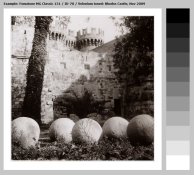
With warm tone papers you don't necessarily develop for maximum black that can kill the warmth. A lot depends on how warm you want your prints, slightly more dilute developer or a shorter time so just short of a maximum black and gain the density with selenium toning. So your Maximum black may in fact be a very beep dark brown.

Tests relevant for Bromide papers aren't right for chloro-bromide/bromo-chloride papers as you need to factor in the shift in image tone. Here's an example.

attachment.php


Ilford Warmtone paper is capable of similar warmth.

Ian
 

Attachments

  • rhodos1.jpg
    rhodos1.jpg
    108.2 KB · Views: 327

Rudeofus

Member
Joined
Aug 13, 2009
Messages
5,119
Location
EU
Format
Medium Format
Doc W, am I correct in my assumption that your test uses unexposed paper strips? If you get base fog in your developer, either your developer went berserk, or your paper is old and foggy. In both cases you should see an improvement when you add 1-2 g/l Potassium Bromide to your developer.
 

Ian Grant

Subscriber
Allowing Ads
Joined
Aug 2, 2004
Messages
23,409
Location
West Midland
Format
Multi Format
Doc W, am I correct in my assumption that your test uses unexposed paper strips? If you get base fog in your developer, either your developer went berserk, or your paper is old and foggy. In both cases you should see an improvement when you add 1-2 g/l Potassium Bromide to your developer.

Or the safelight isn't safe.

Ian
 
Joined
Sep 10, 2002
Messages
3,676
Location
Eugene, Oregon
Format
4x5 Format
Or the safelight isn't safe.

Ian

+1

Repeat your test in total darkness. Do a safelight test while you're at it.

And yes, you may have old paper that is slightly fogged. I've bought "new" paper from reputable suppliers that was clearly fogged. Fortunately, they accepted it back. BTW, my test for paper fog is exactly what you're doing, but with the lights out; fix one unexposed strip, develop another for a minimum time (2 minutes for fiber-base paper) and see if there is fog. If so, then... get some fresh paper and try again.

As Rudeofus pointed out, you can use a restrainer (pot. bromide or BTA) to clear the whites if the paper is not fogged badly. Also, whites can be cleared up on fogged paper by bleaching a bit after printing with a dilute pot. ferricyanide bleach.

Let's hope it's your safelight though.

Best,

Doremus
 

Ian Grant

Subscriber
Allowing Ads
Joined
Aug 2, 2004
Messages
23,409
Location
West Midland
Format
Multi Format
It's worth pointing out that some safelights are fine for graded papers but not safe enough for Variable contrast papers, particularly in a small darkroom.

Ian
 

Rudeofus

Member
Joined
Aug 13, 2009
Messages
5,119
Location
EU
Format
Medium Format
It's worth pointing out that some safelights are fine for graded papers but not safe enough for Variable contrast papers, particularly in a small darkroom.

Operating open trays with photochemistry in complete darkness is not something I would recommend to anyone except under the most special circumstances. If safelights are a concern, I'd recommend leaving a test strip out there for 5-10 minutes, then develop&fix. If this test strip turns out noticeably darker than a test strip going directly into developer&fixer, then yes, safelights do need closer attention.
 

Ian Grant

Subscriber
Allowing Ads
Joined
Aug 2, 2004
Messages
23,409
Location
West Midland
Format
Multi Format
Operating open trays with photochemistry in complete darkness is not something I would recommend to anyone except under the most special circumstances. If safelights are a concern, I'd recommend leaving a test strip out there for 5-10 minutes, then develop&fix. If this test strip turns out noticeably darker than a test strip going directly into developer&fixer, then yes, safelights do need closer attention.

Some older orange/red safelights like the older Paterson ones weren't safe with MG papers it was necessary to buy the newer type and then the MG (902 brown equivalent) dome filter. A lot depends on darkroom size and one work around is to put the safelight on a dimmer switch.

Ian
 
OP
OP
Doc W

Doc W

Member
Allowing Ads
Joined
Nov 7, 2009
Messages
955
Location
Ottawa, Cana
Format
Large Format
Which test? Which book? and, conceivably, not everyone has this book. So, could you be more specific what is on the test strip and what is te purpose of the test:
- unexposed => look for maximum dev time before chemical fogging
- fully exposed => look for minimum time for full blacks
- step tablet => both of the above, plus "fullness" of intermediate tones
- other (please specify)

Missing that info and regretably not having a copy of TBD Tim Rudman book, it's hard to help you.

The test involves unexposed strips. One is put straight into the fix. The others go the normal route of developer, stop and fix. This test seeks to establish the maximum development time before fogging.
 

RobC

Member
Allowing Ads
Joined
Nov 5, 2007
Messages
3,880
Location
UK
Format
Multi Format
I thought this was a question about "Develop to completion" as per the topic title and my responses were for that.
 

pentaxuser

Member
Joined
May 9, 2005
Messages
20,340
Location
Daventry, No
Format
35mm
Now that we fully understand the process that was used, have we answered the question? If I have understood the test correctly it suggests that even with brand new paper a fogging occurs in normal development after X minutes. So there is a max development time after which the black do not become any blacker but the paper is the print is affected by fog so in effect deteriorates

pentaxuser
 
OP
OP
Doc W

Doc W

Member
Allowing Ads
Joined
Nov 7, 2009
Messages
955
Location
Ottawa, Cana
Format
Large Format
I did a test to see if it was my safelight but first, I positioned the lights so that they were much weaker. I half-covered a strip of paper (MGIV WT FB) and at 30 second intervals, I put a coin on the strip. After 12 coins, I put the strip in the developer (Dektol 1:1) for 10 minutes, then fixed and dried.

Like the test yesterday, the paper showed slight tonality over the undeveloped strip from yesterday, but there was no trace whatsoever of coin shadow. Can I conclude from this that my safelight is in fact safe? If so, then I think that the only thing for me to do at this point is to buy some absolutely fresh paper and try the first test all over again. I have a lot of paper that is 1-3 years old so I may have to look at some sort of restrainer.
 

RobC

Member
Allowing Ads
Joined
Nov 5, 2007
Messages
3,880
Location
UK
Format
Multi Format
safelight test is good except you should flash fog the paper first for 2 or 3 seconds so that your test is done on paper which has had the "paper inertia" used up before adding the coins.

I have my safelights set so that I get a full 20 minutes of safety if possible. Burning, dodging and playing about with masks can take some time.

But is sounds like you are doing the right things.

Also I think some papers can be fussy about developer and if your paper is 3 years old then it may have aged with a hint of fogging. All depends on particular paper and storage conditions. Best try with brand new paper to be sure.
 

Jim Noel

Member
Allowing Ads
Joined
Mar 6, 2005
Messages
2,261
Format
Large Format
Or the safelight isn't safe.

Ian

I agree with Ian. Since most people don't buy huge quantities of paper, and paper doesn't usually fog evenly across its surface it seems less likely that is the problem.
You need to test your safelight.
 
OP
OP
Doc W

Doc W

Member
Allowing Ads
Joined
Nov 7, 2009
Messages
955
Location
Ottawa, Cana
Format
Large Format
Re safelight test, use Kodak's method. Ilford's is the same.

I must admit I don't see any point whatsoever to the test described in the original post, in relation to print quality. It only tests for one specific thing, and there is no defined purpose. The test does not establish "development to completion", nor does it consider tonality at the various development times.

That raises this question: what is the point of development to completion? I know that I should not leave paper in the developer for too long, so what is too long and how do I determine what is too long?
 
Last edited by a moderator:
OP
OP
Doc W

Doc W

Member
Allowing Ads
Joined
Nov 7, 2009
Messages
955
Location
Ottawa, Cana
Format
Large Format
Testing Round 2

I am officially baffled and I am guessing that ALL of my paper must be fogged.

I discovered that my fixer was bad and I am guessing the developer was probably on the shady side as well. I mixed fresh fixer and fresh developer and put a piece of Ilford MGIV WT FB (undeveloped) into Ilford Rapid Fixer (my usual two bath fix, so 30 seconds in each bath). The paper turned a lovely shade of pale brown, not unlike the palest part of a brown egg. Oddly, it is a colour I have NEVER seen before on MGIV WT.

As for the safelight, if it were any darker in that darkroom, I would probably trip and kill myself. As it is, I can barely find the test strip in the fixer (in a white tray - I just changed that to black - lol). But I am open to suggestion. What is a good test for the safety of a safelight?

One more thing: how does one find the expiry date on Ilford paper, or any Ilford product for that matter?
 

RobC

Member
Allowing Ads
Joined
Nov 5, 2007
Messages
3,880
Location
UK
Format
Multi Format
Testing Round 2

I am officially baffled and I am guessing that ALL of my paper must be fogged.

I discovered that my fixer was bad and I am guessing the developer was probably on the shady side as well. I mixed fresh fixer and fresh developer and put a piece of Ilford MGIV WT FB (undeveloped) into Ilford Rapid Fixer (my usual two bath fix, so 30 seconds in each bath). The paper turned a lovely shade of pale brown, not unlike the palest part of a brown egg. Oddly, it is a colour I have NEVER seen before on MGIV WT.

As for the safelight, if it were any darker in that darkroom, I would probably trip and kill myself. As it is, I can barely find the test strip in the fixer (in a white tray - I just changed that to black - lol). But I am open to suggestion. What is a good test for the safety of a safelight?

One more thing: how does one find the expiry date on Ilford paper, or any Ilford product for that matter?

One doesn't, one finds the batch produced date. http://www.palomarkovic.net/mobile/BatchNumberDecoder/

note batch numbers get reused but I doubt your paper is old enough for that. Batch number should be on box label.
 

Ian Grant

Subscriber
Allowing Ads
Joined
Aug 2, 2004
Messages
23,409
Location
West Midland
Format
Multi Format
Ideally your development time is long enough to get the desired maximum black or with warm tone paper the desired tones, you don't want to over develop as that shifts the mid tones and highlight. The manufacturers time is the best starting point, usually 90 seconds to 2 minutes.

Ian
 

Gerald C Koch

Member
Allowing Ads
Joined
Jul 12, 2010
Messages
8,131
Location
Southern USA
Format
Multi Format
Development to completion is a somewhat confusing term. Perhaps it is best to describe the stages of print development.

1. Inertial stage - there is no visual change in the print. No detail is observed.
2. Change in density of the print becomes very rapid.
3. Change in density and contrast slows dramatically. (This point should be within the time range given by the developer manufacturer. For Dektol 1+2 this would be within 2 to 3 minutes at 68F.)
4. Over development - Developer fog becomes to be evident in border regions of the print.

It is at stage 3 that development to completion is said to occur. This method insures rich blacks and clear highlights. It avoids a common error of those new to printing. That is pulling a print before it is completely developed. This is usually done because the printer fears the print is getting too dark.

This is why it is best to watch the print and not the clock. Prints can be left in stage 3 with little change in density and contrast provided they do not slip into stage 4 resulting in fog. It will soon become second nature to determine the correct point to stop development. By using this method rather than time the temperature of the developer is compensated for. The 4 stages will still be present only the times between them will vary.

The times between the 4 stages is dependent on choice of developer and paper.
 
Last edited by a moderator:
OP
OP
Doc W

Doc W

Member
Allowing Ads
Joined
Nov 7, 2009
Messages
955
Location
Ottawa, Cana
Format
Large Format
Stop the presses!

Hexavelent, a local Apugger, came by to help and was suspicious of the results so far. He said the test strips looked like they were printing out. He suspected that the fixer was bad - the SECOND batch of fixer - so we put a piece of film in it just to check. Nothing. The film didn't budge. That fixer might as well have been gin (which I surely need about now). We then mixed up a small test batch of yet more fixer and this batch cleared the film. We threw in a few test strips from earlier today and they completely changed, almost instantly. The brown colour was gone. It was quite remarkable. I was too beat to take this any further tonight but I will continue tomorrow and post results.

Sorry for all the false starts. Live and learn. Thanks for all of the great advice. I am optimistic that this is going to work out fine tomorrow night.
 
Photrio.com contains affiliate links to products. We may receive a commission for purchases made through these links.
To read our full affiliate disclosure statement please click Here.

PHOTRIO PARTNERS EQUALLY FUNDING OUR COMMUNITY:


Ilford ADOX Freestyle Photographic Stearman Press Weldon Color Lab Blue Moon Camera & Machine
Top Bottom