
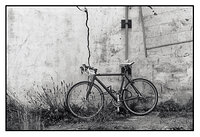
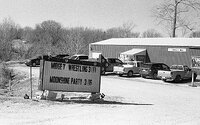
I have just realised that over the last week or two I've shot a couple of rolls of HP5 and a roll of Delta 100, three stops under exposed. I was using a new light meter app on my phone (light meter tools for android) and using the filter compensation feature to add 1.5 stops of neutral density to account for the yellow 12 filter that I way using. For some reason the app also allows positive nd values and indeed these are the values which are visible when you open the filter section, whilst negative nd values are hidden off screen. I thought I was adding additional exposure, in fact I was taking it away. All in all the films were 3 stops under exposed.
I admit that it should have been obvious that something was wrong but I find reading winter sunlight difficult and unpredictable.
That's the sob story, now for the solution.
I know I am not going to get back shadow detail that was never exposed but I would like to be able to salvage something, if at all possible. I'm sure I will have better luck with the HP5 as this is generally considered a good film for pushing so my main focus is on the Delta 100.
I have HC110, Rodinal, Xtol and Acu-1 (long life version of acufine) available to me. I will be looking to print these on mult-grade paper rather than scan.
My thought is either a straight push with Xtol or Acu-1 or a 2 hour stand in Rodinal.
I've never bothered with stand development and I'm aware that it cannot perform miracles but I have seen examples of two stop pushes using this method with impressive results. I would like to keep the contrast manageable whilst salvaging any mid-tones that I can and I'm worried that a straight push would end up with extreme contrast.
I've never used the Acu-1 developer (or Acufine) they are meant to be speed increasing developers but I rarely see them mentioned around here. What do people think about the claimed speed increases? Are they genuine?
I'm also aware that this may be a write-off which I will have to chalk up as a learning experience but I'd like to give it my best shot.
I admit that it should have been obvious that something was wrong but I find reading winter sunlight difficult and unpredictable.
That's the sob story, now for the solution.
I know I am not going to get back shadow detail that was never exposed but I would like to be able to salvage something, if at all possible. I'm sure I will have better luck with the HP5 as this is generally considered a good film for pushing so my main focus is on the Delta 100.
I have HC110, Rodinal, Xtol and Acu-1 (long life version of acufine) available to me. I will be looking to print these on mult-grade paper rather than scan.
My thought is either a straight push with Xtol or Acu-1 or a 2 hour stand in Rodinal.
I've never bothered with stand development and I'm aware that it cannot perform miracles but I have seen examples of two stop pushes using this method with impressive results. I would like to keep the contrast manageable whilst salvaging any mid-tones that I can and I'm worried that a straight push would end up with extreme contrast.
I've never used the Acu-1 developer (or Acufine) they are meant to be speed increasing developers but I rarely see them mentioned around here. What do people think about the claimed speed increases? Are they genuine?
I'm also aware that this may be a write-off which I will have to chalk up as a learning experience but I'd like to give it my best shot.


