

-
Welcome to Photrio!Registration is fast and free. Join today to unlock search, see fewer ads, and access all forum features.Click here to sign up
You are using an out of date browser. It may not display this or other websites correctly.
You should upgrade or use an alternative browser.
You should upgrade or use an alternative browser.
Decided to take a closer look at Pyrocat-HD, various dilutions & continuous agitation
-
A
- Thread starter Andrew O'Neill
- Start date
Recent Classifieds
-
For Sale LINHOF SUPER TECHNIKA III VERSION 5 with Raptar 135, film holders and FP4
- Started by Simon Benton
-
For Sale LINHOF TECHNIKA III ver 5 LENSBOARDS
- Started by Simon Benton
-
Sold KODAK COLOR THERMOMETER F
- Started by Jon Shiu
-
Want to Buy Sinar P2 8x10 Bellows (Need the frames)
- Started by Jessxi
-
Want to Buy Jobo ATL-1000 or ATL-1500
- Started by Rolfe Tessem
Forum statistics
pentaxuser
Member
Andrew, another useful video for Pyrocat HD users I was quite amazed at how much extra exposure rendered a difficult to print negative a very acceptable to print negative What was also clear to someone like me who has no experience of staining developers was how much extra stain is produced by lower dilution
In the few moments it took to watch it I note that the likes has jumped threefold
As an animal lover can I add a word of caution. If you leave open those massive 14x17 bellows for a few moments then for goodness sake check that a mother cat and her kittens have not made a home in the bellows before collapsing them
pentaxuser
In the few moments it took to watch it I note that the likes has jumped threefold
As an animal lover can I add a word of caution. If you leave open those massive 14x17 bellows for a few moments then for goodness sake check that a mother cat and her kittens have not made a home in the bellows before collapsing them
pentaxuser
OP
OP
Andrew, another useful video for Pyrocat HD users I was quite amazed at how much extra exposure rendered a difficult to print negative a very acceptable to print negative What was also clear to someone like me who has no experience of staining developers was how much extra stain is produced by lower dilution
In the few moments it took to watch it I note that the likes has jumped threefold
As an animal lover can I add a word of caution. If you leave open those massive 14x17 bellows for a few moments then for goodness sake check that a mother cat and her kittens have not made a home in the bellows before collapsing them
pentaxuser
 We have two cats (sisters) who were eyeballing my new bellows when I had it laid out on the table. They snuck into my room when I went out for a brief moment. Both of them were sniffing it. Who knows what could have happened if I decided to have a snack! Pinhole city! Don't worry... I'll be careful no cats... or squirrels... sneak inside the bellows when I'm not looking

Sirius Glass
Subscriber
Thank you. You have shown that at box speed and 1:100:100 as recommended by the film manufacturer and the developer manufacturer are close to being slight on with some slight metering correction it would be your version of perfect.

Very interesting once again, Andrew!
One thing you made me wonder about is the amount of b+f on the various dilutions. I understand why you quickly eliminated the 1+1+200 dilution from the test, but the light table shot did suggest it had by far the lowest fog level.
I've been particularly interested in the b+f issue lately due to my carbon printing experiments, and I'm currently at a point where I make pretty low-contrast tissues, requiring high-contrast negatives. This tends to exacerbate b+f issues as well. As you know, it's just additional density to print through, and carbon (especially with DAS sensitizer) is kinda slow to begin with.
What are your impressions b+f-wise?
One thing you made me wonder about is the amount of b+f on the various dilutions. I understand why you quickly eliminated the 1+1+200 dilution from the test, but the light table shot did suggest it had by far the lowest fog level.
I've been particularly interested in the b+f issue lately due to my carbon printing experiments, and I'm currently at a point where I make pretty low-contrast tissues, requiring high-contrast negatives. This tends to exacerbate b+f issues as well. As you know, it's just additional density to print through, and carbon (especially with DAS sensitizer) is kinda slow to begin with.
What are your impressions b+f-wise?

I'm wondering what effect a 2+1+100 dilution would have. Has anyone tried it?
I wonder if the 1+1+200 was very underdone because there wasn't enough developer. I know Pyrocat-HD doesn't oxidize fast, but in that little tube maybe it was just exhausted.
OP
OP
Very interesting once again, Andrew!
One thing you made me wonder about is the amount of b+f on the various dilutions. I understand why you quickly eliminated the 1+1+200 dilution from the test, but the light table shot did suggest it had by far the lowest fog level.
I've been particularly interested in the b+f issue lately due to my carbon printing experiments, and I'm currently at a point where I make pretty low-contrast tissues, requiring high-contrast negatives. This tends to exacerbate b+f issues as well. As you know, it's just additional density to print through, and carbon (especially with DAS sensitizer) is kinda slow to begin with.
What are your impressions b+f-wise?
The main reason I eliminated the 1+1+200 test was due to the amount of time required to bring the densities up to a satisfactory level. For the test, I developed that sheet for 25 minutes. It's not fun standing there, spinning that tube for that length of time
Increasing the time to 30 minutes probably would have bumped the densities up a little bit. HP5 is notorious for rapid increase of B+F with increased development times... also the fact that the film I used had been outdated (stored in the freezer).It's not fun standing there, spinning that tube for that length of time
Yeah, I know; that's mostly why I've been experimenting with dilutions like 1+1+25, or simply using print developer (ID62)...
HP5 is notorious for rapid increase of B+F
Uhuh; I did a few similar sheets like yours - pretty long-expired HP5+ in Pyrocat. Negatives were kind of nice, but so much base density to print through...I guess I'll have to stick to really fresh film for this kind of thing!

Yeah, I know; that's mostly why I've been experimenting with dilutions like 1+1+25, or simply using print developer (ID62)...
Uhuh; I did a few similar sheets like yours - pretty long-expired HP5+ in Pyrocat. Negatives were kind of nice, but so much base density to print through...I guess I'll have to stick to really fresh film for this kind of thing!
ID-62 is a Universal developer Ilford used to recommend it for films, this is from a 1960 Ilford Formulae book.
I have used ID-62 with 35mm FP4 at 1+19 and the results were excellent, fine grain, good tonal range and sharp, slight speed loss though.. I also used it extensively with Ilford Ortho for work in the 1970s & 80s.
Ian
I use Pyrocat-HDC, which is pretty much the same as Pyrocat-HD and find 1:1:100 works just fine for me. I've played with other dilutions and while they serve different purposes I always seem to fall back to 1:1:100. One method I haven't really tried is using it as a 2-bath developer. For me, Pyrocatcat-HDC is the perfect staining developer just as I think Xtol-R is the perfect non-staining developer. That's just me of course. I only mix my Pyrocat-HDC in glycol. Andy, I have nothing better to do with my time so longer developing times don't really matter. Of course at 73, with an enlarged prostrate, I might end up doing a little dancing towards the end of those long developing sessions.
@Ian Grant hah, that's nice - I did not know that ID62 was actually (also) intended as a film developer. I use it for paper mostly, but sometimes also for film, in similar dilutions at around 1+4. Yes, it's fast that way - which is the point for me. It's also quite grainy when used like that, but that's not a problem when contact printing. I never tried more sensible dilutions for film like the 1+19 you mentioned.
@Ian Grant hah, that's nice - I did not know that ID62 was actually (also) intended as a film developer. I use it for paper mostly, but sometimes also for film, in similar dilutions at around 1+4. Yes, it's fast that way - which is the point for me. It's also quite grainy when used like that, but that's not a problem when contact printing. I never tried more sensible dilutions for film like the 1+19 you mentioned.
I should correct the 1+19, that's for the concentrated version, which is PQ Universal, that's equivalent to 1+7 for the formula as published.
Ian

Hello,
I recently mixed Pyrocat-HD with Glycol, but I have my doubts about the Pyrocatechin. Its color was too dark - I guess it oxidized over time. The first test looked good, but I have a slight sediment at the bottom - is this normal?
I recently mixed Pyrocat-HD with Glycol, but I have my doubts about the Pyrocatechin. Its color was too dark - I guess it oxidized over time. The first test looked good, but I have a slight sediment at the bottom - is this normal?
OP
OP
I use Pyrocat-HDC, which is pretty much the same as Pyrocat-HD and find 1:1:100 works just fine for me. I've played with other dilutions and while they serve different purposes I always seem to fall back to 1:1:100. One method I haven't really tried is using it as a 2-bath developer. For me, Pyrocatcat-HDC is the perfect staining developer just as I think Xtol-R is the perfect non-staining developer. That's just me of course. I only mix my Pyrocat-HDC in glycol. Andy, I have nothing better to do with my time so longer developing times don't really matter. Of course at 73, with an enlarged prostrate, I might end up doing a little dancing towards the end of those long developing sessions.
Take care John! By the way, I'll be uploading a video about 2-bath Pyrocat-HD on the weekend.
I have my doubts about the Pyrocatechin. Its color was too dark
Could you post a photo?
The pyrocatechol that I usually get is tan/brown flakes. When dissolved in glycol when making pyrocat HD, it tends to make a fairly bright red color, like the fresh juice from strawberries. The hue seems to desaturate a bit after that.
Btw, unless it's pitch black, I would not necessarily worry about it. Even a little bit of oxidation will make a pretty dramatic color difference.
OP
OP
I wouldn't worry about it either. Like koraks, mine is light brown. As long as your A solution has a light peachy tint, you're fine.
I will try to take a picture but the bottles I used are very dark brown in color. I will also take a photo of Pyrocatechin - its color is really not "healthy". But as I mentioned, the 1:1:100 working solution seems to work well - I'll scan the test film for the result.
I'm just concerned about the sediment that formed in the concentrate.
I'm just concerned about the sediment that formed in the concentrate.
I'm just concerned about the sediment that formed in the concentrate.
I see, but a little sediment is not necessarily a problem either.
I do agree that ideally, the catechol isn't too dark and there's no sediment in the concentrate after mixing.
OP
OP
Just leave the sediment at the bottom... or you could pour the solution into a container, get rid of the sediment, and pour solution back in...
Sirius Glass
Subscriber
Take care John! By the way, I'll be uploading a video about 2-bath Pyrocat-HD on the weekend.
I am looking forward to that. That means not worrying about the temperature of the developer.
FWIW, I purchased my catechol back in 2016 and made some Pyrocat HD in water. In 2019, I mixed some in glycol. By that time, my catechol, which wasn't clean white to begin with, had become quite darker. Not alarmingly so, but much darker. The concentrate in glycol has a fairly dark tint, a bit darker than lager beer, but works nicely, even after 3+ years. After some cold winters there's a tiny amount of precipitate, fine crystals, but I couldn't care less. Here's what a used working solution looks like:

Hello,
I recently mixed Pyrocat-HD with Glycol, but I have my doubts about the Pyrocatechin. Its color was too dark - I guess it oxidized over time. The first test looked good, but I have a slight sediment at the bottom - is this normal?
If it's a greenish blue it has oxidised to the extent where it can cause uneven staining, straw colour or slightly darker as above is fine.
Ian
I took some pictures.
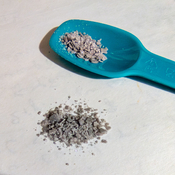
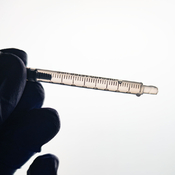
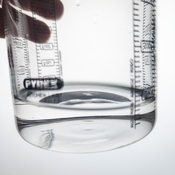
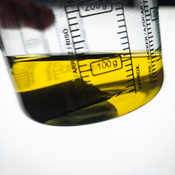
1. My Pyrocatechin - looks like crystals - dark gray in color. It's made by Fluka, but I don't know how old it is. Although it's obviously expired, I might have to be glad I found it at all - it's pretty hard to get anything specific here.
2. An attempt to show the sediment. It looks scary, but it's actually like a fine mist on the bottom. The glass is very dark...
3. Color of the concentrate - pale reddish. Almost colorless.
4. Color of working solution, ratio 1:1:100. Colorless.
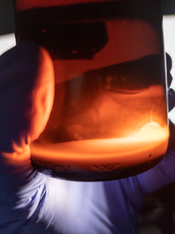
5. I put several pieces of film for about 15 minutes - even after the first one, it turned yellow. Then it darkened to some weird orange.
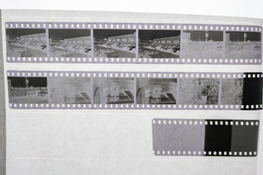
6. My first test with working solution 1:1:100, Ilford Pan F from 1992 (over 30 years old). I didn't have a camera with working metering and I used my phone as a light meter. Development: 20 degrees Celsius (68F), stirring for the first 30 seconds and then every two minutes for 10 seconds.
I'll scan the film tomorrow, it's getting late now...
1. My Pyrocatechin - looks like crystals - dark gray in color. It's made by Fluka, but I don't know how old it is. Although it's obviously expired, I might have to be glad I found it at all - it's pretty hard to get anything specific here.
2. An attempt to show the sediment. It looks scary, but it's actually like a fine mist on the bottom. The glass is very dark...
3. Color of the concentrate - pale reddish. Almost colorless.
4. Color of working solution, ratio 1:1:100. Colorless.
5. I put several pieces of film for about 15 minutes - even after the first one, it turned yellow. Then it darkened to some weird orange.
6. My first test with working solution 1:1:100, Ilford Pan F from 1992 (over 30 years old). I didn't have a camera with working metering and I used my phone as a light meter. Development: 20 degrees Celsius (68F), stirring for the first 30 seconds and then every two minutes for 10 seconds.
I'll scan the film tomorrow, it's getting late now...
Attachments
OP
OP
That is very strange... your working solution should be a light peach/straw appearance, not clear. After use, it should be orange/red (with Ilford films anyways). Your Pan F turned out fine, though... How's the image stain? It's hard to see any in your example...
| Photrio.com contains affiliate links to products. We may receive a commission for purchases made through these links. To read our full affiliate disclosure statement please click Here. |
PHOTRIO PARTNERS EQUALLY FUNDING OUR COMMUNITY:  |