• Welcome to Photrio!
    Registration is fast and free. Join today to unlock search, see fewer ads, and access all forum features.
    Click here to sign up

Darkroom Ventilation

Recent Classifieds

Forum statistics

Threads
203,214
Messages
2,851,553
Members
101,729
Latest member
Luis Angel Baca
Recent bookmarks
0

Mr Worry

Member
Allowing Ads
Joined
Jan 4, 2009
Messages
19
Format
35mm
My partner and I are going to be setting up a small B&W darkroom in a 9x7 (feet) shed and were wondering about ventailtion, would a open window suffice as we are just using std ilford chemicals (dev stop fix) not any toners etc ?
 
I'd think an open window would be fine, but what about light coming through?

I used to have a darkroom in a laundry room in the back of the house when I was in Vancouver and it had no ventilation. However, I hung the photos to dry outside of the darkroom and would frequently leave to proof my prints in strong light. I think the entering/exiting was fine for ventilation, but I'm no doctor. 10 years from now I might have cancer as a result.
 
Good Morning, Mr Worry,

For many years, my "darkroom" was a kitchen without any special ventilation provisions. Even with long sessions, I never had any particular problems with the arrangement, although there was the acetic-acid smell of the stop bath present. It is, however, helpful to keep thin plastic (the dry cleaner type stuff) over large trays of chemicals when they are not actually being used. That goes particularly for toners. A lot may also depend on your own individual sensitivities. My current darkroom is in a much larger basement area in which I experience no problems; if I routinely did day-long printing sessions, I would probably consider installing an exhaust fan.

Konical
 
Each person reacts differently to chemicals. Kodak published a paper back book years ago on how to build a darkroom. Your library may have it. Cleveland does. They said the minimum ventilation should be six changes of air every hour. I like much more but I have allergies. I am not sure how six changes would happen with one window. If you are going to use an enlarger this is a good time to consider dust as well as ventilation. If you have one exhaust fan you have to have an opening to let in air. A good quality furnace filter that you can change or clean put over that opening will keep the fan from sucking in dust. An upgrade from that is and input and then an exhaust fan. The best scenario pressurizes the room so no new dust comes in the cracks. Again filtering the input helps.

If you really want ideas and dreams see the thread “Darkroom Portraits”.

Enjoy,
John Powers
 
The most common mistake using an exhaust fan is to put it over the sink. The fumes come up from the trays, past your nose and out the exhaust. Better placement is to place the exhaust across the sink from you so that the clean air passes you, goes across the trays picking up fumes and out the exhaust.

John
 
I use some computer case fans behind a louvered vent on the door of the storage room I converted. The fans are 12 volts and I got a universal wall transformer rated at 12v from radio shack. It is plugged into a switched outlet strip that also has the enlarger timer and safe light.
 
Regardless of the chemicals, I think you might find it useful to have an exhaust fan for changing the air. A 9x7 shed can get pretty stuffy if you are in there for a while. Especially if 2 of you in there. In a shed, I'd be temped to put a small vent near the peak of the roof and use a small bathroom fan. If you run it constantly, it should work well enough.
 
... although there was the acetic-acid smell of the
stop bath present. Konical

Permeated my entire house. One of the reasons I switched
to neutral to alkaline processing. No odor of ammonia
either since I dropped 'rapid' fixer in favor of the
old slower sodium thiosulfate type. Dan
 
We also have a print processor that was given to us would this be a better option as the slots are smaller than open trays ?
 
We also have a print processor that was given to us would this be a better option as the slots are smaller than open trays ?

Vertical Slot Processors are good for odours - as you say less surface area for fumes to be generated - and secondly less surface area for oxygenating the chemicals (so they last longer)

How much ventilation is a very personal thing - some people are sensitive to chemical odours while others are less so

I don't have a ventilation system but I regularly open the door instead.

The only way to find out what works for you is try it.

Open the door on a regular basis - say once every 30 mins for 5 mins and leave the room.

If it smells OK when you return and you don't develop headaches over the course of your printing session then your fine.

If you do start to get headaches then you need to fit some ventilation system

Martin
 
The fumes from ordinary developers, stop baths, and fixers shouldn't be any problem unless you are the kind of people who just can't stand the odors. If the odors are a problem, you can vent them in much the same way as you would vent a bathroom. The problem is to keep light from entering through the vent. You do that by providing a zigzag path for the air so that a light beam can not shine through the vent. I simply staggered two regular vent panels (similar to furnace vents) in a wall with the outside one being two feet higher than the inside. For forced ventilation, you could either use computer fans, as suggested above, or you could substitute a regular bathroom ventilation fan for the inside vent. Venting into an attic through the ceiling is often practical.
 
IMHO the main reason to be concerned about ventilation has very little to do with the fact that there is chemistry in a darkroom, and much more to do with the fact that you are working in a small enclosed and at least partially sealed room for extended periods of time.

Even without the chemistry, a poorly ventilated darkroom isn't comfortable, and can be unhealthy.

Opening the door regularly helps.

Matt
 
Thanks for all your answers. We have decided put a small vent in the side of the shed and a powered bathroom fan on the other just to be sure. While using the print processor to keep the fumes down.
 
You might find the fumes acceptable with a vertical processor, it certainly helps. The most annoying one for me is the acetic acid stop bath. You can use a 2% solution of citric acid instead. Very cheap, just as good, no odour.
 
We have decided put a small vent in the side of the shed
and a powered bathroom fan on the other just to be sure.
While using the print processor to keep the fumes down.

If you adopted a fumeless, odorless, chemistry you
certainly would not be the first. Dan
 
This is my first posting to APUG and I'm a little unsure whether I should start a new thread or continue this one, as I've done.

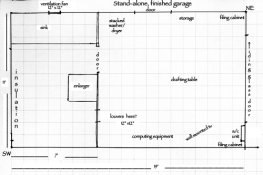
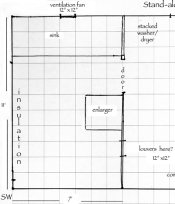
I'm dividing a space (11' x 20' x 8' high) to create a darkroom of 11' x 7'. Thanks to the info on APUG, my husband, and our contractor and I have worked out what I need for ventilation (a Doran 12"x12" ventilation fan, a Doran 12x12 louver, and fiinally a small air conditioner in the space outside of the darkroom to produce positive air flow). Meanwhile the contractor has expressed surprise that I haven't added more than one set of louvers.

So I'm wondering if I should add another louvered device? There's room for another on a wall that is about 6 feet wide. Since I do believe I have a ventilation system that is adequate for changing the air, is it possible nevertheless that more louver vents will make the space more comfortable, or only slightly, or not at all? We will insulate a large south-facing wall which will be the greatest source of heat in the summer but the weather is pretty mild here to begin with (and I will also have the small air conditioner). Is it possible that opening the door frequently will do as much to keep the space comfortable as adding vents? And, if adding vents will increase the problem of dust, I'll gladly pass. (I guess opening the door will also bring in as much dust.)

Another question regarding the louvers: ideally, should they be placed directly opposite the air conditioner, or a few feet further along the wall toward the middle of it, which would put bring in the louvers closer to the sink, or does this make any difference? There is a huge wall-mounted tv that obstucts the pathway to some extent (but I doubt if it will be a problem).

So if anyone has any opinions regarding more vents or where to place it along the inside wall, I appreciate hearing what you have to say.

BTW, the enlarger is as close to the sink as it is because the floor slopes uncomfortably. If we can level it adequately, I'll shift the enlarger farther away from the sink.

I'm attaching drawings of my plans.

Sara

 

Attachments

  • darkroom plan321.jpg
    darkroom plan321.jpg
    96.2 KB · Views: 192
  • darkroom only.jpg
    darkroom only.jpg
    119.8 KB · Views: 174
On the Large Format Forum I saw some good idea's about venting off the fumes of the chemicals: take a 4-6 inch drainage pipe, close one end off, drill some holes in it's lengh and hang that/attach to the wall above your chemicals and lead the sucked air out at a point in the wall or roof.
Have a ventilation hole in the door for fresh filtered air comming in.
In that way you will have no chemical fumes to your nose and clean air to breathe aswell.

It might be an idea.......

Provide for some storage space and a work-bench where you can put your negatives aswell.

Peter
 
Peter,

I think I saw that and will look again. However, if the fresh air is behind me and is sucked across the 31" sink, isn't that far enough from my nose? (I realize however that it will need to rise.) I guess you're saying you don't think the fan will have enough suction, or that is properly directed?

Re a work bench, etc. , I see now that I didn't include as many relevant details of the darkroom as I did of the adjoining room, which I did because I imagined everyone saying, Why don't you just build a larger darkroom? I'll have as much counter space and shelving as I can manage to put in it.

This is my second darkroom so I have some idea of what I need (actually this is my third, but my last was a dark closet and a bathroom--almost doesn't count--but it does! because I was able to work. I had one twenty years ago in a place where real estate wasn't quite as expensive as it is here but it didn't have a ventilation fan, so I just want to do this better.

Thanks for your comments.

Sara
 
Made my own quick and dirty exhaust fan by attaching a 10 foot section of collapsable exhaust tubing (the kind for clothes dryers you can get at a hardware store) using cardboard and duct tape.
 
The best scenario pressurizes the room so no new dust comes in the cracks.
John Powers

I'm glad this thread is still going. I'm setting up a small (9' 4" x 11' 6") darkroom and John Powers' comment (quoted here) reminded me of something I had read in another thread that ventilating a darkroom by blowing filtered air in is better than sucking air out because it discourages dust from getting into the darkroom. This sounds plausible in theory but has anyone actually done this to their darkroom? Did you find that it helped in creating a dust free environment? How did you vent the air out of the room? Was it efficient in "scooping" the smellies out? Or did the intake air just blow the fumes all over the room? I can be convinced that blowing air in will dispel dust. However, I'd like to know if the passive venting of the air out is sufficient and effective in getting the fumes from the trays out of the room. I suspect that the position of the out-vents is quite crucial in this ventilation system. Any information based on your experience will be much appreciated. Thanks!
 
I'm glad this thread is still going. I'm setting up a small (9' 4" x 11' 6") darkroom and John Powers' comment (quoted here) reminded me of something I had read in another thread that ventilating a darkroom by blowing filtered air in is better than sucking air out because it discourages dust from getting into the darkroom. This sounds plausible in theory but has anyone actually done this to their darkroom? Did you find that it helped in creating a dust free environment? How did you vent the air out of the room? Was it efficient in "scooping" the smellies out? Or did the intake air just blow the fumes all over the room? I can be convinced that blowing air in will dispel dust. However, I'd like to know if the passive venting of the air out is sufficient and effective in getting the fumes from the trays out of the room. I suspect that the position of the out-vents is quite crucial in this ventilation system. Any information based on your experience will be much appreciated. Thanks!

There are two potential problems with positive ventilation, one is that it does create a possibility of pushing fumes out those same cracks, which could raise the ire of other house users.

The other issue is that if your in an area that requires heating or cooling during part of the year, you need to heat or cool the air your drawing in. It's tough to keep chemicals at 20℃ when the air coming in is considerably warmer or cooler then 20℃. Which is why most darkrooms are negatively ventilated. One option though, would be to install a humidifier in the darkroom and boost the humidity slightly when it's dry. Dust is often a bigger problem when the air is very dry. Having a film drying cabinet that is positively ventilated, so that dust is kept off damp or wet film, probably halps a lot too.
 
When it comes to Ventilation, quality (where the air enters and exits the room) is more important than quantity.

Yes, it is perfectly feasible to pressurise a room and filter the incoming air.

However, if you are really worried about fumes both in the darkroom and in the rest of the house, then pressurising your room may not be a great idea, as it will force fumes out into the rest of the house as well as out the exit louvers.

How big a deal are Darkroom Fumes - only you know how sensitive you are to them and also what sort of fumes you are expecting to generate.

If (for what ever reason) you are planning on Sulphide Tone in the Darkroom (personally, I wouldn't recommend it & would go only do this sort of Toning outside), you will want to invest serious money, time and effort into elaborate airflow management and fume extraction.

If you just want to do regular B&W printing in your darkroom and are not particularly sensitive to the fumes and odours but want a pleasant working environment then a much more simplistic arrangement will suffice.

Intake air (preferably filtered) somewhere near the enlarger is a good idea and extract behind the Chemical Trays - so the air flows through the darkroom in a controlled manner, across the chemical trays and then out.

This is sufficient for most people.

A few changes of airflow per hour (4 is OK, 6 is really good) is all you need to create a pleasant working environment, in which you can work for prolonged periods.

If you want to be more cautious, then the suggestion of the air extraction pipe with pipe inlets positioned over the trays can work - if you always have the trays in fixed locations and balance the exiting airflows to minimise the odours.

Very sensitive/cautious - have a Perspex (see through) cover between you and the trays with supporting extraction would also improve the situation - but can be a real PITA as it can easily get in the way of normal darkroom operations such as lifting prints in and out of the various trays.

Martin
 
Calumet Photographic carries exhaust fans with proper louvers for darkrooms. I have been using one for many years and agree that it should be placed so the fumes are not drawn towards you. Consider one that exceeds the minimum requirements for the size of your room. My dr is inside my house and is under our central ac but the exhaust fan is vented outside of the house. Installation was easy.
Jeffreyg
 
Thanks for the replies. (I don't mean to take over this thread but I thought my questions would add to the discussion.) It seems to me that ventilating a darkroom by blowing air in is one of those things that may seem like a good idea BUT . . .

Maybe that's why I haven't seen a single darkroom that's ventilated with a fan blowing air in.

My darkroom by the way will be in a stand-alone shed, so no problems with other people in the house venting their displeasure with the fumes from my trays if I choose to have my darkroom ventilated in this way. However, I think I'll go with the extraction fan vented to the outside via ducts and a "blank" inlet vent from the other side of the darkroom. I'll place the extraction fan duct over the wet side and the intake vent on the enlarger side. I'm not fanatical about this issue, just want to be comfortable in the darkroom for long periods of time. ("Attention to health is life's greatest hindrance" Plato). Thanks again.
 
Photrio.com contains affiliate links to products. We may receive a commission for purchases made through these links.
To read our full affiliate disclosure statement please click Here.

PHOTRIO PARTNERS EQUALLY FUNDING OUR COMMUNITY:


Ilford ADOX Freestyle Photographic Stearman Press Weldon Color Lab Blue Moon Camera & Machine
Top Bottom