• Welcome to Photrio!
    Registration is fast and free. Join today to unlock search, see fewer ads, and access all forum features.
    Click here to sign up

Darkroom sink - how small can it be?

Forum statistics

Threads
203,139
Messages
2,850,436
Members
101,692
Latest member
eviosl
Recent bookmarks
0

jay moussy

Member
Allowing Ads
Joined
Jun 10, 2019
Messages
1,315
Location
Eastern MA, USA
Format
Hybrid
New to darkroom work, or soon to be (!), I wonder how small a sink I could get away with. The maximum size process work would be 4x5

I have access to a nearby drain (to septic system), just need to makeshift extension.
 
I use a single-bowl stainless kitchen sink in my darkroom. For film processing, I generally use a tray next to the sink to contain a water bath, film washing happens in the sink. For printing, I set up trays on a counter that's separated from the sink because of the room layout. I have a vertical print washer next to the sink opposite the tray, which drains into the sink, a tray with a syphon drain would work too.
A smaller sink, for example, a typical "bar sink" would work too if you're really constrained for space. IMO what's most important is that the sink has a flat bottom. The depth is not so important (IMO), most bar sinks are probably a bit too deep to be convenient, though they are easy to buy in home centers and such. There are food service handwashing sinks that are pretty small and shallow, but they can be expensive new.

 
Are you seeking to use it just for film processing, or are you hoping to use it for trays for prints as well?
And do you have room for flat counter space as well?
For film processing, I use a fairly large double bowl kitchen sink with counter on each side. Having the two bowls is very useful.
My rotary agitator and bottles of chemicals sit in trays or on a dish draining base which together protect the counters.
 
Are you seeking to use it just for film processing, or are you hoping to use it for trays for prints as well?
And do you have room for flat counter space as well?
For film processing, I use a fairly large double bowl kitchen sink with counter on each side. Having the two bowls is very useful.
My rotary agitator and bottles of chemicals sit in trays or on a dish draining base which together protect the counters.

I have space equivalent to a narrow galley in the basement with drain nearby (old shower stall).
Yes, I would think there will be 4x5 tray-developing, and baby-steps printing done at some point, 6x9 film max, per enlarger on hand.
 
You might consider something like a laundry sink and as long a counter as you can manage.
Under bed plastic storage units can be used on top of counters to hold trays.
 
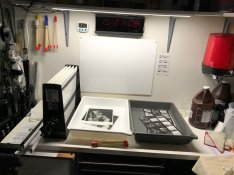
For film development, here's what I get by with. The tank will hold a dozen 4x5 negs. A Uniroller has since been added and fits nicely between the sinks.

L1080469.JPG
 
New to darkroom work, or soon to be (!), I wonder how small a sink I could get away with. The maximum size process work would be 4x5

I have access to a nearby drain (to septic system), just need to makeshift extension.
I operated color and black and white on a septic system with no problems. I built a counter and installed a inexpensive stainless steel single bowl kitchen sink. I washed prints in trays, occasionally dumping the water into the sink. My current darkroom has a 8 foot fiberglass and a 10 foot stainless sink. I found these over the years as surplus that was nearly free for the taking.
These big sinks are not necessarily.
My youth darkroom had a sink made with a Rubbermade dish pan with a garden hose for a drain leading to the floor drain. Worked well.
 
Would the typical stainless steel kitchen sink bottom be close enough?

I have a spare one, 21" x 16" x 6" depth.

That would work fine, mine is a tad shallower at about 5 inches, but the same size otherwise. What you have is ideal, given that you already own it.
 
I have a kitchen sink for film processing. Prints are done in tray which are emptied into bottles or dumped down the toilet. Hazardous waste goes to the hazardous waste disposal nearby. Prints get washed in a print washer that sits in the bathtub.
 
Hazardous waste goes to the hazardous waste disposal nearby

I have yet to learn what part of darkroom work is hazardous to "dump".
Cape Cod, Mass.
I live across from a watershed zone (municipal well).
There is fragile coastal areas nearby, with nitrogen issues, but we have haz material collections organized twice a year.
Septic gets pumped every three years, as recommended.
 
I have yet to learn what part of darkroom work is hazardous to "dump".
Cape Cod, Mass.
I live across from a watershed zone (municipal well).
There is fragile coastal areas nearby, with nitrogen issues, but we have haz material collections organized twice a year.
Septic gets pumped every three years, as recommended.

By hazardous, I meant that I take expended hypo to the toxic waste dump because it contains significant amounts of silver.
 
New to darkroom work, or soon to be (!), I wonder how small a sink I could get away with. The maximum size process work would be 4x5

I have access to a nearby drain (to septic system), just need to makeshift extension.
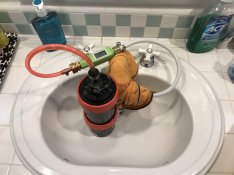
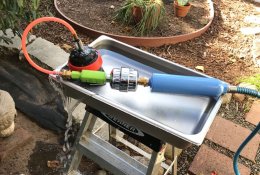
I assume you mean processing 4x5 film. You can get away with no sink at all, just empty used chemicals into a jug for later disposal. Washing can be done in a bathroom sink or even outside.

Film wash bathroom sink.jpg Film wash outside.jpg
 
I have a bit of a makeshift darkroom for the part of the year I'm in the Boston area. I use a kitchen sink with about 1 ft of counter space on each side for film processing in tanks. I have an old desk next to it that I use for trays. Not ideal, but very workable.

Lots of mixed opinions (and little real data-driven analysis) about darkroom chemicals and septic. Depleted fixer - which has silver in it from paper and film - is a no-no. It will kill off the "good" bacteria in your tank. But so will most toilet bowl cleaners. Obviously a little bit in a large septic tank will have little impact. If you're processing film every day, or you want to play it safe, take your used fixer to the haz mat dropoff.
 
I am using Jobo Expert tanks for 4x5 to 8x10 -- motor base -- a UniColor on th e kitchen counter at the moment with a Beseler as a spare. I have a double sink I find convienent. It can get cold in the winter and one half can be used to temper the chemicals and the other side used to dump chemicals/washes, rinse graduates or whatever else I need to do.

In the bathroom, I have counter space to set three 12x16 trays side-by-side for 11x14 film processing...and a tiny little bathroom sink at the end for now. I am using two water rinses between the dev and the alk.fixer, so I keep an over-turned 16x20 tray over the (alk.) fixer tray to reduce fumes and I put the second 12x16 tray of water on top of the 16x20 tray. So it is 4 12x16 trays: dev - 1st water rinse - 2nd water on top of fix tray - lift 16x20 tray (w/ 12x16 water tray and film on top) and put it over the tray to the left -- film into fixer - turn lights on after a few minutes.

It works, not optimal by any means. Instead of a 16x20 tray over the fixer tray, I think a very thick piece of plex (1/4"), perhaps about 18x24, would be nice. What is working right now is that the grooved bottoms of the trays keep the two trays from sliding around when I move them. Using the plex would require less lifting -- more or less slid over instead. But doing something like this on a 4x5 scale would be rather easy and make the most of a small space/sink.
 
For film developing, almost any size sink will do, but a sink with a flat bottom will be much more useful as it will allow you to set bottles and graduated cylinders in the sink as you pour chemicals. A deep sink is not necessary.
For printing, I like a sink that is large enough to rinse out the print trays without splashing water all over the place. I have a 12x16" bathroom sink that is 8" deep, just large enough to easily rinse 11x14" trays. Also, a high-arched commercial style faucet is a good idea to consider. It's nice to be able to rotate out of the way while using the sink.
 
B&W only, 135, 6x6, 4x5
That looks like the beer-making cooling of the wort!

I do that [135, 120 [6x6] and 4"x5"] in my kitchen for both black & white and color with a Jobo processor. I use the Jobo 3010 Expert Drum.
 
Yep, a sink with a rounded bottom is annoying but you can use a wooden frame
with wooden cross pieces on it.
There's a proper name for it but I'll be dipped if I can remember it.
 
Hi Jay,

I am also on a septic system and I never put anything down the drain but wash water. I collect all chemicals and bring them to one of the local EPA household waste collection sites. To minimize volume I reuse fixer with a silver recover system bought from one of the member here (jnanian?). I collect the fixer, reuse it once and then bring that to the collection site.

Good luck,

Neal Wydra
 
Yep, a sink with a rounded bottom is annoying but you can use a wooden frame
with wooden cross pieces on it.
There's a proper name for it but I'll be dipped if I can remember it.
How about a darkroom sink "rack". Corrugated fiberglass can make a good one. While you can "get-by" with a small kitchen sink, etc, there is nothing better than a sink "big enough". It makes life in the darkroom easier. Buy or build as large a darkroom sink as you have room for. A sink is as important as any other piece of darkroom equipment and I include enlargers when I say that. I honed my use of curse-words trying to work with a too-small sink.....Regards!
 
I should have mentioned this earlier, but I simply have a laundry room sink from the local home center. For washing large prints the tray hangs off the washing machine and an old Kodak siphon splashes into the sink. for 11x14 and smaller I have a print washer that sits on a shelf and drains into the sink.
 
New to darkroom work, or soon to be (!), I wonder how small a sink I could get away with. The maximum size process work would be 4x5

I have access to a nearby drain (to septic system), just need to makeshift extension.
The bigger the "better".
Have you ever worked in a darkroom before.?
You will be using 8x10 trays at the smallest.
11x14 maybe.?
Do you have all of your "stuff" already.?
Imagine your film reels pulled apart or 4x5 tanks that need cleaning.
You can always "Make Do" ..... but that gets old.
IMHO... If you have the room for a 4 foot sink or bigger, i would do it for sure.
good luck :smile:
 
Alternate materials for drain board ideas, next to, and in addition to the sink itself?

pond liner?
tiles?
 
Photrio.com contains affiliate links to products. We may receive a commission for purchases made through these links.
To read our full affiliate disclosure statement please click Here.

PHOTRIO PARTNERS EQUALLY FUNDING OUR COMMUNITY:


Ilford ADOX Freestyle Photographic Stearman Press Weldon Color Lab Blue Moon Camera & Machine
Top Bottom