• Welcome to Photrio!
    Registration is fast and free. Join today to unlock search, see fewer ads, and access all forum features.
    Click here to sign up

Darkroom design question

Recent Classifieds

Forum statistics

Threads
203,393
Messages
2,853,955
Members
101,817
Latest member
goodman1999
Recent bookmarks
0
Without it, the flue gases from the existing hot water tank would be drawn into the room by the exhaust fan instead of going up the chimney...

we need to know if the burner is sealed to the room or if it draws its air from the room in order to make a statement to that effect...
Look at photo three in post #18. The hot water heater is an atmospheric gas-fired type that draws combustion air from the room in which it's installed and vents its exhaust via convection through a galvanized steel stove-pipe chimney. As opposed to the space heating furnace, which is a sealed-combustion condensing type, drawing outside air through one PVC pipe and venting its exhaust through a second PVC pipe.

Balanced ventilation of the space is definitely necessary to avoid problems with water heater exhaust gas. I still wouldn't do this without installing a fast-acting, low-level carbon monoxide detector. Better yet, partition off the furnace and water heater as suggested in post #9. I'd rather see you go digital than die in a darkroom. :blink:
 
Without it, the flue gases from the existing hot water tank would be drawn into the room by the exhaust fan instead of going up the chimney. All that is needed is a fan of the same cfm rating as the exhaust fan, and they both should be on the same power switch.

Oooh. Good solution.
 
Steve, that style of hot water tank has been the norm in the US and Canada for decades. Easily identifiable from the photo as Sal wrote.

Even if the tank and furnace are partitioned off, there has to be a good sized vent grill to the open area of the basement/house.
 
Steve, that style of hot water tank has been the norm in the US and Canada for decades.

It is the type which was banned here decades ago - and for good reason.


Steve,
 
...Even if the tank and furnace are partitioned off, there has to be a good sized vent grill to the open area of the basement/house.
Yes, and even that relies on the house being leaky enough so outside air can enter. A space that's sealed from the rest of the house but communicates directly with the outside would be better. Heating appliance manufacturers specify the free vent area in their Installation and Operation manuals.

It's unfortunate that so much of this continent heats with "scorched air." If the OP's house used a sealed combustion boiler and hot water space heating, his comfort level would be higher and an indirect tank could be installed for domestic hot water too. Then there would be no need to consider these venting matters when planning his darkroom.
 
Sal, if he was in a climate like yours, he likely wouldn't have a basement. :sad:

Nothing wrong with scorched air heating, it's usually more efficient than a boiler, and much lower in capital cost.
 
For what I know, you never (never) extract air from a room where a furnace works, unless the furnace is mounted in camera stagna, with sealed air intake and air exhaust, so that it is isolated from the air in the room.

On the other hand, a darkroom should have some kind of forced ventilation to reduce the amount of vapour of chemistry breathed by the printer.

I would seriously separate the two environments, each of them having an independent air source and air exhaust, and no air-pressure cross-effect between them.
A better solution would be to build a small "room" outside the outside, leaning on the outer wall, and moving there the furnace. Or changing the furnace and properly installing a "sealed chamber" one.

I would not attempt to balance the air flows.
 
That heating/water installation is really incredibly huge! Or compared to here (Holland) anyway, but we only get down to minus 15C or so in the Winter - and that for only a few weeks.

As the burner(s) is apparently drawing combustion-air from it's surroundings I wouldn't put myself down there. Like others have said, can you partition the basement and give the burner it's own inlet and outlet? Then a filtered positive-pressure ventilator for the darkroom can work completely separately from your heating, perhaps with heated air from another part of the house in the Winter, so that you will be pushing clean air into your space instead of sucking in dust all the time.
 
For at least 30 years US building code has mandated an outside air inlet somewhere near the furnace and WH. This was done when houses started being more airtight. It's usually an insulated, flexible duct hanging down from the ceiling to a few inches off the floor. I don't see one in the pics. How old is this house?
 
I'm amazed at the size of the thing. In Europe, this would heat and provide hot water for a whole house without the need for header tanks or cylinders:

Dead Link Removed

http://www.boilers2go.co.uk/userfiles/images/Vaillant ecoTEC Exclusive Dimensions.jpg


Steve.


Steve,

We (in US) have the type you mentioned (on demand heating type) also but they are not very popular. Mine is 40 gallon (144 liters) in capacity. I think the one OP has is even bigger. They serve as a hot water storage tank as well as being a heater.
 
I want one of the on demand ones, but they're quite pricy and I can't get my husband to agree with me. They do save you money, though.

As to the OP, this is one of the reasons I'm going to ask my husband to switch around the way the bedrooms are in the house: I want the kids to be upstairs and us downstairs. I can then put my darkroom/office in what is right now my daughter's room, and I won't have the issues I'll have if I have to be down the basement.

I need an office with water anyway. I dye yarn. It'll be nicer to have a room that is dedicated to my arts/crafts than trying to have it all over the house.
 
The on demand heaters aren't really designed to provide continuous delivery of warmed water over an extended time.

Now who on APUG would want something that supplies continuous delivery of warmed water over an extended time.:whistling:
 
I tried to visualize what you have to work with and think you might wall in the furnace and water heater if it's legal and safe. Forget the door to your office.

Give them an upside-down "L" shaped room of their own. Sort of like an upside-down Idaho with a vented door at the Canadian border. Solves all your ventilation issues.

This leaves your darkroom as a right-side up "L" with a large 5 x 9 main work area plus a vestibule.

My first thought was to have the sink against back wall and the door to the left of the sink. That way you can open the door soon as the white lights are on... and it would be convenient to walk out to the laundry tub and wash your trays and tanks there.

If you did that, the vestibule should be a comfortable fit for the enlarger and a dry side shelf. The 9 foot walkway along the sink could be left open or you could put a narrow chemical storage shelf / bookshelf behind where you walk.
 
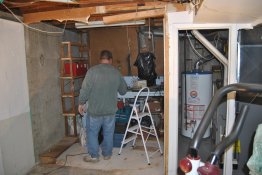
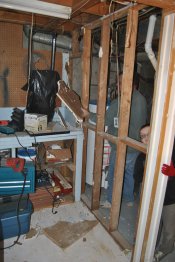
DSC_0294.jpgDSC_0295.jpg

When we first started the demo my furnace and water tank were in a little closed in area. We think they tore down a wall to install the furnace I have been in the house for 7 years furnace was new when we moved in. water tank I had put in right after we moved in. I thought by taking down that little wall I would be able to open up the work area a bit. I hope these photos are helping because all this advise I am getting is really helping me. I want to do this right and safe and I thank you all for the input.
 
I tried to visualize what you have to work with and think you might wall in the furnace and water heater if it's legal and safe. Forget the door to your office.

Give them an upside-down "L" shaped room of their own. Sort of like an upside-down Idaho with a vented door at the Canadian border. Solves all your ventilation issues.

This leaves your darkroom as a right-side up "L" with a large 5 x 9 main work area plus a vestibule.

My first thought was to have the sink against back wall and the door to the left of the sink. That way you can open the door soon as the white lights are on... and it would be convenient to walk out to the laundry tub and wash your trays and tanks there.

If you did that, the vestibule should be a comfortable fit for the enlarger and a dry side shelf. The 9 foot walkway along the sink could be left open or you could put a narrow chemical storage shelf / bookshelf behind where you walk.

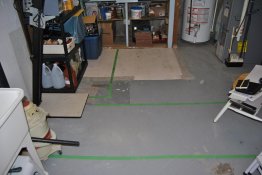
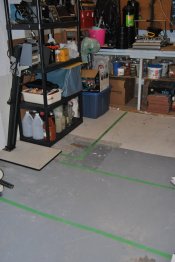
Here is a few photos Bill of my very early planning ideas. DSC_0016.jpgDSC_0013.jpg
The line of tape under the shop vac will be my exterior wall. Next line is the out line to my dry counter. The line by the black shelve is my sink. I was also kicking around putting the sink on the new wall and moving my dry to the sink. making my dry a L shaped dry counter lead to the sink. The reason I have my door off the office is for space really as we have plans for the new wall to have shelves on them for my wife stuff. As she is losing a chunk of storage area in her laundry room. So one idea is to have the dry counter run from the counter were the paint can are to the enlarger on the floor. then across my new wall would be sink. leaving me some space beside the sink for storage and shelves. Also I have plans of converting the office/computer room into an extended work area for my. some where to mat and dry mount and maybe put my print dryers. I hope this explains my ideas and vision and I will look at your suggestions as well.

Learning about this stuff is so cool I always wanted my own darkroom and to think I am going to have one very soon excites me! As I was able to pick up 2 enlargers and ALL my supplies for FREE!! from someone who was going to take it all to the dump as he thought no one would be interested in doing your own printing.

Tim
 
Sal, if he was in a climate like yours, he likely wouldn't have a basement...
Around here the lack of basements means our tank-type water heaters are typically found in the garage. They're placed on platforms at least 18 inches high so any pooled gasoline fumes won't be ignited. Large wire-screened vents to outside are required near the garage floor and approximately 8 feet high. Not that I'd be too concerned about adequate combustion air anyway, given the huge gaps around those ill-fitting one-piece garage doors that are typically installed. :smile:

...Nothing wrong with scorched air heating, it's usually more efficient than a boiler, and much lower in capital cost.
Nothing wrong with it if one is enamored of spreading dust everywhere and experiencing the thrill of wind chill indoors during winter. :D

Space heating with a furnasty is not inherently more efficient than using a hydronic system to accomplish the same thing. There is a complete range of efficiencies available from either appliance type. Since forced air has more than 90% of the US market, minimum efficiency regulations for furnaces are a few years ahead of those for boilers, but that's changing. Standing pilots will soon be gone and outdoor reset required. The only reason one finds 80% efficient boilers being installed today is that they are cheaper and still available. Modulating, condensing boilers with 97% efficiency can be purchased from a large number of manufacturers and are regularly installed for homeowners who understand their benefits.

While speculative home builders will always select space heating systems with the lowest up front cost, i.e. furnaces, anyone who takes a long-term view and values comfort opts for forced hot water instead. One can configure a number of different distribution systems with varying degrees of comfort, but even the least expensive of them (baseboard convectors) is much more comfortable to live with than forced air. Continuous circulation and proper sizing permit lower water temperatures that mean steady, even heat delivery. The most expensive emitter would be in-floor radiant; that approach delivers such comfort that occupants are regularly happy with thermostat settings a number of degrees lower than they'd otherwise require. Even smaller fuel bills is the result.

Unless the housing market returns to its bubble days of frequent "flips," I suspect more homes will be in the hands of individual owners for extended periods of time. Hopefully, that will encourage long-term thinking and a resurgence of hydronic heating systems. There's certainly no question that, when a house is constructed on the New Hampshire land I purchased earlier this year for retirement, it will be heated by hot water.

Now, what was the topic of this thread again? :D

 
Photrio.com contains affiliate links to products. We may receive a commission for purchases made through these links.
To read our full affiliate disclosure statement please click Here.

PHOTRIO PARTNERS EQUALLY FUNDING OUR COMMUNITY:


Ilford ADOX Freestyle Photographic Stearman Press Weldon Color Lab Blue Moon Camera & Machine
Top Bottom