• Welcome to Photrio!
    Registration is fast and free. Join today to unlock search, see fewer ads, and access all forum features.
    Click here to sign up

CyanoType from Negative Film

Hooters gonna hoot

H
Hooters gonna hoot

  • 1
  • 0
  • 0
Barry at Elwood

A
Barry at Elwood

  • 0
  • 0
  • 0

Recent Classifieds

Forum statistics

Threads
202,483
Messages
2,841,395
Members
101,351
Latest member
pavdee
Recent bookmarks
0

mitchins

Member
Allowing Ads
Joined
May 22, 2014
Messages
49
Format
Medium Format
Hi all,
This is my first time posting here, I've been looking at Cyanotype prints (preferably to canvas) and I know there are some other threads here and information in general but I had some specific questions I can't seem to find answered.

Most specifically I am considering the effects of directly printing the cyanotype from a negative, this would require a large negative, and I'm thinking I could enlarge a 6x4.5 (or 4x5") to 16x20", or perhaps just try it out with a 4x5" to start with. I'm thinking Arista Ortho Lith might work well for the enlargement and perhaps even the original negative if 4x5" is acceptable, however I'm not sure.

Most information pertains to printing out from photoshop to an overhead transparency, and I'm wondering why not dive directly into printing cyanotype the negative as stated, I know it's a little more involved, but my assumption is that the reproduction would be more original, if not accurate - though my knowledge is limited and so I'm not sure.

Can anyone offer any advice before I dive in? Much appreciated and I look forward to being an active member!
 
Gum Printing and Other Amazing Contact Printing Processes by Christina Z. Anderson and The Book of Alternative Photographic Processes by Christipher James.
 
Exposure time. Even using Mike Ware new cyanotype, said to be more sensitive, I need 10 min (contact) exposure at ~15cm from a 70W metal halide lamp. Prossibly a little shorter in sunlight. Compare sunlight to the light intensity you can obtain on your enlarger baseboard, even with the lens wide open... One week exposure time? But already overnight, the coated (undeveloped) paper starts to degrade.
Plus, what is the UV transmission of the enlarger optics? And focusing?
 
I read the OP as asking for help making enlarged negatives for contact printing cyanotypes rather than trying to make cyanotypes under the enlarger.
 
I read the OP as asking for help making enlarged negatives for contact printing cyanotypes rather than trying to make cyanotypes under the enlarger.

Yes. Making cyanotypes from an enlarger is not feasible.

You can make copy film internegs. There are two ways: You make a copy and reverse process it, or make an interpositive and then a final negative. The contrast is really important for alt processes, and the best control you can get over this is by making a low contrast interpositive. For this, you will need a low contrast developer, for which there are recipes available. I suggest you start with Christopher James's book, as it describes the process fairly nicely. It is hard work to get your final film negative, but it will not suffer from many of the ills of printed negatives, notably the tendency of the emulsion to stick to glass and everything else it touches, and peeling off in bits in the process. If you are only ever going to make one print from that negative, it is arguably not worth the effort. But if you will print it multiple times, it is probably worth it.

Or: Get a large format camera and take the size negatives you want to print. 11x14 large enough for you?
 
Canvas is great try to get an unprimed one as the primes is often alkaline and Cyanotypes unlike other processes prefers a slightly acidic atmosphere (paper, ground, etc). Ed Buffalo has an article on Unblinking eye that might interest you: http://unblinkingeye.com/Articles/NbyR/nbyr.html (Negatives by Reversal)
 
Canvas is great try to get an unprimed one as the primes is often alkaline and Cyanotypes unlike other processes prefers a slightly acidic atmosphere (paper, ground, etc). Ed Buffalo has an article on Unblinking eye that might interest you: http://unblinkingeye.com/Articles/NbyR/nbyr.html (Negatives by Reversal)

Ditto. I've made negatives using that workflow for printing cyanotypes and vandyke. Gives a little grainy negatives but that can be fixed - to some extent - with soft working developers such as Soemarko LC-1...

BTW, definitely put a thin (2mils / ~ 50um) sheet of polyester / mylar between the in-camera (or enlarged) negative and the sensitized paper / canvas to protect it from the sensitizer.

Regards,
Loris.
 
If you already can shoot 4x5, then it's a great size to start with. Timing is different between film negatives and inkjet ones. There are also many more issues (better discussed on dpug) having to do with getting a truly good enough neg from an inkjet (banding, density, wheel marks, and more).
I have made enlarged negs on the older version of Arista Ortho Lith film starting with slides. It worked fine, but it did take some fiddling the first few. I wouldn't jump in with anything bigger than 8x10 the first few times.
 
For purposes of contact printing to cyanotype, is it possible to improve on an in-camera negative? I would like to get into this myself, and, in fact, I'm looking to buy an 8x10 camera at the moment. One of the (many) appeals in doing so, is not having to make enlarged internegatives for cyanotype. (I absolutely don't want to fuss with digital negatives.) I'm hoping that the in-camera negative, providing, of course, it's properly exposed and has a good range of tones, will simplify the process of making cyanotypes. Am I thinking coherently?
 
For purposes of contact printing to cyanotype, is it possible to improve on an in-camera negative? I would like to get into this myself, and, in fact, I'm looking to buy an 8x10 camera at the moment. One of the (many) appeals in doing so, is not having to make enlarged internegatives for cyanotype. (I absolutely don't want to fuss with digital negatives.) I'm hoping that the in-camera negative, providing, of course, it's properly exposed and has a good range of tones, will simplify the process of making cyanotypes. Am I thinking coherently?

Making large negatives in darkroom may be more practical than using a larger format camera. I mean if you already have a 4x5", you don't necessarily need the 8x10". Even if you upgrade to 8x10", you'll still need to make extra negatives; if you decide to use another process or a variation of the same process that needs a different density range. Making the printing negatives in the darkroom gives you more control too - such as possibility to crop or to dodge-n-burn...

As a last note: You absolutely don't need to make an internegative, you can make your enlarged negative in one-step, see the link provided above...

Regards,
Loris.
 
If you already have 4x5 images, starting with 4x5 cyanotypes while you learn the process, and figure out what works for you, is a great idea. I mucked about for a few years with digital negatives. I got really tired of spending more time with the computer than in the darkroom, and now do all my alt printing from 4x5 and 8x10 negatives.
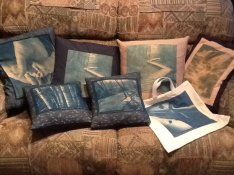
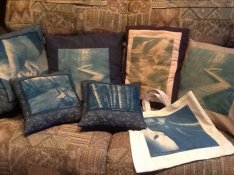
I've printed cyanotype on cotton and silk. (My home is festooned with cyanotype pillows.) Silk is awesome if you want a very delicate look. My only attempt with canvas didn't work because there was too much sizing in the canvas.
I've never made internegs, so can't help you there, but I'll be following this thread to see what others suggest. I hope to hear how things work out (or don't) for you.
 
I put together a pamphlet, PP presentation, and there is a video of that presentation at http://glsmyth.com/articles/ of digital negatives. One of the great things is that not can any digital capture (or scan) be used, as opposed to shooting for a particular process, but once your color and curve are set, you are done. This means that you are in front of the computer a very short time (important for me, as I am in front of one at least 40 hours a week).

Cheers -

george
 
...
I've printed cyanotype on cotton and silk. (My home is festooned with cyanotype pillows.) Silk is awesome if you want a very delicate look.

I'd LOVE to see a picture of a group of cyanotype pillows!
 
Bvy, I've got some gum over cyanos posted elsewhere:

http://silverlilly.zenfolio.com/p946924648/h2cd3828b#h2cd3828b

I've spent more time in recent years on other alt processes. Cyanotypes were the gateway drug.

And for Winger:

image.jpg

Some pillows (there's more at my office) and a shopping bag.
These don't belong on APUG, as they were made with Dnegs. As noted before, I've given up on Dnegs. I've seen great work by others, but was endlessly frustrated by printer and computer issues, and find it much more fun, even when I'm frustrated, to work strictly analogue.
 

Attachments

  • image.jpg
    image.jpg
    131.2 KB · Views: 268
Last edited by a moderator:
when i see work of the quality on show at sly's zenfolio site, I do sometimes wonder why I bother picking up a camera ... (winger, your mordançage has the same impact)

superb
 
when i see work of the quality on show at sly's zenfolio site, I do sometimes wonder why I bother picking up a camera ... (winger, your mordançage has the same impact)

superb


Thank you!

And I'm with Brian - I'm reminded why I do it. Not to copy hers, but to make my own statements with my images. And maybe if mine are good enough, then to trade with people like sly.
 
I put together a pamphlet, PP presentation, and there is a video of that presentation at http://glsmyth.com/articles/ of digital negatives. One of the great things is that not can any digital capture (or scan) be used, as opposed to shooting for a particular process, but once your color and curve are set, you are done. This means that you are in front of the computer a very short time (important for me, as I am in front of one at least 40 hours a week).

Cheers -

george

thanks george !

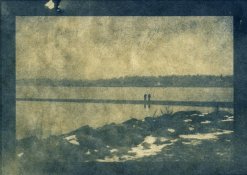
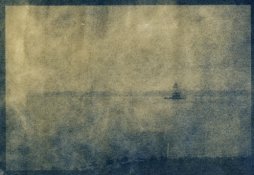
i have made enlarged negatives by just making them at a copy shop instead of on film
then waxing the paper with parafin since i had it handy ...
and using that as my cyanotype negative ... like you said took very little time
and the only effort was emailing or bringing a cd to the staples down the street and having cheap thin negatives printed ...
if my printer made water safe ( or laser ) prints it would have been even easier.
 

Attachments

  • paper070sm.jpg
    paper070sm.jpg
    93.8 KB · Views: 333
  • lighthouse079sm.jpg
    lighthouse079sm.jpg
    61.4 KB · Views: 265
  • coast080sm.jpg
    coast080sm.jpg
    55.1 KB · Views: 253
Photrio.com contains affiliate links to products. We may receive a commission for purchases made through these links.
To read our full affiliate disclosure statement please click Here.

PHOTRIO PARTNERS EQUALLY FUNDING OUR COMMUNITY:


Ilford ADOX Freestyle Photographic Stearman Press Weldon Color Lab Blue Moon Camera & Machine
Top Bottom