• Welcome to Photrio!
    Registration is fast and free. Join today to unlock search, see fewer ads, and access all forum features.
    Click here to sign up

Could someone tell me about how many mL of potassium dichromate crystals equals 1g?

Forum statistics

Threads
203,117
Messages
2,849,998
Members
101,676
Latest member
stasney
Recent bookmarks
0

paradine

Member
Allowing Ads
Joined
Sep 12, 2010
Messages
9
Location
London, UK
Format
Multi Format
This may seem like a stupid question but I recently bought a kitchen scale and it doesn't like low weight measurements at all and I have no way of telling measurements of almost anything under 10 grams..

So as the title suggests could someone tell me about how many mL of crystals equals 1 gram?


Thank you in advance.. I need to find a better scale.
 
Wikipedia is your friend! :D

http://en.wikipedia.org/wiki/Potassium_dichromate

From Wikipedia: Density = 2.676 g/cm3, solid.

Therefore, one gram would be approximately 0.37 ml. ( 1 ÷ 2.676 = 0.37369208 )
This assumes that the crystals are small and uniform in size. You still won't get a very reliable measurement.

The best thing to do is get a good laboratory balance, not a "scale."

A kitchen scale is designed to measure weights in the range of a few hundred grams to a few kilograms. That's between 100 and 1,000 times larger than you are trying to measure. A kitchen scale probably won't measure anything less than 10 or 20 grams with any kind of accuracy. Furthermore, it resolve to 0.5 grams. Even then, expect only ± 1 gram of precision. When you are cooking, you don't need accuracy/precision to 0.01 gram. Why should a cook spend the money for something that will?

All that aside, you MIGHT have better luck if you put some other weight on the scale along with the item you are trying to measure. That will bring the scale into its most accurate range.

Stack a handful of coins on the scale so that it reads, maybe, 50 or 100 grams then press the "tare" button. You will set the display to zero and the scale will remember the offset. Be sure to include your petri dish or other measurement container in the tare reading.

Even with all that, you'll be lucky to get within a gram of the true weight/mass of the thing you want to measure.

 
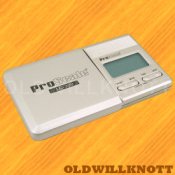
You can't compare volume and weight unless you know density. Different materials have different densitys. You need to find a scale that measures small weights, as you comment. You could get something like the illustration below for less than $20 at: http://www.oldwillknottscales.com/proscale-lc300.aspx
 

Attachments

  • Pocket Photo Scale.jpg
    Pocket Photo Scale.jpg
    17.7 KB · Views: 116
You will probably find that the most accessible, accurate and easy to use scales will be found at places that sell reloading supplies to hunters and shooters. They need to measure small amounts of gunowder, quickly and accurately.

http://www.midwayusa.com/viewProduct/?productNumber=814722

To get anything better than that you're probably going to have to step up to a laboratory grade balance.

http://www.affordablescales.com/scales_specs.asp?specs=3153&Adam_Equipment_TBB_610S

(Not recommending "affordablescales.com" as a merchant. Just using it as an example. Although, I have ordered from "midwayusa.com" and found them to be a reliable company.)
 
Milliliter is a unit of volume and grams is a unit of weight. The best thing is to get a with finer units. I've heard of bakers that the make bread by weighing their flour. The reason is that humidity can affect the weight of the flour. So I'm not sure this is a good comparison, but it seems logical to me.

Here's one online that will weigh 1/10 of a gram.
Dead Link Removed

Good luck!
 
You could just take all your dichromate ( or maybe just 13g of it ) and make a saturated solution which is about 13%. It keeps just fine that way and is far easier to handle as a solution.
 
Small pocket balances that weigh in fractions of grams are available for pennies on ebay.
 
either online, or the local 'head shop'

I came up with a great little electronic unit at a auction that des 0.01g (though not totally repeatably) and does tare also, with a capcity to 50g. $20 at a liqudation auction.
 
Measuring crystals by volume will not work because even if you know the density of the solid (as per W1811), you don't know the packing factor, i.e. how much air is in there between the crystals. Seriously, look on eBay, there are plenty of scales like Mike Wilde mentions selling for peanuts.
 
Do not measure solid materials by volume. The error can be as much as 20% either way. I have posted considerable data on APUG when I tested this out about 2 or 3 years ago (or maybe more).

PE
 
If you are *really* stuck, you can make a stock solution. Take 10g (minimum you can measure) and add distilled water to make 100ml. Then just use 10ml of that to get 1g effective quantity.

Be sure to use distilled water, as you want to keep the integrity.
 
If I had some potassium dichromate crystals, I'd weigh a teaspoonful for you, which is what I think you're asking for. But R Shaffer's suggestion is a great one if what you're doing is making a solution for gum prints. Take some dichromate crystals, add enough room temp. water so that most but not all of the crystals dissolve. The solution will be 12% (if you're at 20ºC). Draw your solution from the top so you don't scoop up undissolved crystals.

If you want just a rough guess, it's somewhere around 1.5 g/ml, so a teaspoonful should weigh 7 or 8g.
 
Just to say accuracy, if you want a really good one, you gotta shell out quite a few hundred bucks. I just needed a good quality at best price, so that's why I got a better one from Elite Scale which is perfect for what i need!
 
Photrio.com contains affiliate links to products. We may receive a commission for purchases made through these links.
To read our full affiliate disclosure statement please click Here.

PHOTRIO PARTNERS EQUALLY FUNDING OUR COMMUNITY:


Ilford ADOX Freestyle Photographic Stearman Press Weldon Color Lab Blue Moon Camera & Machine
Top Bottom