• Welcome to Photrio!
    Registration is fast and free. Join today to unlock search, see fewer ads, and access all forum features.
    Click here to sign up

Controlling Depth of Field in Pinhole Photography

Recent Classifieds

Forum statistics

Threads
203,376
Messages
2,853,632
Members
101,810
Latest member
knorbeek
Recent bookmarks
0
You are not controlling depth of field with this method, but just creating motion blur.
 
(there was a url link here which no longer exists)
 
You should call it "Controlling Motion Blur in Pinhole Photography." It should sell like hotcakes.
 
Controlling Depth of Field in Pinhole Photography

I guess to promote inexact nomenclature one could say that opening up a lens 'blurs' the background also.
 
I know this is controversial to discuss DoF this way - I've been practicing photography for over 25 years and this is the first time I've heard anyone say it :smile:

I consulted over 50 websites and publications on the definition of Depth of Field. Without exception, Depth of Field was defined as something similar to "that portion of the photo which is acceptably sharp". It is not until later in those articles and texts do they talk about how to control DoF via aperture. Why? Because aperture adjustment is the easiest way to control it with a LENSED camera. In short, DoF is an aesthetic effect. Aperture is simply the mainstream tool to control it.

Regardless, I was quite clear in the article that I was discussing how to adapt a creative tool that lensed photographers have for a similar effect in pinhole/lensless photography.
 
... "that portion of the photo which is acceptably sharp"...

I've always seen it referred to as that portion of the scene which is acceptably sharp, a different concept.

That being said, the technique you describe is very useful for all kinds of photography, thanks for sharing!

-Tim
 
Last edited by a moderator:
I like it!

Depth of field is formally defined as the range of object *distances*, rather than being based on object *positions*. A subtle distinction, but it implies depth of field is independent of the scene (and wholly a function of the lens). Your article implies that's not necessarily true. Very interesting.

I promise you this will soon come up for debate with other optical engineers over morning coffee. :smile:
 
It is a very curious concept and deserves thought, even though it's so apparently familiar to those who take photographs with variable aperture lenses.

If we consider our own visual experience, the idea of a "depth of field" is really quite slippery. I can't vary it, for instance, although it's more-or-less clear that when I look at (focus on) something near (or far) then something far (or near) is less clearly defined.

Plus of course I've never experienced anything that could be described as bokeh. Except I suppose under certain conditions that we won't go into now ... :cool:

But DoF isn't a fact about the world, it's an artifact of manufactured optical systems.
 
I'll have to disagree, pdeeh, with your last statement. DOF is a real effect. It is apparent even in non-manufactured optical systems (ie your Mk 1 eyeball). No, it is not an artifact but a real world phenomena derived from how photons behave.


Anyways, our morning chat centered on this topic. While not as heated as the coffee, the unanimous optical engineering conclusion was that as photographers, you are allowed some artistic license in defining Depth of Field. :smile: Well done!
 
Photons or waves?
:D
 
Anyone wanting to decrease the apparent DOF in lensless photography might consider zone plates.
 
more info on zone plates: http://pinhole.stanford.edu/zp.html. These are often duplicated on very high contrast film. One could also set up a jig to drill the holes in very thin sheet metal or perhaps etch them in thin sheet metal. They could also be fabricated by depositing the pattern on a glass substrate.
 
hi kier:

nice article !

if something is moving for long enough and it is used to created a blur or the photographer hopes to use
the subject's motion to change what is in focus ... sometimes because of the extended time it takes to make a pinhole image
that moving thing vanishes. water becomes almost still, cars &c disappear ... while i think it is a hugely useful tool to use subject movement
or for/background movement to change the apparent depth of field the exposure-time and sensitivity of the film / paper being used is critical ...
for example ... with iso 3200 or 1600 film what the motion/distortion will be completely different in daylight hours, than paper or iso 25 film ( or paper )
in dim light / twilight/dawn &c .. so one needs not only to chose the background/forground carefully, but the emulsion carfully as well !
 
... one could say that opening up a lens 'blurs' the background also.

You mean something like this??

attachment.php
 

Attachments

  • sensor-cleaining.jpg
    sensor-cleaining.jpg
    51.8 KB · Views: 218
This was an interesting read, like the other articles on your blog.

As you said: "So, we shall free ourselves of the technical aspects of the customary understanding of depth of field, and let’s focus on the aesthetic." That's a good way to find a new approach to ones photography.

I like your technique as well: "Want a pinhole photo of an object that really pops? Put that object in motion and lock the camera to that motion"

Here are some of my examples to go along with your article:

attachment.php


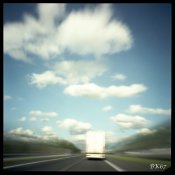
This is my WPPD-2015 contribution. PinHolga 6x6, Fuji NPC 160 (expired 2004), exposure 10 sec.
I followed the truck on the highway for 280 meters in 10 seconds (about 100 kmh).


And this technique is also useful for landscapes:

attachment.php


attachment.php


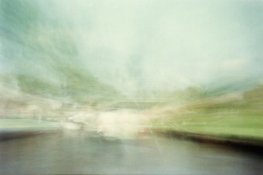
I made these images with my pinhole camera (a rebuild Gevabox 6x9). The exposures were handheld (no tripod) for 40 seconds on Konica PRO 400 roll film. It's what I might call "controlled pinhole blur".

The image on the left was made from the shore overlooking a wide lake, as part of a series of pinhole landscapes. I was pleasantly surprised how it turned out. The image on the right was made standing on a boat in a canal in the historical town of Giethoorn.

Bert from Holland
http://thetoadmen.blogspot.nl

 

Attachments

  • PinHolga-NPC160-05-WEB-30x30.jpg
    PinHolga-NPC160-05-WEB-30x30.jpg
    685.9 KB · Views: 237
  • konica_pro400-1a.jpg
    konica_pro400-1a.jpg
    14.3 KB · Views: 220
  • konica_pro400-landscape-7_659228.jpg
    konica_pro400-landscape-7_659228.jpg
    36.5 KB · Views: 225
so one needs not only to chose the background/forground carefully, but the emulsion carfully as well !

Totally agree, and that's an excellent point. That's also one of the reasons I choose to carry multiple pinhole cameras, so I can have color, b&w, and different speeds

The image on the left was made from the shore overlooking a wide lake, as part of a series of pinhole landscapes. I was pleasantly surprised how it turned out. The image on the right was made standing on a boat in a canal in the historical town of Giethoorn.

Those are some great images, Bert! And glad you enjoyed the change in perspective! :smile:
 
Photrio.com contains affiliate links to products. We may receive a commission for purchases made through these links.
To read our full affiliate disclosure statement please click Here.

PHOTRIO PARTNERS EQUALLY FUNDING OUR COMMUNITY:


Ilford ADOX Freestyle Photographic Stearman Press Weldon Color Lab Blue Moon Camera & Machine
Top Bottom