• Welcome to Photrio!
    Registration is fast and free. Join today to unlock search, see fewer ads, and access all forum features.
    Click here to sign up

Contrasty grainy rock n roll images

Recent Classifieds

Forum statistics

Threads
203,245
Messages
2,851,953
Members
101,746
Latest member
Balage
Recent bookmarks
0

jglass

Member
Allowing Ads
Joined
Jul 20, 2007
Messages
399
Location
Austin
Format
Multi Format
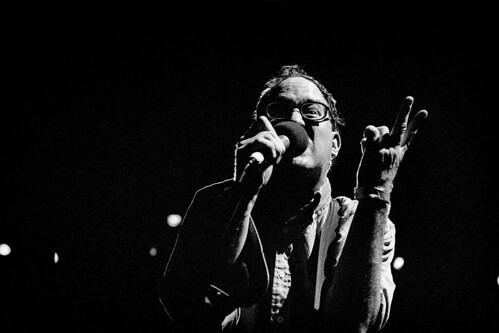
A musician friend wants me to make some images of his band for his website etc. Printing would be secondary.

He wants them to look nice and dark and grainy and probably contrasty and all smokey and rock and rolly.

I think the lighting will be the key but I also want to make sure I get this look in camera/developmnt. I am just considering shooting Tmax 3200 at about 1600 and developing in D-76 stock.

Anybody KNOW of a definitely better way of getting a nice grainy neg? I don't want to be blowing it up to accentuate grain or whatever.

I DON'T WANT TO DO IT IN PHOTOSHOP.

Here's a shot that has the look he would like.

http://www.musicphotographer.co.uk/live.html

Also anybody know some of the great musician photographers I could look at their work. I'm ignorant in this area.

Thanks.
 
Try a process developer like D-8 or D-19, or one of the commercial X-ray developers that have high alkalinity. If you have time to do some tests you can try boosting the pH of developers you have available to you.

Hydroquinone Caustic Soda (Kodak D-8)
Developer for very high contrast on films and plates.

Water, about 90° F (32° C) 750 cc
Sodium sulfite, dessicated 90 g
Hydroquinone 45 g
Sodium hydroxide 37.5 g
Potassium bromide 30 g
Cold water to make 1000 cc

Dissolve chemicals in the order given. Stir the solution thoroughly before use.

For use, take 2 parts of stock solution and 1 part of water. Develop about 2 minutes in a tray at 65° F (18° C).

For general use, a developer which is slightly less alkaline and gives almost as much density can be obtained by using 28 g of sodium hydroxide per 1000 cc of stock solution instead of the quantity given in this formula.

Source: Handbook of Chemistry and Physics. Cleveland, OH: Chemical Rubber Company, 1949.
 
Well, that example is extremely high contrast & might be better to do it at the print stage. But you could do this with any film by underexposing and overdeveloping. Or making internegatives on ortho litho film in full strength developer.

Do a test roll first, or shoot one roll saying 'just for fun' and use that for calibration.
 
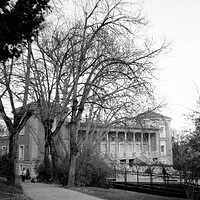
35mm Tri-X 400. Rate at 1600. Underexpose further after that while shooting, to taste depending on light. Push develop 2 stops. Here's that in xtol, but you might want a more grainy developer... This was in camera. No photoshop trickery, save for a small curve (which I do to all my shots).

http://www.flickr.com/photos/33946021@N04/4420646483/
http://www.flickr.com/photos/33946021@N04/4508820478/

Your going to need some serious contrast in lighting of your subject to pull this off though with people. What I was shooting above was brightly lit buildings in almost darkness.

You also better read up on the zone system. That's how I knew how to set the exposure.
 
TMZ or D3200. Rodinal 1+25.

You don't need the zone system or anything like that, just shoot. The less you try to engineer this the better your results will be.
 
Well, that example is extremely high contrast & might be better to do it at the print stage. But you could do this with any film by underexposing and overdeveloping. Or making internegatives on ortho litho film in full strength developer.

Do a test roll first, or shoot one roll saying 'just for fun' and use that for calibration.
I like the interneg idea as well and have done that in the past. It's a whole lot easier to get the look you're after with ortho litho and a developer like D-19.
 
TMZ or D3200. Rodinal 1+25.

You don't need the zone system or anything like that, just shoot. The less you try to engineer this the better your results will be.

Zone system or no, he'll need some way to set the exposure to place what would probably be Zone III and IV shadows on the meter into zone Zone I and II. I definitely didn't mean to imply he'd need to meter every shot. How you get there can be as simple as setting the exposure compensation down two stops. But I do not believe a Nikon Matrix meter set normally on aperture priority would get what he is looking for not matter what film/developer he uses. Maybe I'm wrong.

The most important ingredient, I think, would be to have some serious rock&roll stage lighting to create all that contrast.
 
Assuming the shot was done on film, the photographer probably started off with Tri-x or HP5 pushed at least 2 stops, as suggested, then printed with high contrast. If that doesn't get you there, you could try making an interneg on lith film, or just processing the paper with full strength lith developer. Or else, a very active developer for doing the film, as suggested.
To get just the look your friend wants will probably take some experimentation with various techniques.
 
Aside from the questions of grain/developer, etc. Have a look through the articles section here and read Tony Egan's excellent article on live music photography.

EDIT: Here it is - (there was a url link here which no longer exists)


Steve.
 
400speed film ... wide open at 1/30thS use a shoe flash at 1/8th power
process in dilute print developer
time it to be 2x your development time
stand it for about 3/4 the time and agitate the last few mins
10seconds / minute ...

you might want to do a dry run :wink:
 
Well . . . I guess I asked for it. I really appreciate all the suggestions. At this point, I'm really leaning towards Clayne's keep it simple, stupid suggestion of just shooting the 3200 speed film and Rodinal.

Question, Clayne, Why 1:25 on the Rodinal? I am not familiar with the stuff but have wanted to try it for while. I assume Rodinal will give more grain than xtol or d-76 1:1, my usual developers. How would Rodinal 1:25 compare to D-72 stock? Anyone know?

And I'm pretty sure, as JohnNYC says, the key is going to be lighting. I better work on that before I get too exotic with ortho and homebrew developers. Don't really have time to experiment with the latter.

In terms of zone system and exposure, I intend to meter in the highlights (for face, hands, instruments) and then maybe open a stop to get a bit more shadow. Since these are primarily for a web site, I don't mind laying a simple curve on the jpgs once scanned to get enough black in the shadows, pretty much what I'd do if I was wet printing, but it might be good to have SOME shadow detail.

All further comments appreciated

Thanks.
 
Last edited by a moderator:
Just a note, that I've never really seen (to my recollection) HP5+ pushed more then a stop without it going grainy; at certain enlargements. There might be someone around that can do it, but I'd try a 2 stop push in perhaps Diafine. At least don't use a solvent developer.
 
The reason I recommended 1+25 is because it's the down and dirty quick rodinal dilution. 8m for TMZ@3200, 11m for D3200P@3200 (I'd shoot Delta at 1600 though).
 
Pushed Tri-x, as others have suggested, will give you good looking grain. Rodinal will give you nice grain, but you will sacrifice film speed. Unless you want to experiment, I'd stick to the developer you know and work from there. Experimenting with too many variables is simply not a good idea unless you have time to experiment. The easiest way to get big grain is simply to frame generously and crop heavily. One other alternative to consider is to lith print the negatives on Slavich Unibrom or maybe even Fomabrom. Here and here are Slavich samples. Both are on Tri-x at 400...the second is from a medium format neg. And here is a Fomabrom example from a 35mm negative.
 
Last edited by a moderator:
Also - if you want real edge to the shots, you might consider intentionally overdeveloping. This will bring out an overall grit and sharpness to any highlights - not to mention raise the contrast.
 
Mark, thanks for the samples. Lith is something I'm experimenting with and I see you're using the Arista lith, which is what I have. I may try to lith one or two of these, but I'm trying to do it as barebones as possible.

Erik, that's exactly what I'm looking for. if my images look something like that, lack of grain will not be a problem.

Thanks to all this advice, I believe I'll be trying TMax 3200 @ about 2000 with a 20% push in development or so with my normal D-d76 or Xtol, probaly 1:1 or maybe even 1:2, if i can do it.

Is adding 20% to published times for this film/developer enough of a push to give a bit of extra contrast?

Thanks
 
Those are extremely contrasty. TMZ at 1600 won't be that contrasty unless you print on a high grade paper or play with levels a lot. Try shooting it at 3200 and pushing it in development.

I wouldn't intentionally overdevelop - pushing for your exposure is likely to be enough. If you want more than that, print on grade 4 or bump the levels a little bit in photoshop. It's hard to come back if you go overboard in the developing stage.

As far as grain, I say Tri-X pushed to whatever isn't as grainy as TMZ at 800, much less 3200. If you want grain, go with TMZ. Do some test shot playing around with contrasty lighting and exposure and see what you like. Personally I think TMZ looks best at 800 or 1600, but I've gotten plenty of good shots at 3200 when the lighting was nice. Hard lighting is good in these situations. Dim, flat, low contrast lighting ends up looking like crap a lot of time when shooting at 3200 (in my experience). That's probably because I just needed to add more exposure.

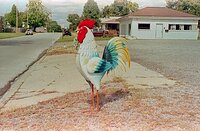
This was shot with harsh lighting at 3200 on TMZ.

 
A musician friend wants me to make some images of his band for his website etc. Printing would be secondary.

He wants them to look nice and dark and grainy and probably contrasty and all smokey and rock and rolly.

I think the lighting will be the key but I also want to make sure I get this look in camera/developmnt. I am just considering shooting Tmax 3200 at about 1600 and developing in D-76 stock.

Anybody KNOW of a definitely better way of getting a nice grainy neg? I don't want to be blowing it up to accentuate grain or whatever.

I DON'T WANT TO DO IT IN PHOTOSHOP.

Here's a shot that has the look he would like.

http://www.musicphotographer.co.uk/live.html

Also anybody know some of the great musician photographers I could look at their work. I'm ignorant in this area.

Thanks.

The old tried and true rock and roll combo straight from the late 60s and 70s - Tri-X processed in Accufine, rated at 1600 or 1200. Use stage lighting to make the images look contrasty.
 
Photrio.com contains affiliate links to products. We may receive a commission for purchases made through these links.
To read our full affiliate disclosure statement please click Here.

PHOTRIO PARTNERS EQUALLY FUNDING OUR COMMUNITY:


Ilford ADOX Freestyle Photographic Stearman Press Weldon Color Lab Blue Moon Camera & Machine
Top Bottom