• Welcome to Photrio!
    Registration is fast and free. Join today to unlock search, see fewer ads, and access all forum features.
    Click here to sign up

contrast filters

Recent Classifieds

Forum statistics

Threads
201,723
Messages
2,829,121
Members
100,913
Latest member
J Holga
Recent bookmarks
0

koraks

Moderator
Moderator
Joined
Nov 29, 2018
Messages
26,740
Location
Europe
Format
Multi Format
Is there a typo in this sentence - did you mean to say Green LEDs have higher lumen efficiency, or did you mean to say Blue LEDs have higher lumen efficiency?
No typo, but there's a caveat I missed and it makes things a little more complex at the detail level - but with the same outcome.

The green leds generally have higher luminous efficiency, by which I mean they put out more lumens per watt than the green ones. In the LEDs I currently use the green ones put out roughly twice the amount of lumens per watt than the blue ones. However, the caveat is in the definition of 'lumen': https://en.wikipedia.org/wiki/Luminosity_function As you can see, for monochromatic blue light, the number of lumens at the same radiant power level will by definition be much lower, so luminous efficiency is not a good measure in this context.

The actual radiant flux of the blue leds will therefore likely be much higher than of the green ones, even though the number of lumens/watt is lower. A paper like Ilford MG FB is significantly more sensitive to green light than it is to blue (see its datasheet). This, however, is a bit misleading and a single spectral sensitivity plot for a VC paper (effectively several emulsions) is difficult to interpret.

So my observation matches yours: that you need only a small blue exposure to zap the blacks relative to a much bigger green exposure. It conforms with the observation I made that I had to attenuate the blue channel substantially in comparison with the green to get the same time for reaching dmax on the paper.

All this makes perfect sense if you realize that 'variable contrast' isn't really variable contrast. It's really variable sensitivity. See here: http://www.film-photography-blog.com/black-and-white-photographic-paper-essentials/
So it follows that if you expose VC paper with blue light, density builds quickly as all (two, three, perhaps more) emulsions are activated. If you throw green light at it, only the green sensitive layer(s) play(s) ball, effectively reducing the paper's sensitivity to green light.

It would be quite difficult to make a paper that's more responsive to green than to blue light, as you'd have to somehow tailor the green+blue-sensitive emulsion(s) to be more sensitive to green than to blue. I personally am not aware of any way to do that, apart from embedding this emulsion underneath a filtering layer that stops part of the blue light (cf. color film and paper). It would also make little sense from a technical viewpoint due to the dominance of light sources with a vastly higher output in the green spectrum than in the blue part, so it would effectively be a wasted R&D effort in the first place.
 
OP
OP

CMoore

Member
Joined
Aug 23, 2015
Messages
6,289
Location
USA CA
Format
35mm
On a much less scientifically rigorous note, it makes sense to me that the Blue sensitive emulsion components are faster. For most split grade prints, the low contrast (green) exposure gets you most of the way there - all you need is a relative "smidge" of high contrast (blue) exposure to bring the result into form.
I find it instructive to prepare a good "straight" print using split contrast, "0" filter and "4-5" filter techniques and then make two separate prints of the same negative, one with just the "0" filter exposure used in the regular print, and the other with just the "4-5" filter exposure used in the regular print. You will see that almost all of the image is there in the "0" filter exposed print.
That has certainly been my (limited) experience.
When i "split print" the Y-Filter goes 2-3 times longer than the M-Filter does.
 

DREW WILEY

Member
Allowing Ads
Joined
Jul 14, 2011
Messages
14,854
Format
8x10 Format
Koraks - I have no idea exactly how you obtained RGB output from an LED source. My own colorheads involve true narrow-band tricolor cutoff from halogen bulbs, designed for very precise color printing, even in large sizes, but obviously suitable for VC papers too. No extant LED option can do that; so it may be the case that your respective source values are quite out of balance in terms of filtered output. That's perfectly OK if only VC is what you have in mind, but would be misleading to compare to more common colorhead or comparable VC head results based on filtered halogen. A comparable issue exists with big pro laser printers because there is really no such thing as a suitable green laser diode. Instead, what they do is take the bit of green light contamination remaining in a red diode, filter for sake of that, then increase the power of the green channel. Then RA4 papers themselves got tweaked to increase their sensitivity to green. But congrats on your progress figuring out the potential of what LED currently does offer. If you did go to the extra step of using cutoff filters to purify your three respective color sources into true narrow-band accuracy, I think you'd discover quite a difference from your current expectations. But there's no need to do that unless you have high-quality color printing in mind.
 

koraks

Moderator
Moderator
Joined
Nov 29, 2018
Messages
26,740
Location
Europe
Format
Multi Format
I have no idea exactly how you obtained RGB output from an LED source.
With separate led arrays. Initially a COB module with separately controlled arrays of R, G and B leds, but I was dissatisfied with the wavelengths of the R and B arrays. So I switched over to individual leds to have more control over led selection. I'm still optimizing it; R is a whole lot better now, but I'm not happy with B. I currently use 410nm for B, but that seems to be too low; I think Royal Blue may be closer, so I have to rework the assembly one more time. One of the more interesting observations so far is that you need a truckload of R, half that of G and only a small amount of B. However I decided to use B and G in a 1:1 ratio for even illumination.
 

koraks

Moderator
Moderator
Joined
Nov 29, 2018
Messages
26,740
Location
Europe
Format
Multi Format
A comparable issue exists with big pro laser printers because there is really no such thing as a suitable green laser diode. Instead, what they do is take the bit of green light contamination remaining in a red diode, filter for sake of that, then increase the power of the green channel.
I think in leds they use blue or uv with a green emitting phosphor. Efficiency seems to be quite decent, but as you point out, elevated green sensitivity of the paper would help.
 

ic-racer

Member
Joined
Feb 25, 2007
Messages
16,719
Location
USA
Format
Multi Format
In my darkroom equal timed exposure through my BLUE and GREEN filters produced an ISO(R) contrast around 1.05 (Grade 2).
ExtendedScale.jpg
 

koraks

Moderator
Moderator
Joined
Nov 29, 2018
Messages
26,740
Location
Europe
Format
Multi Format
I'm sorry, I expressed myself poorly: how much radiance per part of the spectrum? The filters give information on attenuation; combined with data on the light source, the answer could be found. If it's eg a halogen light source, it follows that the total blue radiance will be substantially less than green, even though the blue filter passes a bit more in its part of the spectrum than the green filter. Hence, in absolute terms, it would mean your paper needs much less blue than green to reach average contrast, which matches my experience.
 

DREW WILEY

Member
Allowing Ads
Joined
Jul 14, 2011
Messages
14,854
Format
8x10 Format
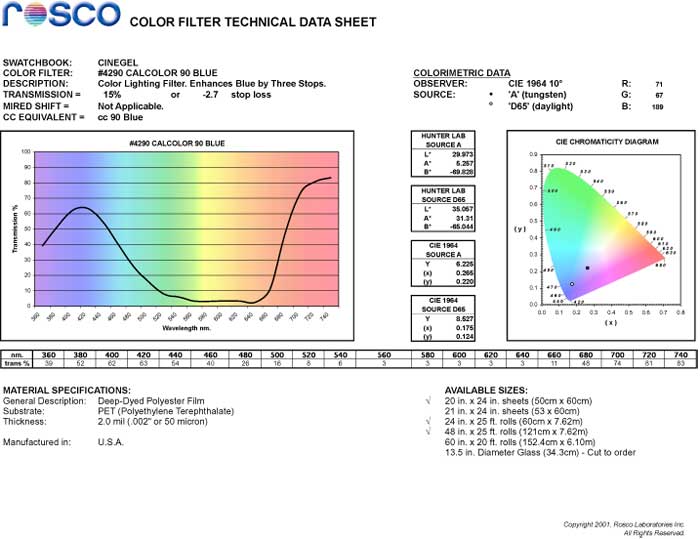
Hmm... Rosco lighting gels are hardly definitive in this case, unless that is what you personally use. Objectively analyzing split printing effects requires pure deep blue versus pure deep green filtration. That's how I do it. But you also have to account for the balance of the light source prior to filtration to factor ratios.
 
Photrio.com contains affiliate links to products. We may receive a commission for purchases made through these links.
To read our full affiliate disclosure statement please click Here.

PHOTRIO PARTNERS EQUALLY FUNDING OUR COMMUNITY:


Ilford ADOX Freestyle Photographic Stearman Press Weldon Color Lab Blue Moon Camera & Machine
Top Bottom