Mick Fagan said:
I pondered this paragraph in that book, for quite some time. Eventually I woke up to the fact that there are three colours in the film and three in the enlarger head. We actually use all three colours when enlarging, the Yellow & Magenta filters are the ones we adjust on the enlarger head, Cyan is controlled by the density, which is a time adjustment.
The only time before that revelation I had used cyan, was when I needed neutral density to slow down printing times when making extremely small prints.
Not quite.
Color paper and color film BOTh have three layers - one sensitive to Magenta, one to Yellow, and one to Cyan (I'll exclude Fuji, for the moment). To print color properly,
each layer must be exposed to obtain the proper density. The final, overall density will be a total of all the light-sensitive layers. If we add additional light to any individual layer, we will bias the final image in that direction. To only add cyan, for example, will increase the amount of yellow in the print (remember, we are working with a negative). To re-balance the final image, it is necessary to add more yellow and magenta to compensate, and the final image will then have the proper color balance, and the desired increased overall density.
Modern color negative films have a built-in (negative) cyan bias, observed as a dark yellow (a.k.a. "brown") cast, to eliminate much of the need for cyan filtration. In balancing, Magenta and Yellow are the only filtration
usually necessary to "catch up" to the Cyan bias.
There are occasions where the "pre-cyan" bias is not enough, and cyan must be added to obtain balance. As an example, I have worked with a technique where images of color slides are projected onto the bodies of models, and the whole thing was captured on daylight-balanced film. First, the lamp in the
projector has a spectrum much lower in color temperature than daylight - something like 3600K as opposed to 5500K daylight - and all bets are off anyway, after the light passes through the color transparency.
In printing, those images took a lot of magenta, yellow AND cyan filtration to obtain skin tones that actually looked like skin. I think that printing those would have been nearly impossible without the ColorStar.
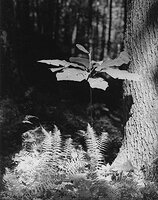
See "Floral Nude #1" and "Floral Nude #2" in my gallery.