
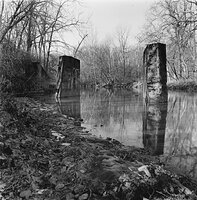
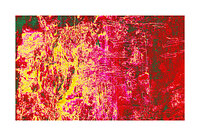
Shot to hell, I'd say...
I found it very hard to control.
The very dilute 0.01% ferri solution doesn't last more than a few minutes. I made up new bleach for each print. A transfer pipette is useful - I dispensed a 0.5 ml of 10% stock in 0.5 liter of water just before use.
It is an easy technique to play around with and good for getting rid of a rainy Sunday afternoon.
On the contrary, if I have needed to use it, I have found it a reproducible technique. But, I have been using LIB with a restricted range of papers (Ilford and Kentmere), I know Tim Rudman in his book on darkroom techniques says some papers are prone to streaking or splotching.
I prepare a 0.1% stock solution (which is pretty stable stored in dark brown glass bottles), I then use this for preparing my latent image bleaches, and use from 5ml - 20ml of this stock per litre for my working bleach (i.e. between 5 and 20 times more dilute than with your trials). The working solution I use once, and then discard. During the bleaching I agitate gently, and continuously.
For this image (there was a url link here which no longer exists)(part of the "Let's all print one negative" thread) I wanted to print at grade 4 to keep the sparkle in the snows highlights, but from my trial contacts of the negative, I knew anything much above grade 2½ made the river very dark. To get the effect I required with latent image bleaching needed three small trial prints. I started with 10ml/l for one minute - too strong an effect, so I went to 5ml/l for one minute - too little of an effect, then tried 5ml/l for two minutes which gave me the effect I required. For the final prints I used the 5ml/l bath for two minutes, and got the same effect. This was on Ilford MG FB Warmtone.
Other papers do behave differently when bleaching the latent image; some may require continuous, vigorous agitation; others may prove unuseable. It is definitely not a one size fits all technique, and must be tested for the papers you use.
