• Welcome to Photrio!
    Registration is fast and free. Join today to unlock search, see fewer ads, and access all forum features.
    Click here to sign up

Contrast and dilution

half stop lighter er.jpg

A
half stop lighter er.jpg

  • jhw
  • Jan 12, 2026
  • 8
  • 7
  • 110
sentinels of the door

A
sentinels of the door

  • 4
  • 0
  • 91

Recent Classifieds

Forum statistics

Threads
201,718
Messages
2,829,041
Members
100,909
Latest member
SuninPisces
Recent bookmarks
1

herb

Subscriber
Allowing Ads
Joined
Jan 22, 2005
Messages
405
Format
Medium Format
I have not found any threads that directly address the relationship between b/w film developer concentration and contrast.

I suspect there is some text that discusses this relationship, but it is a bit of a mystery when trying to fine tune dilution, time and contrast for a particular film/developer combination. I use Pyrocat hd and Rodinal, which in my experience give radically different contrast results.

Love to hear what the smart people know or can direct me to.
 

Lee L

Member
Joined
Nov 17, 2004
Messages
3,287
Format
Multi Format
You might find this thread of interest:
(there was a url link here which no longer exists)

You can develop to the same contrast with higher dilutions by extending time, but the degree of change is dependent on the developer and film combination. You might also get a slightly different curve shape by doing this, and you also need to include agitation as a variable.

I don't think you'll find anything more than general rules of thumb, as the developers and films vary enough to make it difficult to establish a single fixed relationship. As with the above info in the link to the Gassan experiments, someone needs to do a lot of work to come up with good information on a single developer across a limited range of films, and no one has done it across a significant number of films and developers.

You might start by looking at the manufacturer suggested times to see how times change (probably on a percentage basis) as dilution changes. Rodinal often gives both 1:25 and 1:50 times for the same film.

Lee
 

Claire Senft

Member
Allowing Ads
Joined
Dec 7, 2004
Messages
3,239
Location
Milwaukee, W
Format
35mm
I have not used Rodinal for a long time. My memory says the Agfa has standard developing times that give much more contrast than what is common in the usa.
 

jim appleyard

Subscriber
Allowing Ads
Joined
Nov 21, 2004
Messages
2,421
Location
glens falls, ny USA
Format
Multi Format
I have not used Rodinal for a long time. My memory says the Agfa has standard developing times that give much more contrast than what is common in the usa.

Someone once suggested (perhaps here on APUG?) that the Rodinal times are for the outdoor lighting conditions in Europe. But, having never been there, I can't say.
 

Lee L

Member
Joined
Nov 17, 2004
Messages
3,287
Format
Multi Format
I have not used Rodinal for a long time. My memory says the Agfa has standard developing times that give much more contrast than what is common in the usa.
Yes, I think their target gamma was higher than what's typically used in the US, but it's the same target for any dilution, so the relationship between times and dilution will still be indicative. I lived in Rhineland Germany for a year in the early 80's and can appreciate the differences in common shooting conditions and the higher contrast typically preferred by German B&W printers.

I'm also sure there are posts about dilution vs contrast for pyrocat hd, but can't point to them off the top of my head. I wouldn't draw any conclusions from them unless times and dilutions were from the same source, and I'd be careful about the target use, as posts for good alt process negatives won't necessarily be directly applicable to gelatin silver prints.

I'd check Sandy King's posts for the effects of dilution with pyrocat HD. He's also published articles in View Camera that might be useful.

Lee
 
OP
OP

herb

Subscriber
Allowing Ads
Joined
Jan 22, 2005
Messages
405
Format
Medium Format
Developer dilution and contrast

Thanks a ton. I use semi stand almost always, so it should be pretty easy to arrive at a correct developer conc/time regimen. I only use two films, mostly one in particular.

I was also concerned that low contrast landscapes were not able to be salvaged unless I used high concentration developers.

I will be doing some tests and will post the results hopefully by the end of the year.

Thanks for the replys.
 

Uhner

Member
Allowing Ads
Joined
Feb 28, 2006
Messages
1,100
Location
Oslo, Norway
Format
Multi Format
Having used Rodinal for film exposed from Lofoten in the north to Malta in the South – I can say that Agfa’s suggested development times in general are to hot for my liking for normal contrast scenes. Perhaps they are referring to foggy days in the Ruhrgebiet during the early seventies?
 

Lee L

Member
Joined
Nov 17, 2004
Messages
3,287
Format
Multi Format
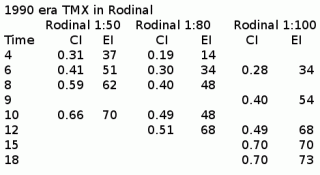
FWIW, here's a chart derived from a more comprehensive set of data published in Kodak Tech Bits, Issue 2, 1990, page 8. This data is for 1990 vintage TMX in Rodinal at three dilutions. Tests run by Nancianne Judge and Jack Holm of RIT under guidance from Kodak's Scientific Imaging division. A single run was done for each film/developer/dilution combination.

TMX is probably more sensitive to variations in time than older style emulsions. TMX has changed since this data was published.

An interesting article, with Tech Pan and TMX tested with 12 different developers/dilutions over times from 4 to 21 minutes. EI and CI derived for each combination.

I miss Tech Bits. You could subscribe for free.

Lee
 

Attachments

  • TMX-Rodinal.gif
    TMX-Rodinal.gif
    9.2 KB · Views: 275

df cardwell

Member
Allowing Ads
Joined
Jul 16, 2005
Messages
3,358
Location
KY USA
Format
Multi Format
With Rodinal especially, there is not a direct correlation between dilution and contrast.

Dilution simply determines the time it takes to reach a given contrast.
You can get the same contrast with 1+25 as 1+100 ... if you let the film develop long enough.

Unless you alter the the ratio of agitation to total development time, you don't change the contrast.

NOTE: Agfa states the development times in their charts are for agitation every 30 seconds, and to achieve a CI of .65. That IS more contrast than we tend to like, but is good for a fully overcast day. HOWEVER: if you agitate only once a minute, or every other minute, you come closer to a negative that prints on #2 paper and a diffusion enlarger.

/d
 

Rick Jones

Member
Allowing Ads
Joined
Feb 9, 2004
Messages
127
Location
Maryland
Format
Multi Format
My WAG is that the vast majority of folks adjust negative contrast with changes in development time rather than dilution. That may partially explain why you're having trouble finding threads discussing dilution to control contrast. While any developer can be used at any dilution you choose as long as you use enough stock to get the job done and make appropriate time corrections I suspect the manufacturer's don't recommend more than modest dilution changes for fear their customers will not use enough developer and therefore never reach their target CI no matter how long they extend times. So you are pretty much left to fend for yourself. Your statement "Pyrocat hd and Rodinal, which in my experience give radically different contrast results" is vastly different from my experience. Granted, I have never used Pyrocat HD but I have never failed to match contrast using D76, Rodinal and HC110 by adjusting times. I would like to hear from you as to exactly what efforts you have made to match contrast with the two developers you mentioned.
 

Larry Bullis

Subscriber
Allowing Ads
Joined
May 23, 2008
Messages
1,265
Location
White Rock, B.C. Canada
Format
Multi Format
I've never used pyrocat HD, but I have used lots of pyrocatechin. I don't know if Sandy's formula produces a brown negative, but typically, pyrocatechin does. If the color is brown, it can produce a markedly different contrast characteristic than Rodinal, which in my experience gives a very neutral tone.

The particular kind of contrast that occurs with brown negatives varies with the color sensitivity of the particular paper you are using. If you are using a variable contrast paper, the stain will act as a progressive yellow filter, minimal in the shadow areas but very heavy in the highlights. The paper will respond accordingly. It can play havoc with the steps between the grades due to the interaction of the yellow with the various spectral transmissions of the individual filters resulting in goofy contrast variations between densities up the scale. It is quite easy to achieve hugely exaggerated contrast in the shadows while the highlights are aggressively compressed. This can be useful in particular circumstances, but more often it is just aggravating. This type of negative prints just fine on graded papers, since the brown stain acts as a proportional barrier to the blue light the paper sees, giving greater effective printing density.

I'm sure that the brown stain produced by the pyrocatechin would be a very welcome advantage in printing platinum, etc. It may not be that great for everyone who prints with silver. I've always loved it, but I use it, most often, with graded or single grade paper.
 

JBrunner

Moderator
Moderator
Allowing Ads
Joined
Dec 14, 2005
Messages
7,429
Location
PNdub
Format
Medium Format
I'm sure that the brown stain produced by the pyrocatechin would be a very welcome advantage in printing platinum, etc. It may not be that great for everyone who prints with silver. I've always loved it, but I use it, most often, with graded or single grade paper.

One of the nice advantages of Pyro developers is that you can use them to produce negatives that are dense enough for alt process, yet print well with silver, as the stain has a different opacity in regard to UV. I find the greenish stains of PMK etc particularly useful with split printing, as it seems to isolate the soft from the hard to more effect.

It has never occurred to me to alter contrast with dilution. Changing development time with a set dilution seems so much easier, so I wonder why the OP would want to do it with dilution? (hehe, I said "do it hehe):tongue:
 

Kirk Keyes

Member
Allowing Ads
Joined
Jun 17, 2004
Messages
3,234
Location
Portland, OR
Format
4x5 Format
I have never used Pyrocat HD but I have never failed to match contrast using D76, Rodinal and HC110 by adjusting times. I would like to hear from you as to exactly what efforts you have made to match contrast with the two developers you mentioned.

Hear, Hear!
 

Larry Bullis

Subscriber
Allowing Ads
Joined
May 23, 2008
Messages
1,265
Location
White Rock, B.C. Canada
Format
Multi Format
One of the nice advantages of Pyro developers is that you can use them to produce negatives that are dense enough for alt process, yet print well with silver, as the stain has a different opacity in regard to UV. I find the greenish stains of PMK etc particularly useful with split printing, as it seems to isolate the soft from the hard to more effect.

It has never occurred to me to alter contrast with dilution. Changing development time with a set dilution seems so much easier, so I wonder why the OP would want to do it with dilution? (hehe, I said "do it hehe):tongue:

John Lindstrom at Everett Community College did a study on controlling contrast with HC110 by dilution instead of time. I, too, never got the point. Why?
 

c6h6o3

Member
Allowing Ads
Joined
Oct 16, 2002
Messages
3,215
Format
Large Format
(there was a url link here which no longer exists)
 

JBrunner

Moderator
Moderator
Allowing Ads
Joined
Dec 14, 2005
Messages
7,429
Location
PNdub
Format
Medium Format
(there was a url link here which no longer exists)

I am familiar with stand and semi stand dilutions and methods, but unless I'm mistaken the OP concerns expansion and contraction by dilution, using a reference time of "normal" for a particular film/developer.
 
OP
OP

herb

Subscriber
Allowing Ads
Joined
Jan 22, 2005
Messages
405
Format
Medium Format
More on contrast adjustment

I re shot my test scene yesterday and will do some developer tests today.
Semi stand is a good method for me as it allows some room light development when the film is standing. I use ss racks and tanks with lids, which keeps me from scratching 8x10 and 5x7, which I do not like to do in trays. Semi stand gives a better cloud tone gradation, IMHO than does short development with frequent agitation.

When I get resultant prints I will post the methods and results.
 

JBrunner

Moderator
Moderator
Allowing Ads
Joined
Dec 14, 2005
Messages
7,429
Location
PNdub
Format
Medium Format
I re shot my test scene yesterday and will do some developer tests today.
Semi stand is a good method for me as it allows some room light development when the film is standing. I use ss racks and tanks with lids, which keeps me from scratching 8x10 and 5x7, which I do not like to do in trays. Semi stand gives a better cloud tone gradation, IMHO than does short development with frequent agitation.

When I get resultant prints I will post the methods and results.

So we are talking about stand development.
 

JBrunner

Moderator
Moderator
Allowing Ads
Joined
Dec 14, 2005
Messages
7,429
Location
PNdub
Format
Medium Format
Some how I missed that. I did read the thread. Makes more sense for me now.
 

c6h6o3

Member
Allowing Ads
Joined
Oct 16, 2002
Messages
3,215
Format
Large Format
I am familiar with stand and semi stand dilutions and methods, but unless I'm mistaken the OP concerns expansion and contraction by dilution, using a reference time of "normal" for a particular film/developer.

Dilution is how Steve Sherman controls the midtone micro contrast. He was always able to control the shadows and highlight values by varying exposure and development time, but the results often left him with pure mud in the middle. The ability of semi-stand development to precisely control the entire contrast range of a scene no matter what the light is what led him to master the technique.

The bottom line is that ss or stand development is not particularly useful for expanding the overall range (which is what I think the OP had in mind), but yields incredible results in increasing contrast in the middle.
 
Photrio.com contains affiliate links to products. We may receive a commission for purchases made through these links.
To read our full affiliate disclosure statement please click Here.

PHOTRIO PARTNERS EQUALLY FUNDING OUR COMMUNITY:


Ilford ADOX Freestyle Photographic Stearman Press Weldon Color Lab Blue Moon Camera & Machine
Top Bottom