


• Welcome to Photrio!
    Registration is fast and free. Join today to unlock search, see fewer ads, and access all forum features.
    Click here to sign up

Consistent lith agitation, EMaks paper

PenStocks

A
PenStocks

  • 6
  • 1
  • 80
Landed Here

H
Landed Here

  • 4
  • 6
  • 75

Recent Classifieds

Forum statistics

Threads
201,838
Messages
2,830,946
Members
100,977
Latest member
Midmod
Recent bookmarks
0

MarkL

Subscriber
Allowing Ads
Joined
Jan 5, 2006
Messages
606
Location
Upstate NY
Format
4x5 Format
I have a stock of the discontinued EMaks grade 3 paper and I hate to burn through it without the best strategy for lith developer agitation. Even though my agitation is consistent gentle rocking of an over-sized tray it apparently isn’t doing the trick. Can anyone help me with a method of mechanical agitation (or any other advice)? Often areas such as edges get too much development. I know that’s part of lith but I think that if I had increased agitation but evenly distributed across the print surface (instead of favoring the edges), I’d reduce uneven development issues!

In Tim Rudman’s “World of Lith Printing” book there’s mention of a Russian photographer who managed to circulate chemistry via an aquarium pump to get very consistent results on Unibrom paper. I’ve emailed the photographer in hopes of getting details and I’ll share his response here if I get one.

I attached a picture of the four 16x20’s I tried yesterday. They were exposed exactly the same except for continually reduced top edge burn. After 3 prints I replenished the developer. In the bottom left you can see the edge development issues because I probably agitated a bit too much. In the bottom right picture you can see the random overdeveloped branches on the right. If anyone has experience with Emaks or if you can spot something I’m doing wrong I’d love the advice!

Here’re the details:

16x20 EMaks grade 3 paper, LD20 developer at room temp ~70F
20x24 tray
Presoaked prints in room temp water for a couple minutes to soften so that edges aren’t curled at first.
Flipped print end over end several times then gentle rocking of tray corners as print floats face up.
100A + 100B + 3,000 water + 150 old brown (very old and very brown)
Development in 6 to 8 minute range
After 3rd print, added 100A + 100B + 3,000 water
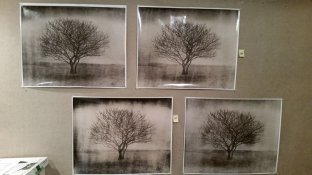
Prints A19-22.jpg
 

mooseontheloose

Moderator
Allowing Ads
Joined
Sep 20, 2007
Messages
4,110
Location
Kyoto, Japan
Format
Multi Format
I was going to suggest a larger tray for developing but I see you are already doing that.

I've never had this problem before but I don't do lith at these sizes and I've never used Emaks paper.

I did a lith workshop with Tim Rudman a few years ago and he was always after us to constantly change up the agitation - side to side, back and forth, corner to corner. Some people flipped the paper from end to end as well. I did it at the workshop but I'm not so fussy with my own printing and don't seem to have a problem with it. He also pointed out that you could take out the parts of the print that were overdeveloping and just keep the section of the print you wanted to develop further in the developer. Not sure how that would work with your particular problem and with such large paper though.

Perhaps the other issue is that you are exposing the print almost up the edge of the paper - have you tried a larger border around the print? That might help.
 
OP
OP
MarkL

MarkL

Subscriber
Allowing Ads
Joined
Jan 5, 2006
Messages
606
Location
Upstate NY
Format
4x5 Format
That's a good idea Rachelle. Another thing I had reasonable success with was doing low volume 1-shot developing. I would use an oversized smooth (no gutters) tray with no solution. Then I stick the pre-soaked print on the bottom of the tray. You know how a wet print will stick to a squeegee board? Well after letting it drain a bit it will stick to the bottom of the dry tray and won't slip around during agitation. Then I'd pour in enough solution for the one print and really there's little if any edge overdevelopment because there's no massive sloshing at the sides of the tray...just the minimal solution sheeting over the emulsion. It worked great for some images and papers but not for this image for some reason.
 

Mark Fisher

Member
Allowing Ads
Joined
Dec 13, 2003
Messages
1,691
Location
Chicago
Format
Medium Format
The trick is to vary the agitation. Very gentle and alternate directions. I find floating my tray in a larger tray of water (warm or not) allows more easier and better agitation. I never found emaks to be a huge issue but Slavich and Fomabrom are another story. It may also help to go more dilute and/or room temp developer.
 

Rich Ullsmith

Member
Allowing Ads
Joined
Jan 26, 2007
Messages
1,159
Format
Medium Format
Vignette your borders when printing, maybe 1/2 to 1 stop, develop with normal agitation, then selectively develop the borders by inspection as necessary.

The russian guy you refer to, I think he had some sort of perforated sheet of plexi, print supported below, and a fish tank pump to circulate. This was to address your same problem, but I don't know if you really want to go there. Me not big fan of emaks for lith, although I like the results you show.
 
OP
OP
MarkL

MarkL

Subscriber
Allowing Ads
Joined
Jan 5, 2006
Messages
606
Location
Upstate NY
Format
4x5 Format
The trick is to vary the agitation. Very gentle and alternate directions. I find floating my tray in a larger tray of water (warm or not) allows more easier and better agitation.

Excellent suggestion about floating the tray in a larger tray! Especially since most sinks including mine are pitched towards the drain and that can be enough to increase sloshing on the downhill side.
 
OP
OP
MarkL

MarkL

Subscriber
Allowing Ads
Joined
Jan 5, 2006
Messages
606
Location
Upstate NY
Format
4x5 Format
The russian guy you refer to, I think he had some sort of perforated sheet of plexi, print supported below, and a fish tank pump to circulate. This was to address your same problem, but I don't know if you really want to go there. Me not big fan of emaks for lith, although I like the results you show.

Rick thanks so much. Emaks in lith can yield a texture that works in some prints. Of course it's forever discontinued but I have stock that I would like not to waste! So I'm willing to try to rig up the aquarium pump system which the Russian guy claims totally controlled development of the very difficult Slavich Unibrom (which I also have some of!).

Are you able to give any more detail? I'd say having the print supported above the bottom of a tray so that developer can run off all edges and be collected by the pump pickup line is the easy part. Distributing the developer over a perforated sheet of plexi or aluminum sounds good. If enough volume of developer was pumped on top of the perforated sheet, and the holes were small enough, it would pool on top of the perforated sheet and come down uniformly.
 
Last edited by a moderator:

Mateo

Member
Allowing Ads
Joined
Sep 7, 2002
Messages
505
Location
Hollister, C
Format
Multi Format
I think maybe agitation isn't the issue here. Maybe you are underexposing the print and pushing the development to far.
 
Photrio.com contains affiliate links to products. We may receive a commission for purchases made through these links.
To read our full affiliate disclosure statement please click Here.

PHOTRIO PARTNERS EQUALLY FUNDING OUR COMMUNITY:


Ilford ADOX Freestyle Photographic Stearman Press Weldon Color Lab Blue Moon Camera & Machine
Top Bottom
