• Welcome to Photrio!
    Registration is fast and free. Join today to unlock search, see fewer ads, and access all forum features.
    Click here to sign up

Condenser vs Diffuser

man arguing 1972

A
man arguing 1972

  • 4
  • 0
  • 18
Got milk

H
Got milk

  • 2
  • 0
  • 10

Recent Classifieds

Forum statistics

Threads
203,012
Messages
2,848,636
Members
101,599
Latest member
martto
Recent bookmarks
1
Diffusion (colour head) for 4x5 and 120. It took me ages to get the hang of it too. I wish there were better and easier to understand resources on using colour heads for b&w.

Condensor for 5x7 and some 4x5.
 
I like to thank everyone for their responses. The results was a surprise to me. Out of all users, roughly 50% use a diffusion enlarger, 25% use a condenser and 25% use both. This means that more than 1/3 of all enlargers are likely to be condensers. Well, that's enough reason to continue our investigation and come up with a deep-dive report, comparing the two enlarging concepts yet again.
What purpose is this research for?:confused: You said that you were not interested in the differences between the two systems.
 
Diifusion for 35 mm and medium format, durst modular 70 vario. To second Keith: What's the aim of your investigation? Or just mucking about for fun's sake (which is fine by me)?
 
What purpose is this research for?:confused: You said that you were not interested in the differences between the two systems.

Keith (and others)

I'm preparing a publication that explains the difference between the two systems and their impact on print tonality. However, I was concerned that condenser enlarger are hardly used these days and was glad to find out that that is not the case.

Thanks for all the help!
 
Ralph,

If you are planning to publish an article about the various enlarger configurations, I would like to see a proper distinction made between the three types: condenser, diffuser, and condenser-diffusion.

I find that most published material on the issue of contrast differences tend to lump into two categories: condenser and diffuser. The adjustments in film development for G-bar/CI for condenser enlargers usually do not distinguish between point source (true condenser) enlarger and the more common condenser-diffusion enlarger, which utilizes an opal bulb and/or diffusion filter. The amount of the diffusion can vary a bit depending on the combination of bulbs/filters.

For example, Contrast Index figures for condenser enlargers are quoted in the neighborhood of 0.43 to 0.45 and diffusion enlargers are quoted as 0.56 to 0.58. In practice, my condenser-diffusion enlargers are in the neighborhood of 0.50 to 0.53. G-bar would have similar placements for the C-D enlarger.

I had to determine these variations empirically; it would have been nice to go to a published reference with confidence and save time and money.

Just a suggestion,

-F.


Fred

Good point. I will take this into account.

The terminology is difficult and, unfortunately, not universal. I have seen 'point source' 'point light source', both with and without 'enlarger'. It's often called a 'true' condenser but never a 'condenser enlarger'. What you rightly call 'condenser/diffusion' has condensers and is consequently called 'condenser enlarger' by most. In fact, I believe that a true 'condenser' does not exist. It's a hypothetical state of no diffusion.

BTW, the numbers you quoted match my measurements pretty well, and I found an amazingly easy way to determine the right contrast index for any condenser(/diffusion) enlarger.
 
Ralph says:

"BTW, the numbers you quoted match my measurements pretty well, and I found an amazingly easy way to determine the right contrast index for any condenser(/diffusion) enlarger."

So, are you going to share that or do we have to wait for the book/article?

Since I already have my numbers, I could wait....

-F.
 
Ralph says:

"BTW, the numbers you quoted match my measurements pretty well, and I found an amazingly easy way to determine the right contrast index for any condenser(/diffusion) enlarger."

So, are you going to share that or do we have to wait for the book/article?

Since I already have my numbers, I could wait....

-F.

I was asking for it, wasn't I?

Empirically, I discovered the following equation:

gs = gd/Q

The average gradient for a (partially) specular light source (gs) is equal to the average gradient for a totally diffused light source (gd) divided by the Callier coefficient (Q) of the specular light source.

Here is an example:

optimized avgGrad for a diffused light source = 0.57
estimated Callier coefficient of my condenser enlarger = 1.2
customized avgGrad for my condenser enlarger = 0.57 / 1.2 = 0.47

Try this with your numbers and let me know, but from what you told us, I bet it is around 1.1!
 
Ralph,

My calculations come in at 1.14, pretty darned close. This number is based on my favorite enlarger, the Vivitar VI with the 'light pipe.' I think this enlarger is one of the best kept secrets in enlarging! My Beseler and Omega are just slightly different. Of course, I am backing into these numbers since I derived my factors empirically.

Printing's a snap when you play by the numbers!

-F.
 
Last edited by a moderator:
Fred

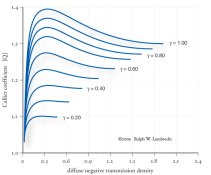
That's good. Some variation comes from at which diffuse density you measure the Q-factor. The Callier coefficient is not constant across diffusion densities. At 0.3D the Q-factor is typically at its highest value.
 

Attachments

  • CallierEffect.jpg
    CallierEffect.jpg
    40.2 KB · Views: 153
Some good point were raised concerning Contrast Index and G-bar. Ilford used to supply times for condenser enlargers as G-bar =0.55 and higher contrast for diffuser/cold-light source enlargers as G-bar = 0.70. With the latest type of enlargers, they averaged the times for a G-bar of 0.62.
I believe that Tetenal still provide times for two levels of contrast. All of these of course are guide times which can be modified to suit each individuals own personal preferences.
 
I thought I would point out from old magazine articles which date back to the 1950`s that I have, that it was once a common practice to develop 35mm negatives so that they printed well on to grade 3 papers rather than the usually recommended grade 2 papers. The films were given just enough exposure to record enough detail for the shadows, while the shorter than usual development times required to enlarge on grade 3 papers helped to minimise graininess.
 
Ralph, I use a Vivitar VI with dioptic light source, so I have no clue whether you would call that a diffuser or a condenser system...
 
Some good point were raised concerning Contrast Index and G-bar. Ilford used to supply times for condenser enlargers as G-bar =0.55 and higher contrast for diffuser/cold-light source enlargers as G-bar = 0.70. With the latest type of enlargers, they averaged the times for a G-bar of 0.62.
I believe that Tetenal still provide times for two levels of contrast. All of these of course are guide times which can be modified to suit each individuals own personal preferences.

It is important to understand and not mix up the different ways of measuring negative contrast, because they return similar but not identical values. Kodak uses the Contrast Index (CI) and Ilford used the Average Gradient (G-bar). I prefer Ilford's way of measuring contrast but do it over 2.1 log exposure units where Ilford uses only 1.5 units of exposure. I also use a speed-point density of 0.17 and not the typical 0.1 density value. IMHO, this works better for Zone System work, ensures more shadow detail and takes the whole characteristic curve into account.
 
Ralph, I use a Vivitar VI with dioptic light source, so I have no clue whether you would call that a diffuser or a condenser system...

It is a diffused light source with a triple condenser collimation system. So, a condenser-diffuser enlarger which requires negs with a CI something less than diffuser developing times, which are the most commonly quoted times on data sheets.

-F.
 
Hi Ralph:

Durst exactly as you use, and described in your book. Use the enlarger light source as projection for 4x5, and as a light source for contact printing 8x10. I also use a "naked" bulb for doing some contact prints, mainly with Azo/amidol.
 
Ralph, I use a Vivitar VI with dioptic light source, so I have no clue whether you would call that a diffuser or a condenser system...

Thanks Michel

On my balance sheet, it went onto the condenser side.
 
Condenser, mainly 35mm (Leitz Valoy II), some 6x6 and 4x5 (Beseler MXT). I like diffuser fine, but my current light source for this is a bit too fast.
 
diffuser because I do mostly color (although yes it's possible to have do color with a condenser enlarger and with dichroic head as well). I do mostly 35mm.
 
I use a condensor enlarger (Durst Laborator 1000) for subjects where greatest contrast and detail is required, and DeVere with Color Head for subjects requiring smoothest tonal gradation or 500H head for general work
 
Up to a year ago D2v,bought a cold lite enlarger haven't had much time to use it but when I did I liked it .
 
My school has diffuser enlargers and I have a condenser at home. Although I haven't used my own in a few years so I guess that would be just diffuser.
 
Condensr/Diffusion

Diffusion: Focomat V35 mostly but now also 6x7 on a Focomat 11c with Ilford Multigrade 500 head.
Richard
 
Photrio.com contains affiliate links to products. We may receive a commission for purchases made through these links.
To read our full affiliate disclosure statement please click Here.

PHOTRIO PARTNERS EQUALLY FUNDING OUR COMMUNITY:


Ilford ADOX Freestyle Photographic Stearman Press Weldon Color Lab Blue Moon Camera & Machine
Top Bottom