• Welcome to Photrio!
    Registration is fast and free. Join today to unlock search, see fewer ads, and access all forum features.
    Click here to sign up

Compensating Development

Recent Classifieds

Forum statistics

Threads
201,724
Messages
2,829,141
Members
100,916
Latest member
mikenickmann99
Recent bookmarks
0

kodachrome64

Member
Allowing Ads
Joined
Jun 2, 2008
Messages
301
Location
Dallas, TX
Format
Medium Format
I've been reading The Negative and searching threads for information on guidelines to use for compensating development in high contrast scenes. I have successfully used stand development when pushing TMY-2 to 1600, using T-Max developer for 26 minutes only agitating the first minute. That was a guess and it worked.

What I am trying to accomplish now is something I don't have time to do a lot of testing for first. I need to make some exposures at night of a lighted house, similar to taking street pictures with street lights in the scene. My idea is to use reduced agitation or stand development to develop the shadows without blowing out the highlights, which is quite easy in scenes of this type (in my experience). The film I am thinking of using is 100 TMX (135) but I also have TMY, Plus-X, and Tri-X. I've had good results with T-Max developer at 1:9, so that would be my starting point. I also have HC-110, D-76, and XTOL, but I only have a 1 roll tank which limits my chemical volume to 250 mL or so.

Does anyone use any certain techniques or rules of thumb when trying to compress the dynamic range of a scene? I need to make these exposures soon and don't have time to do a whole bunch of testing first, so I was hoping for a good starting point.

Thank you,
Nick
 

Jim Noel

Member
Allowing Ads
Joined
Mar 6, 2005
Messages
2,261
Format
Large Format
It is easier and less risky to do a pre-exposure on about Zone II. Old time free lance news photographers used this trick extensively when working at night.
 
OP
OP
kodachrome64

kodachrome64

Member
Allowing Ads
Joined
Jun 2, 2008
Messages
301
Location
Dallas, TX
Format
Medium Format
I've never tried the pre-exposure idea. Interesting.

I tried T-Max developer, 1:9, for 20 minutes at 24 degrees, agitating at 0, 5, 10 and 15 minutes for 15 seconds each. The negatives look to be of the proper density and are evenly developed, but they are still drying and I haven't scanned them yet.

I cut the roll in half so now I'm going to try the other half with HC-110 dilution H.

Thanks,
Nick
 

Larry Bullis

Subscriber
Allowing Ads
Joined
May 23, 2008
Messages
1,265
Location
White Rock, B.C. Canada
Format
Multi Format
Do you have time to mix some Windisch pyrocatechin? see http://www.pbase.com/bullis/image/101128616

This image was lit entirely by the chandeliers, which are included in the scene. I can actually print it to show the individual bulbs, but I liked this brighter version so I uploaded it instead.

This was tri x sheet film processed in diluted Windisch using divided development.
 

Paul Verizzo

Member
Joined
Jan 20, 2008
Messages
1,648
Location
Round Rock, TX
Format
35mm
Do you have time to mix some Windisch pyrocatechin? see http://www.pbase.com/bullis/image/101128616

This image was lit entirely by the chandeliers, which are included in the scene. I can actually print it to show the individual bulbs, but I liked this brighter version so I uploaded it instead.

This was tri x sheet film processed in diluted Windisch using divided development.

Beautiful!
 
OP
OP
kodachrome64

kodachrome64

Member
Allowing Ads
Joined
Jun 2, 2008
Messages
301
Location
Dallas, TX
Format
Medium Format
That's a nice shot and looks good the way you developed it.

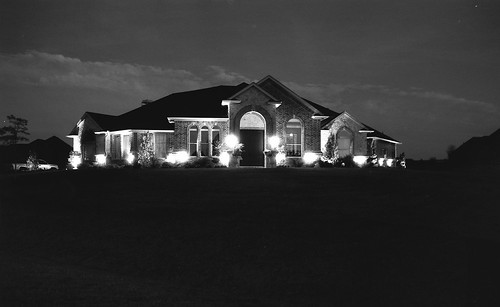
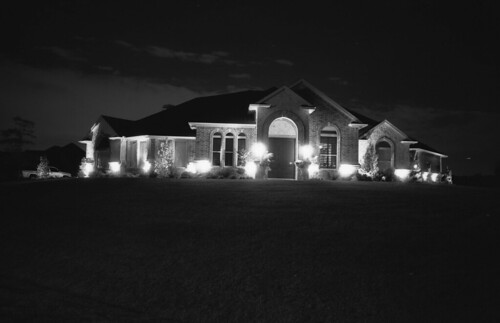
I took the pictures I wanted to take last night, and developed one half of the roll in T-Max 1:9 with minimal agitation, and the other half in T-Max 1:4 with normal agitation.

Here is the one developed 1:9 for 20 minutes, with gentle agitation once every 5 minutes:

2739156862_f665d056e0.jpg


And the one developed in 1:4 for 6.25 minutes with agitation 5 seconds every 30 seconds:

2739156560_a15d24e625.jpg


They don't look that much different to me (as far as the lights on the side of the house go). The highlights seem blown in both negatives. I am going to have to try the pyrocatechin or something.

Does anyone have any ideas on how to use T-Max or HC-110 (or Rodinal) as a compensating developer?

Thanks,
Nick
 

Larry Bullis

Subscriber
Allowing Ads
Joined
May 23, 2008
Messages
1,265
Location
White Rock, B.C. Canada
Format
Multi Format
Does anyone have any ideas on how to use T-Max or HC-110 (or Rodinal) as a compensating developer?

Regardless of what you do you will lose the light sources, unless you use the tanning properties of a staining developer to confine development to the surface area of the film. Mixing pycht is not that hard.

Here's the Windisch formula:


Solution A:
Water......... 100.00 ml.
Pyrocatechin.. 8.00 g.
Sodium Sulphite 1.25 g.
Solution B:
10% Sodium Hydroxide Solution
("Red Devil" lye works just fine)
This formula is reproduced in a wide variety of sources.

For the more active version, as Windisch wrote it:

use 1000 ml. H20, 24 ml. solution A, 12 ml. solution B

I use it more diluted for most, but not all films. Here's how I dilute it for tri-x, which I shoot at 160 ISO with it.

1000 ml. H2O, 16 ml. solution A, 9 ml. solution B

Tri-x, with a one minute presoak, 7 min. developing time, standard agitation.

Here's from my notes, regarding printing these things:

These negatives will look somewhat brown and unimpressive but this is deceptive. They print very nicely on Graded paper. Note that a somewhat odd scale, high contrast at the low end and flat at the high end will result if these brown negatives are printed on polycontrast type emulsions. This can be used to advantage sometimes, but sometimes it looks strange. Also, the low filters tend to be closer together, the higher filters spread out more. A lot of contrast is possible to achieve using the highest filters, because the blue of the filter in combination with the yellow of the negative results in very high printing density. Likewise, with graded papers, the brown gives a lot of printing density because the paper is sensitive only to blue light. In evaluating these brown negatives with a densitometer, a blue filter must be used and the value of the filter subtracted from all of the readings for the same reason.
 

Les McLean

Subscriber
Allowing Ads
Joined
Oct 18, 2002
Messages
1,606
Location
Northern Eng
Format
Multi Format
Does anyone use any certain techniques or rules of thumb when trying to compress the dynamic range of a scene? I need to make these exposures soon and don't have time to do a whole bunch of testing first, so I was hoping for a good starting point.

Thank you,
Nick


You might want to try another method of photographing buildings at night instead of using compensating development.

The method involves making two exposures made from a tripod, one made at dusk when the rooms of the building are not lit. This will be quite a long exposure to record information in the darkest areas of the building. Wait until darkness arrives and the building is lit, make a second much shorter exposure for the bright highlights which will have little or no effect on the information recored by the first longer exposure. Develop the negative normally and you will have detail in both shadows and highlights anda negative of reasonably normal contrast and densities that will print without too many problems.
 

df cardwell

Member
Allowing Ads
Joined
Jul 16, 2005
Messages
3,358
Location
KY USA
Format
Multi Format
And yet another way. TMY & XTOL (say, 1+2) will give you a perfectly linear scale of 14 stops,
at EI 400 and agitation every minute. The only problem will be how you fit all those highlights into your print
(unless you are scanning the negs in which case it will all fall out as easy as you please).
[Beyond thouse 14 stops, there is a shoulder that will squash anything else that might be out there
rendering it as a nice glow.]


Using a two bath developer makes it quite straightforward. (Les has a fine article about Two Bath
hereabouts:
(there was a url link here which no longer exists))

This film and developer combination was designed by Kodak to do exactly what you want do.

An excellent place to begin is 13 minutes at 68Ëš.
 
OP
OP
kodachrome64

kodachrome64

Member
Allowing Ads
Joined
Jun 2, 2008
Messages
301
Location
Dallas, TX
Format
Medium Format
I am scanning, so that is the final destination. Does that mean it is possible to capture all of this range on a negative? I'll have to look at the divided developer solution; is that for negatives too, or just for paper?

Thanks,
Nick
 

Paul Howell

Subscriber
Allowing Ads
Joined
Dec 23, 2004
Messages
10,088
Location
Scottsdale Az
Format
Multi Format
I am scanning, so that is the final destination. Does that mean it is possible to capture all of this range on a negative? I'll have to look at the divided developer solution; is that for negatives too, or just for paper?

Thanks,
Nick

Although there are 2 bath paper develpers most divided developers are for film. Dividied D 23, D 76, Dianfine, Dixetol (SP?) list a few.
 

Larry Bullis

Subscriber
Allowing Ads
Joined
May 23, 2008
Messages
1,265
Location
White Rock, B.C. Canada
Format
Multi Format
Mostly for film. In the example I linked to above, I used Windisch in a divided development scheme. That is, I'm using two rather extreme solutions to the problem simultaneously. Worked beautifully. Either alone would have improved vastly over the normal, but both together, well, I wonder if that's how Edgerton processed the atomic bomb pictures!
 

RobC

Member
Allowing Ads
Joined
Nov 5, 2007
Messages
3,880
Location
UK
Format
Multi Format
That's a nice shot and looks good the way you developed it.

I took the pictures I wanted to take last night, and developed one half of the roll in T-Max 1:9 with minimal agitation, and the other half in T-Max 1:4 with normal agitation.

Here is the one developed 1:9 for 20 minutes, with gentle agitation once every 5 minutes:

2739156862_f665d056e0.jpg


And the one developed in 1:4 for 6.25 minutes with agitation 5 seconds every 30 seconds:

2739156560_a15d24e625.jpg


They don't look that much different to me (as far as the lights on the side of the house go). The highlights seem blown in both negatives. I am going to have to try the pyrocatechin or something.

Does anyone have any ideas on how to use T-Max or HC-110 (or Rodinal) as a compensating developer?

Thanks,
Nick

See "the negative" around page 227 where he describes using HC110 as a compensating developer with TRI-X
 

df cardwell

Member
Allowing Ads
Joined
Jul 16, 2005
Messages
3,358
Location
KY USA
Format
Multi Format
I am scanning, so that is the final destination. Does that mean it is possible to capture all of this range on a negative?

YES YES YES YES !!!!! Shooting TMY in XTOL will give you full control of the image during or after scanning... or printing.

FP4 is ALMOST as good, but slower, and more reciprocity failure. There IS a reason these films were made !

Simply expose for the shadows, and carry on. Bracket if you feel paranoid.
 

Larry Bullis

Subscriber
Allowing Ads
Joined
May 23, 2008
Messages
1,265
Location
White Rock, B.C. Canada
Format
Multi Format
More on compensation; example

You almost have me ready to try it, Don. I'm so addicted to my complicated alchemical shenanigans, though, that it is hard to imagine using anything that simple. My only "conscious" reservation about it has to do with the principle that "there are no straight lines in nature"; why would I want a characteristic curve that is a straight line? Well, why not give it a shot?

So I went over to the storage place and pulled that restaurant job's negatives. They have to be some of the more interesting ones in my files of interesting negatives. I have scanned one similar to the one I posted and done an assemblage of light to dark versions to show the extremity of what this combination of pyrocatechin and bleach will do. I tried to figure up how many zones this manages to contain. I gave up. I lost count. A LOT of zones! Anyway, you can get an idea, when you figure that the exposure was probably about 1/8 or at most 1/15 second at around f/5.6, and the view outside was in full sun. I wasn't using 2475 as I thought, but tri X. I rate XXX with this developer at 160 ISO. So according to the law, the exposure outside would be normally 1/160 at f/16. Hmmm.

Here's where to see it: http://www.pbase.com/bullis/image/101338246

How do I remember the exposure from 30 years ago? I've been using this job as an example in my lectures at school when we are talking about hand holding the camera at slow shutter speeds.

I should note that in the version that is at the far right (showing the dome out the window) I did enhance the contrast so the viewer could get a better idea of what is out there.
 

df cardwell

Member
Allowing Ads
Joined
Jul 16, 2005
Messages
3,358
Location
KY USA
Format
Multi Format
why would I want a characteristic curve that is a straight line?

Input = Output is handy.

I'm happy when all the subject's details and tones are sitting on the negative where I can fetch them as I need them !

A dish of Beer's 1 and a dish of Beer's 7 (or pure Solution B with a wee bit extra Bromide) and I can curve reality as much as I want to ! :surprised:
 

Larry Bullis

Subscriber
Allowing Ads
Joined
May 23, 2008
Messages
1,265
Location
White Rock, B.C. Canada
Format
Multi Format
Input = Output is handy.

Yes, as one means for perhaps a majority of circumstances. One of the things I most dislike about digital is the lack of form in the curve.

There are advantages to the shape of the curve that traditional films give us. I've spent a good deal of my life learning to turn its peculiar limitation to my advantage, and have got fairly good at it. I've grown to love that shape and the challenges it presents me with. Not that it is the only means; it's not. I like to have all the tools available to me so I can choose among the menu of limitations to give me the best fit for my particular needs.

I'm going to try your method and I'll certainly let you know what I find. I'm interested. It may take a while. I can't get much in the way of darkroom stuff here locally anymore.
 

dancqu

Member
Allowing Ads
Joined
Sep 7, 2002
Messages
3,649
Location
Willamette V
Format
Medium Format
I need to make some exposures at night of a lighted house,
similar to taking street pictures with street lights in the scene.

I'd be tempted to try Delta 3200. It is reputed to
be a low contrast film suitable for pushing; in fact
needs to be pushed to reach 3200.

Don't push though, PULL. Dan
 

RobC

Member
Allowing Ads
Joined
Nov 5, 2007
Messages
3,880
Location
UK
Format
Multi Format
What I am trying to accomplish now is something I don't have time to do a lot of testing for first. I need to make some exposures at night of a lighted house, similar to taking street pictures with street lights in the scene. My idea is to use reduced agitation or stand development to develop the shadows without blowing out the highlights, which is quite easy in scenes of this type (in my experience).

If its quite easy in your experience to do this, then why are you asking?
 

Shawn Dougherty

Member
Allowing Ads
Joined
Jul 22, 2004
Messages
4,129
Location
Pittsburgh
Format
Multi Format
I have been working out a method for using Tmax100 in 135mm at night for well over a year now. After much testing and printing I've found the following to be nearly bullet proof.

For scenes of average contrast at night (up to 5ish stops of value you wish to hold).
I meter and expose as I normally would, TMX100 rated at about 64 and BRACKET.
Develop one roll in a two reel tank at 1:125 Rodinal semi-stand for 48 minutes. That's agitation for the first minute then for 20 seconds or so at the halfway point. PRESOAK the film.

For scenes of crazy contrast at night (6 stops or more).
Place the low values where you wish to hold some detail high on zone 5 (that part is KEY) and BRACKET.
Develop one roll in a two reel tank at 1:200 Rodinal semi-stand for 30 minutes. That's agitiation for the first minute then for 20 seconds or so at the halfway point. PRESOAK the film.

I've found this to be nearly bullet proof for any night scene I've encountered. Take a look at my APUG Gallery, specifically "Front Yard In Snow at Night". This was lit entirely by the light behind the tree branch at the top... I've got many other examples but not all of them are in the gallery or on my website at this time. I hope this helps you. All the best. Shawn
 
OP
OP
kodachrome64

kodachrome64

Member
Allowing Ads
Joined
Jun 2, 2008
Messages
301
Location
Dallas, TX
Format
Medium Format
Thank you Shawn, that's exactly the kind of suggestion I was hoping for. Good thing I got my two-reel tank and Rodinal today! Between your suggestion and dfcardwell's, I have a starting point.

I'm asking because I haven't tried it with this film or with long exposures, but I've been successful in holding back the highlights using stand development with TMY pushed in TMAX. I was looking for a way to do this with TMX and maybe some other developers...something that would work in night scenes with lights.

Thank you everyone.
 
OP
OP
kodachrome64

kodachrome64

Member
Allowing Ads
Joined
Jun 2, 2008
Messages
301
Location
Dallas, TX
Format
Medium Format
Shawn,

Why the shorter time in higher dilution? Excuse me if the answer is obvious, but I'm new to stand development.

Thanks!
Nick
 

Shawn Dougherty

Member
Allowing Ads
Joined
Jul 22, 2004
Messages
4,129
Location
Pittsburgh
Format
Multi Format
Nick,
I'm NOT a technical person. I do test materials and kind of happened upon this based on the techniques of a few different people. The 1st (50minute at 1:125) method seems to exhaust the developer enough to control highlights with scenes up to 5 or even 6 stops - if you're willing to give up some shadow detail. I do this only at night so some lack of shadow detail is to be expected. With scenes of extremely high contrast, 6+ and even considerably more, simply increasing the dilution did not effectively control highlights. I assumed the developer was not being exhausted so I cut the time in addition to my original increase in dilution. It worked. This is how I came up with the 2nd (30minute @ 1:200) method. The real key to the second variation is the exposure increase. The area where you want detail in the dark areas needs to be placed high on zone 5. The only drawback I see is the longer waits and I like to bracket... I'm sure someone else could explain how it works better than me... Hope it can help you. All the best. Shawn
 
Photrio.com contains affiliate links to products. We may receive a commission for purchases made through these links.
To read our full affiliate disclosure statement please click Here.

PHOTRIO PARTNERS EQUALLY FUNDING OUR COMMUNITY:


Ilford ADOX Freestyle Photographic Stearman Press Weldon Color Lab Blue Moon Camera & Machine
Top Bottom