• Welcome to Photrio!
    Registration is fast and free. Join today to unlock search, see fewer ads, and access all forum features.
    Click here to sign up

Comparing in camera exposures with enlarger exposures for film testing

Recent Classifieds

Forum statistics

Threads
201,849
Messages
2,831,116
Members
100,984
Latest member
Larrygaga00
Recent bookmarks
0

timparkin

Member
Allowing Ads
Joined
Sep 2, 2006
Messages
212
Format
35mm
Hi,

I'd like to test some photographic film using a stouffer step wedge but am having problems relating enlarger exposure to in camera exposure.

e.g. How do I set my enlarger to match a camera exposure on a 50mm lens of 1s at f/22? I don't want to expose the film in camera because of f/stop is not equal to t/stop and vignetting comes in etc. Plus it's easier to expose under an enlarger.

I have a feeling this should be simple but it's not working for me at the moment! HELP! :smile:

Tim
 

bernard_L

Member
Allowing Ads
Joined
Feb 17, 2008
Messages
2,133
Format
Multi Format
I've been thinking about this myself. Crux of problem (as I see it): for in-camera exposure, the meter meters the scene luminance (reflected reading; incident reading would throw in an extra variable: target reflectance); for under-enlarger exposure, meter is in film plane. Two possibilities:
(A) Proper photometry calculation. But it's easy to miss a factor of Pi here or there.
(B) Transfer a reflected-light measurement of gray card to a measurement of same gray card as seen by meter in the focal plane of the camera; deduce the proper way to interpret a measurement still with same meter on the enlarger baseboard into an exposure time. Second method is not "absolute", insofar as it integrates the difference between F-stop and T-stop for the particular lens used, but from a practical standpoint, that is maybe what one should do.

I'd be happy to elaborate on (A) and (B) by PM, and to jointly post the outcome if we agree. I'm not keen on starting a forum discussion on photometry, solid angles, and the like.
A caveat: I have read that a typical ISO speed (meaning, on the scale of films) for Ilford MGIV is ISO 5. Meaning that exposure times for film under typical enlarger conditions are going (IMO) to be too short to be accurate, which might void the whole exercise. Unless the film is under a step wedge, and zone V is set to be under the D=2.0 patch.
Possibly the way to go is some DIY sensitometer, with a LED light source and some electronics allowing accurate timing of short exposure times.
 
OP
OP

timparkin

Member
Allowing Ads
Joined
Sep 2, 2006
Messages
212
Format
35mm
I've been thinking about this myself. Crux of problem (as I see it): for in-camera exposure, the meter meters the scene luminance (reflected reading; incident reading would throw in an extra variable: target reflectance); for under-enlarger exposure, meter is in film plane. Two possibilities:
(A) Proper photometry calculation. But it's easy to miss a factor of Pi here or there.
(B) Transfer a reflected-light measurement of gray card to a measurement of same gray card as seen by meter in the focal plane of the camera; deduce the proper way to interpret a measurement still with same meter on the enlarger baseboard into an exposure time. Second method is not "absolute", insofar as it integrates the difference between F-stop and T-stop for the particular lens used, but from a practical standpoint, that is maybe what one should do.

I'd be happy to elaborate on (A) and (B) by PM, and to jointly post the outcome if we agree. I'm not keen on starting a forum discussion on photometry, solid angles, and the like.
A caveat: I have read that a typical ISO speed (meaning, on the scale of films) for Ilford MGIV is ISO 5. Meaning that exposure times for film under typical enlarger conditions are going (IMO) to be too short to be accurate, which might void the whole exercise. Unless the film is under a step wedge, and zone V is set to be under the D=2.0 patch.
Possibly the way to go is some DIY sensitometer, with a LED light source and some electronics allowing accurate timing of short exposure times.

Yes I figured it's either complex maths or experimentation but hoped somebody had been there before me... Thanks for the offer. When I've done my calculations I'll send them over to see if you agree..

Anybody else thought about this? Not after perfect accuracy but 0.1 stop would be great 1/3 stop would be adequate..

Tim
 

Chan Tran

Subscriber
Allowing Ads
Joined
May 10, 2006
Messages
7,149
Location
Sachse, TX
Format
35mm
If I am correct the stoffer step wedge is a strip of negative film with different density on it. Tell me how you expose for the step wedge using your camera then I can figure out how to do the same thing with the enlarger.
 

RobC

Member
Allowing Ads
Joined
Nov 5, 2007
Messages
3,880
Location
UK
Format
Multi Format
What focal length is your enlarger lens? Does your enlarger show the magnification factors for that focal length on its column?
 

RobC

Member
Allowing Ads
Joined
Nov 5, 2007
Messages
3,880
Location
UK
Format
Multi Format
Swing your enlarger diffusion filter into place and leave it there. Then take a meter reading at the baseboard using an incident meter.
You need to know the aperture the enlarger is using which is enlarger aperture setting adjusted for lens extension, i.e. magnification factor. You can read this off the enlarger column if it has it and calculate or calculate from the lens board to baseboard distance to give you the effective aperture using standard formulas. Use the effective aperture in your incident meter setting and you should get the required time for exposure.

Goto following page and select on left menu Pre-designer/install

http://winlens.de/index.php?id=15

download and install. This software will do the maths for you and tell you the effective aperture once you've figure out how to use it.
 
Last edited by a moderator:

Jim Noel

Member
Allowing Ads
Joined
Mar 6, 2005
Messages
2,261
Format
Large Format
It is much simpler to do it in camera. The Stouffer 21 step wedge which is graduated in 1/2 stops, will fit at an angle on a piece of 4x5 film. Put the film in the holder then tape the ends of the step wedge on it.
focus the camera on infinity, then aim it at a smoothly lit surface. I use the north side of my house. Meter the surface and place the reading on Zone X and make the exposure. I usually make at least three of these and develop these for different times, or in different dilutions to determine what I want in this regard.
 
OP
OP

timparkin

Member
Allowing Ads
Joined
Sep 2, 2006
Messages
212
Format
35mm
Tape it to a piece of 5x4 film and expose... or is it a trick question?
 
OP
OP

timparkin

Member
Allowing Ads
Joined
Sep 2, 2006
Messages
212
Format
35mm
Swing your enlarger diffusion filter into place and leave it there. Then take a meter reading at the baseboard using an incident meter.
You need to know the aperture the enlarger is using which is enlarger aperture setting adjusted for lens extension, i.e. magnification factor. You can read this off the enlarger column if it has it and calculate or calculate from the lens board to baseboard distance to give you the effective aperture using standard formulas. Use the effective aperture in your incident meter setting and you should get the required time for exposure.

Goto following page and select on left menu Pre-designer/install

http://winlens.de/index.php?id=15

download and install. This software will do the maths for you and tell you the effective aperture once you've figure out how to use it.

Thanks! I'm doing that now :smile:
 

RobC

Member
Allowing Ads
Joined
Nov 5, 2007
Messages
3,880
Location
UK
Format
Multi Format
OK - learning curve :smile:

If you tell me the focal length of your enlarger lens and its working aperture range then I can give you a few pointers. i.e. a screen print which will show you the paramters to set wjich may speed things up somewhat.
 
OP
OP

timparkin

Member
Allowing Ads
Joined
Sep 2, 2006
Messages
212
Format
35mm
If you tell me the focal length of your enlarger lens and its working aperture range then I can give you a few pointers. i.e. a screen print which will show you the paramters to set wjich may speed things up somewhat.
I don't have the enlarger yet. Was going to get a medium format one off eBay to get me going
 

RobC

Member
Allowing Ads
Joined
Nov 5, 2007
Messages
3,880
Location
UK
Format
Multi Format
I have rethought about this. Don't use the enlarger diffuser. Just put light meter on baseboard.
Example below uses 80mm lens at F8. The lens to baseboard distance needs to be 220mm which gives effective aperture of F22. Setting this height is tricky because you can only measure to enlarger lens board when it should really be to lens principal point which may not be exactly the same and in fact could be some way out if lens is not on a flat board.
Now that I look you can measure "total track" which is from baseboard to enlarger negative plane, where it would be if you were using one. But use "image distance" setting and not "total track" setting. i.e. use setting variables as below.

Set meter to F22 and film speed. Then adjust enlarger ND to get meter to output 1 Second. You may need to add additional ND above the lens in the form of Lighting ND filters as enlarger built in ND may not be enough.

I am assuming contact printing step wedge to film on basboard.

I think that will work. However, your enlarger lens is not the same as your camera taking lens and won't match it exactly for light absorption so the level of accuracy is debateable.

For other lens focal lengths or desired effective aperture change the focal length and f-no setting and play with image distance setting until desired effective aperture is given.

attachment.php


p.s. I'm now thinking this method is going be impossible to get 100% correct and that doing it in camera may be more accurate.

Someone else was attempting something similar recently using an IPad. Don't know if they resolved best way of doing it.
 
Last edited by a moderator:

Bill Burk

Subscriber
Allowing Ads
Joined
Feb 9, 2010
Messages
9,469
Format
4x5 Format
I used a piece of glass, a 21-step grayscale, and laid a 2-stop (0.6) ND filter on the densest part of the scale (so it reaches 3.6 density).

On top of a TMY-2 sheet of film. (Part covered so you can make another test).

Metered at the baseboard of enlarger, adjusting lens aperture until meter reads EV-0 (at ISO 100).

Expose for 5 seconds.

Then remove the 2-stop ND filter and expose the other side of the film for 5 seconds.

These are the exposures I found made useful test strips under my enlarger for a 400 speed film.
 

bernard_L

Member
Allowing Ads
Joined
Feb 17, 2008
Messages
2,133
Format
Multi Format
It is much simpler to do it in camera. The Stouffer 21 step wedge which is graduated in 1/2 stops, will fit at an angle on a piece of 4x5 film. Put the film in the holder then tape the ends of the step wedge on it.
focus the camera on infinity, then aim it at a smoothly lit surface. I use the north side of my house. Meter the surface and place the reading on Zone X and make the exposure. I usually make at least three of these and develop these for different times, or in different dilutions to determine what I want in this regard.
+1 The method proposed by Jim Noel is, IMO, the only one so far proposed that works. However, the OP's "to match a camera exposure on a 50mm lens " seems to imply that he's a 35-mm shooter.

@ Bill Burk; I can see how you procedure will help you properly expose a piece of film under your enlarger, e.g. to make an inter-negative. But I do not see how it allows you to find out that film is ISO400 or ISO200, or.... The OP asked for a way to relate to an ordinary camera exposure.

@ RobC; Looked up the manual for the optics CAD package that you propose to the OP to "do the maths for you". It's ray optics, plus some gaussian beams, no photometry; the closest I found relating to the OP's question is 3.3 Standard camera F-stop settings, that relates f-stops to an EV scale. No need for a CAD package to figure out that a 80mm FL lens set at f:8 (80/8=10mm pupil) when seen from a distance of 220 mm produces a beam with an effective aperture 10mm/220mm=1/22.

Set meter to F22 and film speed. Then adjust enlarger ND to get meter to output 1 Second.
Remember the OP's request: "to match a camera exposure on a 50mm lens of 1s at f/22". A method that works on the enlarger baseboard should work also in the actual camera film plane, right?
FM2+35/2. Find a wall inside that reads 1" f/22 ISO100. Set aperture to f/22. What illumination is seen from the position of the film? Open back, trip shutter in Bulb. Have meter (Sekonic 308) stare at the back of the lens (sphere off). Meter says 1" f/2.8+2/3EV. Not 1" f/22. While I'm not surprised, I won't embark into explanations. It's an experiment that any body can perform for him/herself, and the experiment trumps all arguments.

Probably the biggest drawback of method(s) using an enlarger is the mismatches of:
- enlarger lamp spectrum to daylight spectrum, we're talking something like 3200K versus 5800K.
- light meter versus film spectral sensitivities; Selenium (not bad...) CdS (red-sensitive, will overestimate the effectiveness of incandescent light) blue-enhanced Si
The impact of these spectral mismatches is potentially larger than the difference between F-stop and T-stop. As far as I'm concerned that is a show-stopper for the enlarger-based solution(s).

I've been doing sensitometry using the reflective steps included in the Kodak Professional Photoguide. But, under uncontrolled lighting, the specular reflections alter the values of the darker patches. I make do with bracketed (+/-3EV), overlapping exposures, concistency check, and elimination of inconsistent values. But that is a bit complicated. Lacking a LF camera, a better solution might be to take a pic of a 4x5" Stouffer transmission wedge, with proper percautions against flare, and provided the resulting patches are large enough to read with the densitometer. Or, embark into the construction of a DIY sensitometer, using a Stouffer T2115 or T3110, well matched to a strip of 35mm film.

 

ic-racer

Member
Joined
Feb 25, 2007
Messages
16,729
Location
USA
Format
Multi Format
How do I set my enlarger to match a camera exposure

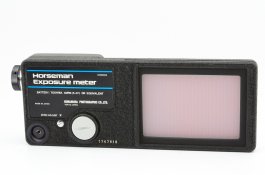
I use a film-plane exposure meter, like the Horseman. Otherwise, if you are using a camera light meter, you need to use this equation.
Film%20plane.jpg
 

RobC

Member
Allowing Ads
Joined
Nov 5, 2007
Messages
3,880
Location
UK
Format
Multi Format
Ooops I was wrong. But if you can meter at the negative plane of the enlarger and get a reading of f22 for 1 second, then the way I have described setting the enlarger to height for an effective aperture of f22 should be correct.

i.e. enlargers are cameras. The object is the negative stage and the image is the baseboard/print stage. So meter the object (the negative stage) is the correct thing to do.

So if you set your enlarger height as I suggested above which gives you your f22 effective aperture. Then take off the lens and put your meter wher the lens was point up and take a reading. Then adjust enlarger ND until meter says f22 for 1 second and then put lens back on. This should give you what you want I think.

However, I think its still ball park and not 100% when compared directly to a camera with a camera lens on it.
 

Bill Burk

Subscriber
Allowing Ads
Joined
Feb 9, 2010
Messages
9,469
Format
4x5 Format
@ Bill Burk; I can see how you procedure will help you properly expose a piece of film under your enlarger, e.g. to make an inter-negative. But I do not see how it allows you to find out that film is ISO400 or ISO200, or.... The OP asked for a way to relate to an ordinary camera exposure.

You get a test strip that covers a wide range of exposures (a 21-step scale gives 10 f/stops worth of exposure range).

The experiment setup is simple. Aim to get the whole scale on film, so the resulting developed negative has step densities that approach zero (near base plus fog).

Graph the results and note the x-axis point on the graph where the density crosses 0.10 above base plus fog.

The x-axis position where the graph crosses 0.10 above base plus fog is the point used to determine the ISO speed of film (sometimes called the speed point).

Use fresh film from a trusted manufacturer (they tested ISO under stringent lab conditions).

Develop the film, to the best of your ability, to meet ISO conditions (I call it "hitting the ASA triangle").

The x-axis position of the graph of the best test strip sample you developed can be calculated backwards to the exposure in meter candle seconds specified in the ISO formula for that speed of film.

You will then have an experimentally-determined exposure that you can compare to theory.

This setup worked so well for me that if something were to happen to my EG&G sensitometer, I'd rig together things I have on hand, a small Durst enlarger with its PH212 incandescent bulb and a voltage stabilizer and an 80b filter. I'd recommend picking up a cheap 35mm camera body with electronic shutter and use an exposure between 1 and 1/100 second.

I did this experiment near the end of this thread...

(there was a url link here which no longer exists)
 

bernard_L

Member
Allowing Ads
Joined
Feb 17, 2008
Messages
2,133
Format
Multi Format
@ ic-racer. The equation is sure impressive, but please give the reference (book, article, chapter, page) so that one can know, rather than guess, the meaning of the various symbols.

@ Bill Burk. "Use fresh film from a trusted manufacturer (they tested ISO under stringent lab conditions). Develop the film, to the best of your ability, to meet ISO conditions (I call it "hitting the ASA triangle")." OK, OK, so you are proposing, instead of an ab initio determination, to base all "enlarger baseboard" sensitometry on one supposedly known film?

(there was a url link here which no longer exists)
Indeed, that thread (pointed out by Bill Burk) is full of useful information (altough it tends to drift into the nuts and bolts of sensitometer models). My take from that thread is that serious work is done with a sensitometer.

Proposal for a less-than-ideal method without a sensitometer.
- Point camera at uniform and reasonably neutral-color surface. Meter that surface for a nominal (say, 100) ISO (camera or hand-held meter). Say to be concrete: 1/15" f/5.6. Avoid using a "fast" aperture, like f/2. That is because in a subsequent step, the exit pupil must be small enough to fit near the peak of the angular response of the light meter.
- Open shutter (Bulb) with aperture f:5.6. There is a certain illumination (XX lux) in the film plane (block stray light, etc...). Film needs that illumination for a duration of 1/15" to hit zone V. Remember the 1/15", forget the f:5.6. We need to transfer that XX lux to the enlarger baseboard. But we do not have a luxmeter.
- Take light meter, just plain, no spotmeter, no incident attachment. As long as illumination is reasonably close to on-axis, that meter can be used as a luxmeter, up to an unknown calibration constant. Set to nominal ISO (assumed 100 above). Place input of light meter against film gate. Measure exposure in EV (or derive it from any valid combination of speed and f-stop). My 308B measures to 1/10 EV (precision, not accuracy). Note that down.
- On enlarger baseboard, position light meter (just like previously) at the baseboard (where the film will be) and adjust f-stop, etc, until lightmeter reads same number of EV as previously. Now a nominal 100ISO film exposed on that baseboard, in that illumination, for 1/15", will reach zone V.
- Sekonic 308B measures "broadside" and can stare towards the enlarger lens while laying flat on board. Other "end-fire" meters may be more problematic.

That is just the basic steps to connect ordinary scene readings with enlarger baseboard exposure. Of course, you will place a step wedge above the film, and you want more than zone V exposure for the clear patch of the wedge. And you actually don't need to match the EV on the baseboard to that in the film gate; what is important is to make a note of the difference and take it into account in the sensitometry plots. Other points:
- color temperature of light, which I pointed out above, and also mentioned in the thread quoted by Bill Burk. 80B filter?
- accuracy of exposure times. Also discussed in that thread. An enlarger lamp has significant turn-on and turn-off times. No way to turn on-off for 1/10"; on the other hand times 1" and longer are subject to reciprocity failure. Not much room for valid times, unless one uses a shutter, as already suggested by B.B.
This answers the question of the OP, as far as I understood it correctly. But the enlarger baseboard may not be the best way to expose test strips; another topic.
 
Joined
Jan 7, 2005
Messages
2,739
Location
Los Angeles
Format
4x5 Format
@ ic-racer. The equation is sure impressive, but please give the reference (book, article, chapter, page) so that one can know, rather than guess, the meaning of the various symbols.

It's the classic exposure equation. This one is from the Jack Holm article, Exposure-Speed Relations and Tone Reproduction which can be found http://64.165.113.140/content/benskin/ When the camera is focused at infinity, the variables F and i can be removed leaving:

H = (q*L*t / A2) * Hf

In truth relative speed is the best that can be expected. The main reason to test with a step tablet is to determine processing. Phil Davis' Beyond the Zone System has a pretty good method using an enlarger to exposure a step tablet.
 
Last edited by a moderator:

ic-racer

Member
Joined
Feb 25, 2007
Messages
16,729
Location
USA
Format
Multi Format
A film-plane exposure meter, in case anyone is not familiar. A little off topic, but I have been using it in the darkroom lately. I have quite a few 35mm slides from the 1980s when I did Cibachrome. I'd like to print some of the slides again but in B&W. I use an enlarger to print the slides to panchromatic 4x5" sheetfilm. I use the Horseman film-plane exposure meter to estimate the exposure under the enlarger.
14411692553479540546-2.jpg
 

bernard_L

Member
Allowing Ads
Joined
Feb 17, 2008
Messages
2,133
Format
Multi Format
Exposure-Speed Relations and Tone Reproduction which can be found http://64.165.113.140/content/benskin/
Thank you. That folder/directory seems to contain other interesting documents.

In truth relative speed is the best that can be expected.
If you say so. And not a real problem for a single, consistent user. But results cannot be compared remotely...
 
Joined
Jan 7, 2005
Messages
2,739
Location
Los Angeles
Format
4x5 Format
Thank you. That folder/directory seems to contain other interesting documents.

Many of the key papers on exposure and film speed are represented.

If you say so. And not a real problem for a single, consistent user. But results cannot be compared remotely...

Exactly. There's a recent thread that dealt with a similar theme "Ipad as Sensitometer?" (there was a url link here which no longer exists)

Accurately determining speed is a question of knowable, repeatable exposures and the correct interpretation of the results.
 

Bill Burk

Subscriber
Allowing Ads
Joined
Feb 9, 2010
Messages
9,469
Format
4x5 Format
@ Bill Burk. OK, OK, so you are proposing, instead of an ab initio determination, to base all "enlarger baseboard" sensitometry on one supposedly known film?

Right. I begin with a non-primary assumption that fresh TMY-2 developed in a standard developer to meet ASA conditions = 400 speed. And I draw conclusions about the exposure by interpreting results working backwards from that assumption.
 

Bill Burk

Subscriber
Allowing Ads
Joined
Feb 9, 2010
Messages
9,469
Format
4x5 Format
The specific film doesn't matter, I use TMY-2 but it could be any film.

It would sure be nice to have a standard reference light source. Something that does not involve Bunsen burners or whales.
 
Photrio.com contains affiliate links to products. We may receive a commission for purchases made through these links.
To read our full affiliate disclosure statement please click Here.

PHOTRIO PARTNERS EQUALLY FUNDING OUR COMMUNITY:


Ilford ADOX Freestyle Photographic Stearman Press Weldon Color Lab Blue Moon Camera & Machine
Top Bottom