It is much simpler to do it in camera. The Stouffer 21 step wedge which is graduated in 1/2 stops, will fit at an angle on a piece of 4x5 film. Put the film in the holder then tape the ends of the step wedge on it.
focus the camera on infinity, then aim it at a smoothly lit surface. I use the north side of my house. Meter the surface and place the reading on Zone X and make the exposure. I usually make at least three of these and develop these for different times, or in different dilutions to determine what I want in this regard.
+1 The method proposed by Jim Noel is, IMO, the only one so far proposed that works. However, the OP's "to match a camera exposure on a 50mm lens " seems to imply that he's a 35-mm shooter.
@ Bill Burk; I can see how you procedure will help you properly expose a piece of film under your enlarger, e.g. to make an inter-negative. But I do not see how it allows you to find out that film is ISO400 or ISO200, or.... The OP asked for a way to relate to an ordinary camera exposure.
@ RobC; Looked up the manual for the optics CAD package that you propose to the OP to "do the maths for you". It's ray optics, plus some gaussian beams, no photometry; the closest I found relating to the OP's question is
3.3 Standard camera F-stop settings, that relates f-stops to an EV scale. No need for a CAD package to figure out that a 80mm FL lens set at f:8 (80/8=10mm pupil) when seen from a distance of 220 mm produces a beam with an effective aperture 10mm/220mm=1/22.
Set meter to F22 and film speed. Then adjust enlarger ND to get meter to output 1 Second.
Remember the OP's request: "to match a camera exposure on a 50mm lens of 1s at f/22". A method that works on the enlarger baseboard should work also in the actual camera film plane, right?
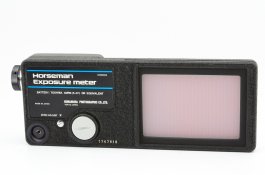
FM2+35/2. Find a wall inside that reads 1" f/22 ISO100. Set aperture to f/22. What illumination is seen from the position of the film? Open back, trip shutter in Bulb. Have meter (Sekonic 308) stare at the back of the lens (sphere off). Meter says 1" f/2.8+2/3EV. Not 1" f/22. While I'm not surprised, I won't embark into explanations. It's an experiment that any body can perform for him/herself, and the experiment trumps all arguments.
Probably the biggest drawback of method(s) using an enlarger is the mismatches of:
- enlarger lamp spectrum to daylight spectrum, we're talking something like 3200K versus 5800K.
- light meter versus film spectral sensitivities; Selenium (not bad...) CdS (red-sensitive, will overestimate the effectiveness of incandescent light) blue-enhanced Si
The impact of these spectral mismatches is potentially larger than the difference between F-stop and T-stop. As far as I'm concerned that is a show-stopper for the enlarger-based solution(s).
I've been doing sensitometry using the
reflective steps included in the Kodak Professional Photoguide. But, under uncontrolled lighting, the specular reflections alter the values of the darker patches. I make do with bracketed (+/-3EV), overlapping exposures, concistency check, and elimination of inconsistent values. But that is a bit complicated. Lacking a LF camera, a better solution might be to take a pic of a 4x5" Stouffer
transmission wedge, with proper percautions against flare, and provided the resulting patches are large enough to read with the densitometer. Or, embark into the construction of a DIY sensitometer, using a Stouffer T2115 or T3110, well matched to a strip of 35mm film.