• Welcome to Photrio!
    Registration is fast and free. Join today to unlock search, see fewer ads, and access all forum features.
    Click here to sign up

Comparing FUJIFILM DPII vs Crystal Archive (ADOX Color Mission)

Forum statistics

Threads
201,613
Messages
2,827,199
Members
100,850
Latest member
timpanic
Recent bookmarks
0

koraks

Moderator
Moderator
Joined
Nov 29, 2018
Messages
26,588
Location
Europe
Format
Multi Format
This one took me some time to (1) muster the courage for and (2) work out: https://tinker.koraks.nl/photography/on-a-color-mission-comparing-two-ra4-color-papers/

It goes into a question that has played in my mind for a few years, but that I never really answered very thoroughly: what really is the difference between entry-level Crystal Archive paper vs. the more premium DPII for optical enlargement? The blog post above attempts to answer that question. It features some 'clinical testing' involving step tablets as well as real-world samples of comparison prints. It's way too much to quote here, so please have a look at the link if this subject interests you. I'll quote part of the conclusion I arrived at here, and will include a few of the dirty pictures from the blog.
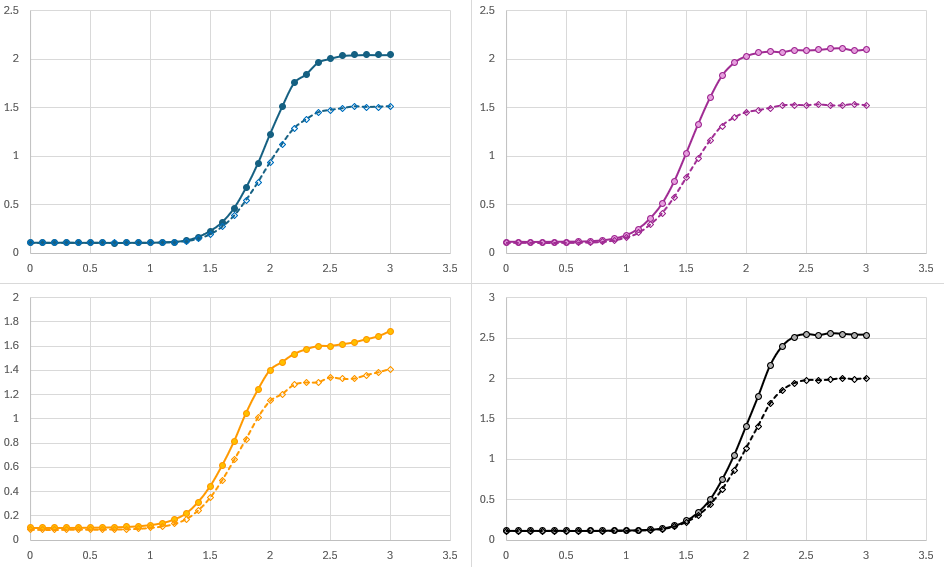
What to make of all this? First and foremost: there are differences between these papers, but in the grand scheme of things, they’re subtle. From an objective quality viewpoint, DPII is the better paper: it offers higher saturation, a larger gamut, deeper blacks and has no mottling issues. It also is coated on a thicker base, but whether that’s better, of course depends on what you’re after.

This is also true in general: while the objective advantage is to DPII, subjectively, you may prefer CA over DPII for certain purposes. The higher saturation of DPII also means that it’ll more readily emphasize color casts, and it’s overall a more ‘punchy’ look. So if you’re looking to print something in very neutral or more subdued hues, CA is an easier paper to work with. On the other hand, if you’re printing something that relies on areas of solid black or otherwise very deep or saturated tones, DPII is the better choice.

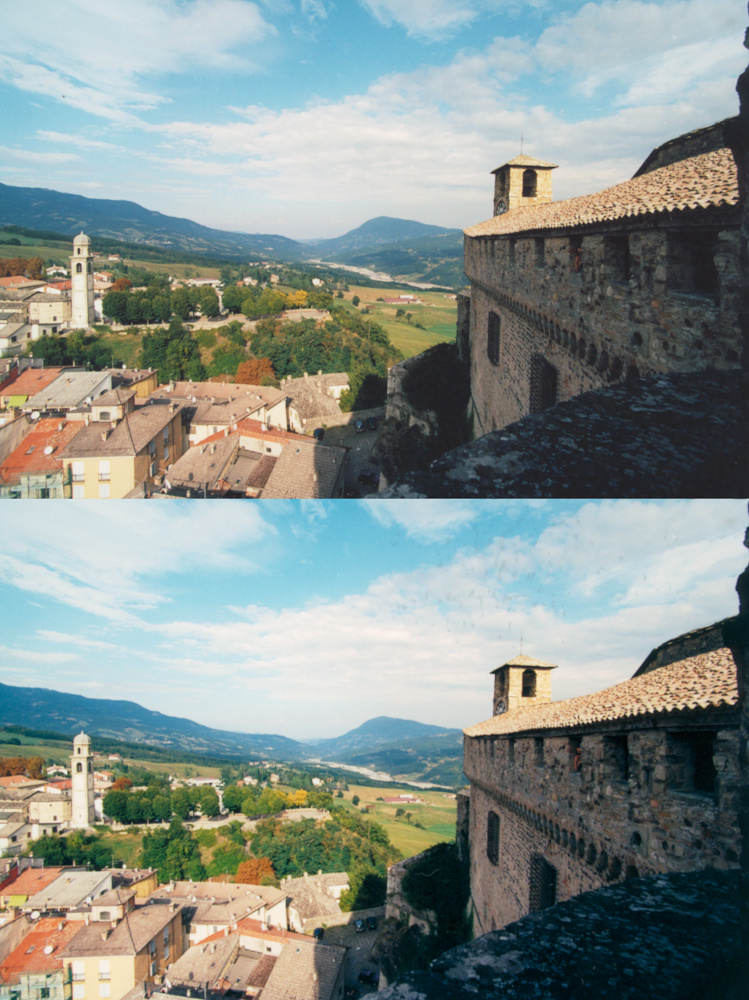
Last but not least: the printed examples below demonstrate in my view very clearly that both of these papers (and the in-between variants like CA Supreme) are by all means suitable for optical/analog enlargement of C41 color negatives as well as ECN2 negatives.

image-2.png

Density plots for DPII (solid line) and Crystal Archive (dotted), for cyan (top left), magenta (top right), yellow (bottom left) and makeshift-grey (bottom right).
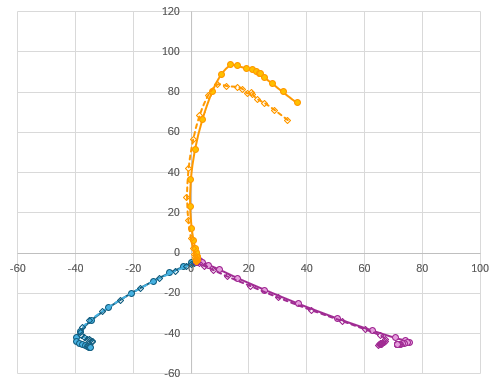
image-7.png

Color space/gamut plotted as a (horizontal) vs b (vertical) out of Lab for the dmax CMY patches; the larger gamut is DPII.


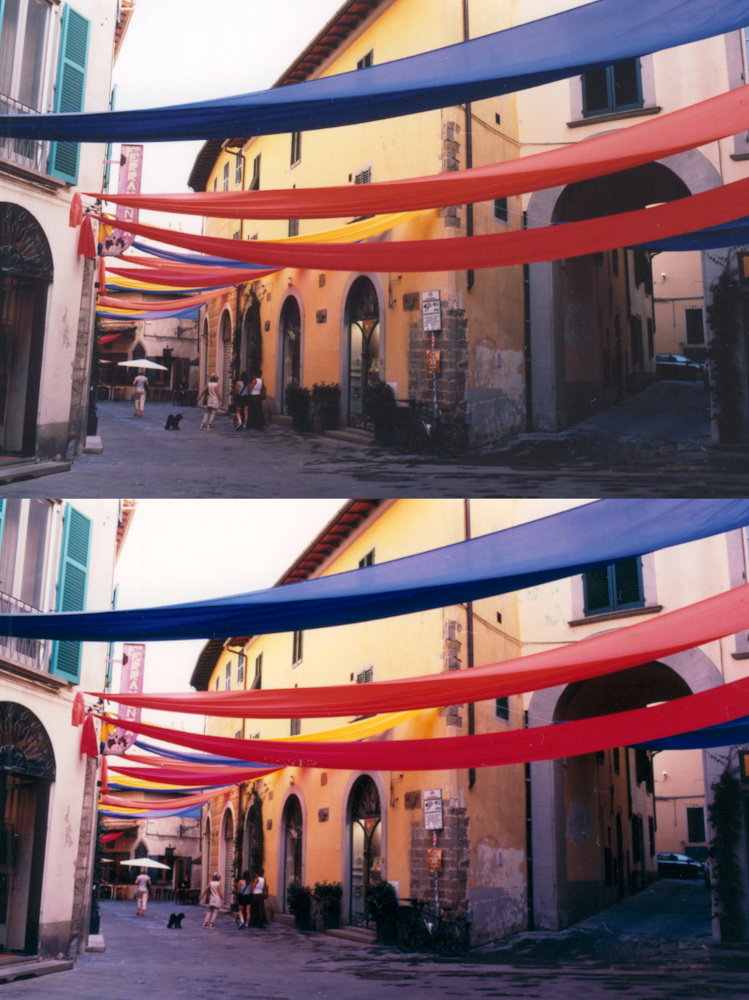
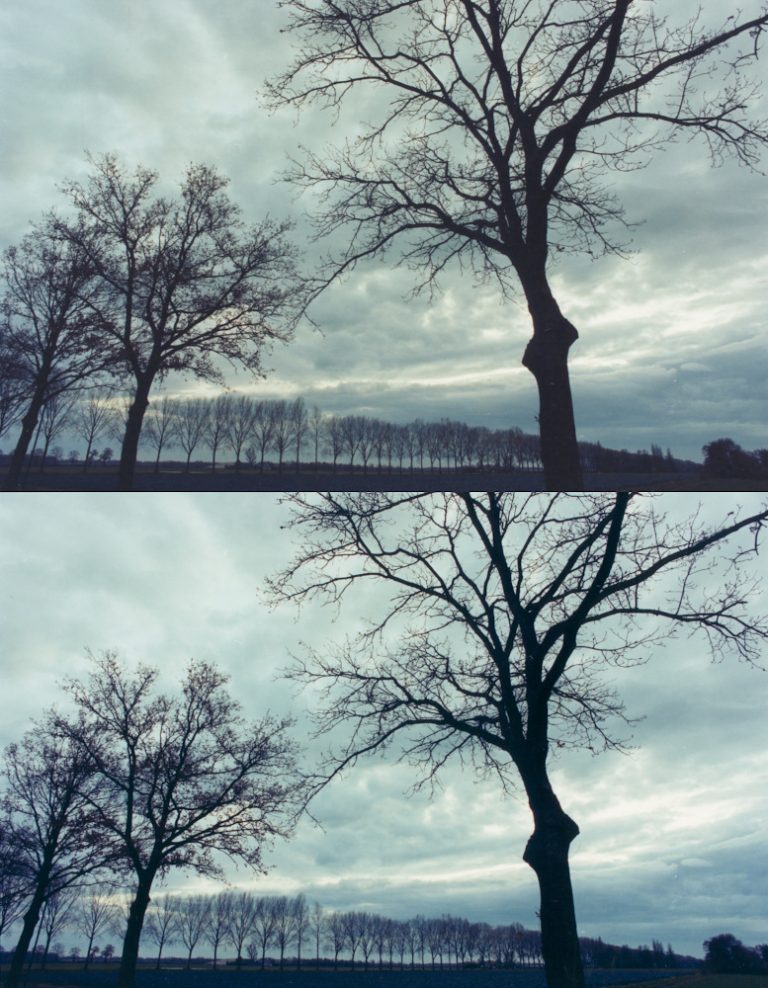
Example prints on Crystal Archive (top) vs. DPII (bottom); same negative, same color filtration, 20% longer exposure for the CA:
DPII_CA_EP_07w.jpg

(Kodak Ektar)

DPII_CA_EP_10w.jpg

(Kodak Ektar)

DPII_CA_EP_17w-768x988.jpg

(Kodak Vision3 250D in ECN2)

The blog also goes into questions about crossover insofar as I hadn't addressed those in an earlier blog, as well as the notorious phenomenon of the brown, mottled blacks of Crystal Archive. For the latter, I have what I believe is a pretty watertight explanation.
 

Film-Niko

Member
Allowing Ads
Joined
Jan 22, 2009
Messages
708
Format
Multi Format
Thank you very much for so much hard and excellent work.
Very interesting and highly appreciated!
 

xtol121

Subscriber
Allowing Ads
Joined
Jul 18, 2020
Messages
104
Location
Los Angeles, CA
Format
35mm RF
This is fantastic. The detective work on the mottling issue finally puts a conclusive result on the internet that I think many people including myself will find valuable. Thank you!
 
OP
OP
koraks

koraks

Moderator
Moderator
Joined
Nov 29, 2018
Messages
26,588
Location
Europe
Format
Multi Format
This is fantastic. The detective work on the mottling issue finally puts a conclusive result on the internet that I think many people including myself will find valuable. Thank you!

Thanks, and yes, I feel I got the final piece of the puzzle with these data last weekend. I already knew about the paper base and was told (by Fuji) what the origins of the issue were, but it really came together when I was looking at those CMY steps to see whether the issue would trace to a particular layer. The outcome was consistent with what I was told before and makes perfect sense.
 

Lachlan Young

Member
Allowing Ads
Joined
Dec 2, 2005
Messages
5,075
Location
Glasgow
Format
Multi Format
I think people underestimate just how thin the layers in colour paper are, especially compared to B&W papers.
 
OP
OP
koraks

koraks

Moderator
Moderator
Joined
Nov 29, 2018
Messages
26,588
Location
Europe
Format
Multi Format
I think people underestimate just how thin the layers in colour paper are, especially compared to B&W papers.

Yes, it's a really thin film. From a Kodak publication, so different paper, but same principle and same order of magnitude:
1740049997686.png

The seven layers together are approximately 7 microns wide (about 0.0003 inches or 3 ten-thousandths of an inch). For comparison, a human hair is 50 to 100 microns in diameter (about 0.002 to 0.004 inches).
The 'seven layers' refers to the everything on top of (and excluding) the white reflective layer in the diagram above.
 

Lachlan Young

Member
Allowing Ads
Joined
Dec 2, 2005
Messages
5,075
Location
Glasgow
Format
Multi Format
Yes, it's a really thin film. From a Kodak publication, so different paper, but same principle and same order of magnitude:
View attachment 391773

The 'seven layers' refers to the everything on top of (and excluding) the white reflective layer in the diagram above.

By way of comparison, a B&W paper usually has a single emulsion layer and a thin supercoat or two in about the same (+/- a micron) total layer thickness - and a reasonably modern but fairly traditional crystal structure B&W 400 speed film is 10 microns or so for 3 layers.
 

DREW WILEY

Member
Allowing Ads
Joined
Jul 14, 2011
Messages
14,831
Format
8x10 Format
Interesting. I might pull the plug this upcoming season and try what is being marketed here are Super C II. It claims to have the same anti-yellowing treatment as other the premium products like Maxima and Fujiflex (i.e., better storage and anti-yellowing properties prior to exposure), along with high saturation, improved green repro, and contrasty deep blacks. This product line is reasonably affordable at the moment, unless of course, the ogre of threatened tariffs raises its head in the meantime.

But here "DPii" is being marketed as "Digital Pearl," a pearlescent finish, with apparently a different meaning than in Europe. Confusing unless one has access to the actual specific product numbers.

And I still can't relate to what you describe as mottled blacks on cut sheet CAii. It's never happened to me, so I wonder if it has something to do with the thinness of this paper. All my color printing is done on black vacuum easels, so there is no "bounce-back" potentially affected a thin slightly translucent paper. "Super C" papers have always been on thick stock, however, suitable for wide roll usage.

My problem at the moment is figuring out which Fuji RA4 chemicals correspond to the Kodak, Arista, and Silver Pixel kits I previously used. Fuji chem is better priced and routinely available from the right sources, whereas the others are hit and miss in terms of in stock status at
places like Freestyle. I need to figure out the right mixing and dilution ratios for one shot drum use, not replenishment regimens.
 
Last edited:
OP
OP
koraks

koraks

Moderator
Moderator
Joined
Nov 29, 2018
Messages
26,588
Location
Europe
Format
Multi Format
But here "DPii" is being marketed as "Digital Pearl," a pearlescent finish, with apparently a different meaning than in Europe. Confusing unless one has access to the actual specific product numbers.

Yes, Fuji isn't very forthcoming when it comes to making the product nomenclature more uniform. Indeed; DPII here is a paper that comes in several finishes, pearl being one of them. I have samples of it in glossy, lustre, silk and matte - interestingly no pearl!

And I still can't relate to what you describe as mottled blacks on cut sheet CAii.

Yeah, that's odd; I do know that it doesn't really show up on many prints as long as you steer clear of (1) large expanses of very dark hues (particularly black) and (2) side-by-side comparison with a paper that's not affected. Two other things come to mind: (1) the possibility that the paper sold in the US as 'Crystal Archive II" is not the same as the Crystal Archive that we buy here, and (2) the paper you're printing on is from the made-in-the-US phase and simply not affected. As pointed out, it's related to the base itself and the US-manufactured paper would likely not have been coated on the same base for logistical reasons, but on something manufactured in the US, possibly by Fuji themselves, as they originally did in Europe. If you run into it in the future, which I hope you won't, at least you'll know what's going on and that it's not because you're doing anything wrong.

I need to figure out the right mixing and dilution ratios for one shot drum use, not replenishment regimens.

OK, I just rely on the Tech Bulletins for this and find the correct starter for the developer and the correct mixing ratios. Based on the 9xxx product numbers this is generally easy and it helps that Fuji (at least here in EU) only lists two starters for all their developers. I'm also quite positive there's no meaningful difference between the different developers for one-shot use. The blix is non-critical since that process goes to completion. It basically always work as long as the concentrates aren't allowed to go bad (the monopart or the fixer part in the two-part system).

In my experience the MPxxx series developer works just fine even though Fuji has recommended CPRA to me and others for small-scale use. The CPRA chemistry is more similar to what Kodak Ektacolor used to be; a three-part system with an A, B and C part. I found that the Fuji MP (monopart/single concentrate) series store very well if you decant the developer concentrate in glass bottles. The monopart stuff is straightforward to use and seems pretty bullet-proof; I see no added value in the 3-part CPRA system.
 

DREW WILEY

Member
Allowing Ads
Joined
Jul 14, 2011
Messages
14,831
Format
8x10 Format
Thanks. That helps. The largest Fuji wholesale distributor targets itself to commercial labs, so might or might not know how to tailor their quite extensive Fuji chem lineup to small volume one-shot users. I've never worked with mono RA4 developers (except the wretched old Tetenal version), but should probably learn, since the "B" component of the 3 part developer always seems to go bad before A and C do. Just depends on how big I am printing. Doing 24 X 30 and 30 X 40 inch prints uses up the chem reasonably quickly. But I have some small print projects in mind this next round too.

Guess I'll never figure out your hypothesis about the possibility of there being two different manufacturing sources for cut sheet CA. I've thought about that myself. But I don't plan to use any more cut sheet in the future. It did a decent job for some images, not for others. It was more the gamut limitations which bothered me, as is plainly evident on your own plotted curves.
 
OP
OP
koraks

koraks

Moderator
Moderator
Joined
Nov 29, 2018
Messages
26,588
Location
Europe
Format
Multi Format
With the kind of volumes we're purchasing, it's always a bit of an uphill battle when it comes to chemistry going bad before it's used up. The monopart developer is surprisingly resilient though; it tends to keep well for at least a year after opening the package as long as it's kept hermetically sealed from oxygen. Decanting in full bottles I believe is necessary.

Yes, for the largest gamut, it's imperative to move up in the product offering towards the top; this means Maxima if you can get hold of it or DPII as a second best. This of course brings new challenges, as filtering becomes more critical and so does crossover control. I know you're set up to handle all this; I'm curious whether you'll also notice (like I did) that there's a real difference if you're trying to print something neutral-toned. On Crystal Archive (no suffix) this is pretty easy to do; on something like DPII it takes really fine filter adjustments to get there. Likewise, any marginal crossover in the negative (and supplementary masks) will stand out much more clearly.

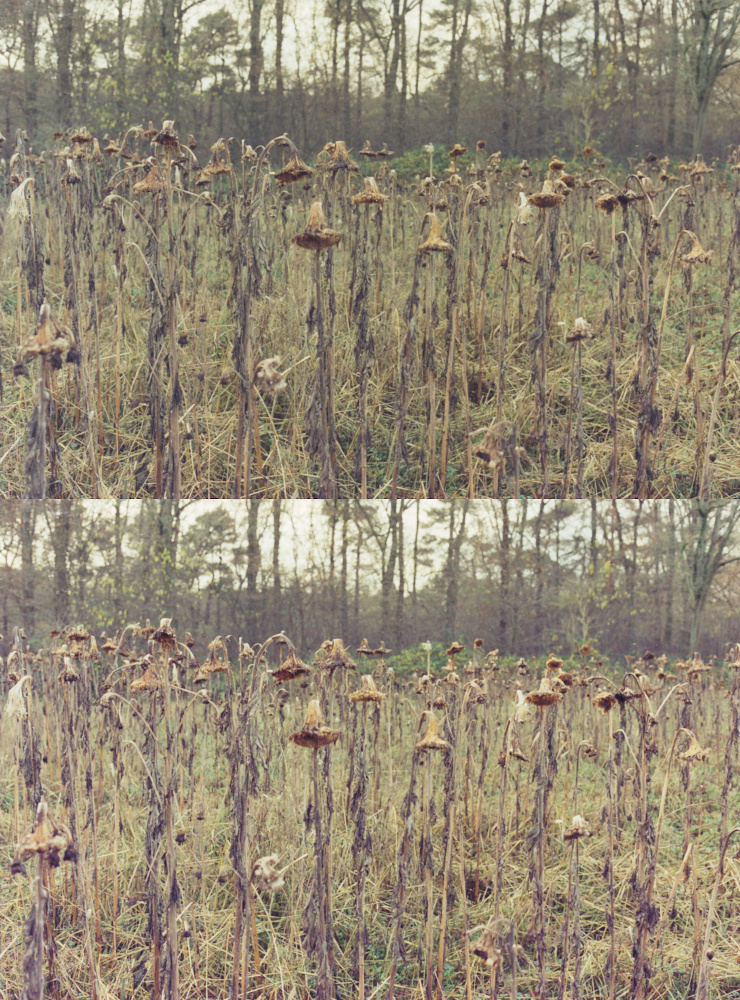
In return, you get hues from negatives that simply don't materialize on the lower-end paper. There are scenes with subtle hues that you can try to print on CA and it'll just drop dead into bland mush, while on DPII etc., there's a richness in those neutral hues. This also translates into something that looks a bit like acutance at a much larger physical scale. As you know, web examples are poor substitutes for viewing real prints, but this example does convey what I mean even within the limitations of online display:
DPII_CA_EP_11w.jpg

Top is the print on CA, bottom on DPII. Note that in this nearly monochromatic scene, the sunflowers differentiate better from the background on the DPII print. There are also subtle violets and blues appearing in the wrinkled leaves that are effectively missing in the CA print.

Some might find these differences subtle to the point of invisible, but I think you also recognize their significance. These are really meaningful differences in my view, even though they bring their own set of challenges.
 

DREW WILEY

Member
Allowing Ads
Joined
Jul 14, 2011
Messages
14,831
Format
8x10 Format
Yeah, it's really certain neutrals which suffer when the cheaper paper is used. The longer gamut and higher contrast of the better papers not only improves saturation, but subtle hue distinctions. I don't have access to Maxima; but the difference between ordinary CA and Fujiflex is quite obvious in that respect. It's a little harder to pin down in comparison to older Super C, simply because back then I was printing a lot of large format Portra 160 VC film, whereas since I've mainly printed Ektar shots. So I'm understandably eager to see how the new round of Super C version II performs. I'm quite optimistic, in fact.

I love subtly shaded weeds myself, and tend to modulate brighter colors with a lot of complex neutrals. Our California colors, even in the Fall, are mainly many-shaded golds and tans, rust colored foliage, and complex sage and avacado greens, accented at times by more vivid colors. This is a very difficult palette of hues to reproduce using color neg film. But Ektar is a suitable tool if one understands proper filtration relative to scene color temperature. It's a delicate balancing act, but overall, potentially successful with the best RA4 papers.

In other words, effective color is more about hue relationships, rather than just saturation like in all those honey and jam atop sugar cubes postcard style images one constantly sees, especially in this era of digital hyper-saturation. Therefore, even on a less than ideal paper, certain hues might play off well against one another if thoughtfully composed on the right film. But the odds of success are always on the side of a wider gamut paper. And yes, I can instantly detect the difference between your two posted shots.

Some of my own images work splendidly on full sheen Fujiflex; while other images suffer from the full sheen. There's a world of distinction, in this respect, from a true gloss polyester surface versus ordinary RC "glossy". The oddball "Pearl" surface is more of a Department store ad display thing, it seems, just like Kodak "metallic" - not my cup of tea. It's also touted as being difficult to scan, to prevent copyright infringement.

Colorhead filtration adjustments are a more complex topic in my case. The pulsed additive RGB heads have a much different personality than my standard CMY Durst 10X10 head. I'm comfortable enough either way to not have think about it much anymore, and can almost spontaneously achieve very similar results, given a couple of test strips. But that was certainly not the case back in Cibachrome days, when the response of the two systems was quite different. Going true narrow-band additive gives a slight advantage when dealing with less than ideal papers like standard cut sheet CA, but can potentially be over the top in terms of contrast and saturation when dealing with the combination of Ektar and Fujiflex. So I'm glad I have both kinds of colorheads. Less supplemental masking is needed.
 
Last edited:

Samu

Member
Joined
Jul 4, 2023
Messages
242
Location
Lithuania
Format
35mm
.
With the kind of volumes we're purchasing, it's always a bit of an uphill battle when it comes to chemistry going bad before it's used up. The monopart developer is surprisingly resilient though; it tends to keep well for at least a year after opening the package as long as it's kept hermetically sealed from oxygen. Decanting in full bottles I believe is necessary.

I´ve been using Enviroprint 160MP for some time, and I agree the concentrate keeps well. Also, if you keep printing, it is also possible to replenish this. Of course, the oxidation will set its limits, but yoy will see when the color gets black. I normally make a batch of one liter, use it in drums in a bit bigger quantities than the minimum in order to ensure even developing (paper from a roll can be quite curly), and replenish every 10 papers of 21x25 ( 21 cm is the widest paper fitting in most of my drums). The results have been constant, provided the developer is replenished, and the bottle is not in a closet. The need for developer and starter is this way even smaller than using the stuff just one shot.
 

DREW WILEY

Member
Allowing Ads
Joined
Jul 14, 2011
Messages
14,831
Format
8x10 Format
Replenishing is not an option for me. I'm moderately allergic to RA4 chem, so the less fooling around with it, the better. I actually do my drum processing outdoors on a portable cart.
 

Lachlan Young

Member
Allowing Ads
Joined
Dec 2, 2005
Messages
5,075
Location
Glasgow
Format
Multi Format
This also translates into something that looks a bit like acutance at a much larger physical scale.

It might be as simple as more emulsion = more coupler = more DIR coupler = more low frequency sharpness.

Yes, for the largest gamut, it's imperative to move up in the product offering towards the top; this means Maxima if you can get hold of it or DPII as a second best. This of course brings new challenges, as filtering becomes more critical and so does crossover control.

There is an old Kodak document on colour printing that essentially lays out their thinking on gamut vs viewing conditions - in effect: 'narrower' dyes give better colour and gamut, at a cost of being more restrictive in viewing condition demands, thus there are compromises that need to be made.

It would seem likely that this explains some aspects of the material behaviours here.
 

mshchem

Subscriber
Allowing Ads
Joined
Nov 26, 2007
Messages
15,898
Location
Iowa City, Iowa USA
Format
Medium Format
Thanks for your work on this! Very confusing trying to get paper here in the US. Next time I get the urge I'm going to call Fuji make sure I'm getting the better, heavier base paper. Sure is convenient to buy the cut sheets here of the CA, boxes are (have always been) labeled made in Netherlands, I don't know where it's cut and finished.
Thanks again!!!
 
OP
OP
koraks

koraks

Moderator
Moderator
Joined
Nov 29, 2018
Messages
26,588
Location
Europe
Format
Multi Format
There is an old Kodak document on colour printing that essentially lays out their thinking on gamut vs viewing conditions - in effect: 'narrower' dyes give better colour and gamut, at a cost of being more restrictive in viewing condition demands, thus there are compromises that need to be made.

It would seem likely that this explains some aspects of the material behaviours here.

Note that the dyes are the same in these papers. In the blog I've also included spectral measurements on the dyes that support this; they're essentially the same spectra. This was also specifically stated to me multiple times by the manufacturer. The degree of contamination (/purity) that occurs is a difference in the degree of crosstalk between layers due to differences in interlayer makeup.

Thanks again!!!

You're very welcome!
 

Lachlan Young

Member
Allowing Ads
Joined
Dec 2, 2005
Messages
5,075
Location
Glasgow
Format
Multi Format
The degree of contamination (/purity) that occurs is a difference in the degree of crosstalk between layers due to differences in interlayer makeup.

There are several areas that are alterable - and it would make sense not to mess with the main coupler set, especially if they are delivering good archival performance and good tolerance of viewing condition variability. Effectively, many of the interlayer controls will also act to enhance sharpness too.
 

DREW WILEY

Member
Allowing Ads
Joined
Jul 14, 2011
Messages
14,831
Format
8x10 Format
Visible acute sharpness differences are more an exponent of the specific surface texture, gloss versus matte etc, with high gloss polyester base exceeding any of the RC paper surfaces with respect to sharpness.
 

bobocamera

Member
Allowing Ads
Joined
Jul 25, 2022
Messages
5
Location
SF Bay Area
Format
Medium Format
For what it's worth, the CA Type II we buy in the USA is also manufactured in the Netherlands and packaged in the UK, so it's likely the exact same as what you get in Europe. The mottling does show up on it, but only in the darkest areas and it can be subtle. Maybe it's more obvious in direct comparison with something like DPII.
 
Photrio.com contains affiliate links to products. We may receive a commission for purchases made through these links.
To read our full affiliate disclosure statement please click Here.

PHOTRIO PARTNERS EQUALLY FUNDING OUR COMMUNITY:


Ilford ADOX Freestyle Photographic Stearman Press Weldon Color Lab Blue Moon Camera & Machine
Top Bottom