
• Welcome to Photrio!
    Registration is fast and free. Join today to unlock search, see fewer ads, and access all forum features.
    Click here to sign up

Color enlarger filter faded,wave length

Recent Classifieds

Forum statistics

Threads
203,113
Messages
2,849,947
Members
101,673
Latest member
mkamera
Recent bookmarks
3

czygeorge

Member
Allowing Ads
Joined
Dec 18, 2020
Messages
145
Location
Beijing
Format
Medium Format
It is very frustrated to see my rollei 67(Actually it was manufactured by some Japan like lpl or nikkor etc) color enlarger's filter can't do there job more and more oftenly.

I think it was caused by once I forgot to turn it off and the lamp just toasted those filter s for more than twenty four hours:sad:
From someday I have to use extra filter set (unicolor) to finish some print.

Actually the one which has faded enough to influent the work is the magenta.Usually I need to take extra 10M to make their perfect but today oops,it is like fifty five.So I think it's time to replace it.

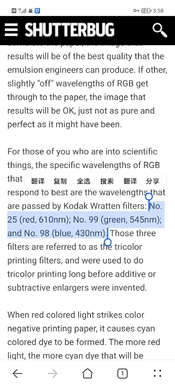
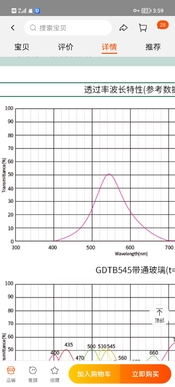
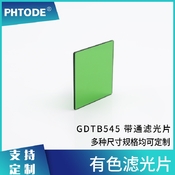
Unfortunately today I can't find somewhere which still sold these filter.So I read this post(p1),and wondering if the one in p2,it's okay to do this job.

Actually yes the question here is the wave length requirement of color enlarger filters.Hope someone had experience of this could help:sad: and also hope those color darkroom user like me can finally get help by reading the answers.And also I think maybe put a uv between filter constructure and lamp house is a great idea:smile:
 

Attachments

  • Screenshot_20230214_035842.jpg
    Screenshot_20230214_035842.jpg
    584.5 KB · Views: 98
  • Screenshot_20230214_035937.jpg
    Screenshot_20230214_035937.jpg
    454.6 KB · Views: 92
  • tb_image_share_1676319385191.jpg
    tb_image_share_1676319385191.jpg
    159.2 KB · Views: 99
omg look what mistake i made, the maginta filter of course should be maginta but not green
 
If using Ilford Multigrade paper, you could match your filters to their filters. Check out the two biggest peaks. MG00 would be yellow (blue blocker) (blue line) and MG5 would be magenta (green blocker) (red line).
1107646560_MGFilterSetScan2015.thumb.jpg.9ac63c95f16003f8f720abd96d94e552.jpg
 
those were all made by LPL, and sold under several names.

the one firm in north america who may know is are these folks

 
omg look what mistake i made, the maginta filter of course should be maginta but not green

Yeah, you're essentially looking for the inverse of the filter you've found, although I think you want something more selective than what you've found.

If using Ilford Multigrade paper

This is in the color section, so I assume it's also for color printing. In that case, I'd be hesitant to recommend relying on Ilford's spectra since the B&W application is much less critical. For color, you want a fairly steep cutoff below 600nm to cut off red, and the lower cut-off point needs to be above 525 or 530 or so. To be honest I never looked into how steep the cutoffs of the dichroic filters in color enlargers are. To me, the response of the green filter OP found looks suspiciously bell-shaped. I have doubts it will work OK especially in differentiating between the green- and blue-sensitive emulsions of a color paper. It also doesn't look very ideal to me for B&W work given the light it passes in the blue band.
 
Yeah, you're essentially looking for the inverse of the filter you've found, although I think you want something more selective than what you've found.


This is in the color section, so I assume it's also for color printing. In that case, I'd be hesitant to recommend relying on Ilford's spectra since the B&W application is much less critical. For color, you want a fairly steep cutoff below 600nm to cut off red, and the lower cut-off point needs to be above 525 or 530 or so. To be honest I never looked into how steep the cutoffs of the dichroic filters in color enlargers are. To me, the response of the green filter OP found looks suspiciously bell-shaped. I have doubts it will work OK especially in differentiating between the green- and blue-sensitive emulsions of a color paper. It also doesn't look very ideal to me for B&W work given the light it passes in the blue band.

Thanks a lot koraks😍I'll try find the one could match the wavelength you said,I found the devere factory here who custom make and sell it for like fifty dollars each,but unfortunately they were closed months ago

 
Are you making color or black-and-white prints?

Rollei and Nikkor, enlargers were essentially re-labeled LPL enlargers. The built-in dichroic filters cannot fade because they contain no dyes. However, it is possible to damage the dichroic coatings in some circumstances. In general, dichroic filters are permanent and don’t change their filtering characteristics with accumulated use. Here is a useful article describing the characteristics of dichroic filters.

https://en.wikipedia.org/wiki/Dichroic_filter

While it’s possible that the filters in your enlarger have somehow changed, it is more likely that the materials you are using, paper or chemicals, have changed. Color printing is especially sensitive to changes. For example, one package of color paper might give a different color response compared to an earlier package.

Too, voltage changes to the power supplied to your building can result in aggravating changes in the color of prints. Additionally, as the quartz-halogen lamp in your enlarger ages, the filament gets thinner and that will alter the spectrum of light it produces. This consequently can alter the required filter settings. The older the lamp, the faster its light spectrum changes.

Commercial photo labs used relatively fast changes to the required filtration as an indicator to discard the lamp and install a new one, since the lamp was near the end of its life and the changes lead to the expensive waste of time and materials.

It will be useful to establish the color output of your enlarger with a new lamp of the correct type installed. This can be measured with a color analyzer or a color meter. That can definitively answer the question: “Are the filters in the enlarger truly out of their specified range?” You might find that one of the possible sources listed, above other than the filters, are responsible for the color mismatch you have observed.

If your filter is obviously damaged upon visual examination, then, of course, it will have to be replaced.
 
Last edited:
While it’s possible that the filters in your enlarger have somehow changed, it is more likely that the materials you are using, paper or chemicals, have changed.

Good point, Ian.
Fouling of course is a possibility. But I agree that some form of user error elsewhere in the processing chain is far more likely a cause for the effect that's described.
 
Are you making color or black-and-white prints?

Rollei and Nikkor, enlargers were essentially re-labeled LPL enlargers. The built-in dichroic filters cannot fade because they contain no dyes. However, it is possible to damage the dichroic coatings in some circumstances. In general, dichroic filters are permanent and don’t change their filtering characteristics with accumulated use. Here is a useful article describing the characteristics of dichroic filters.

https://en.wikipedia.org/wiki/Dichroic_filter

While it’s possible that the filters in your enlarger have somehow changed, it is more likely that the materials you are using, paper or chemicals, have changed. Color printing is especially sensitive to changes. For example, one package of color paper might give a different color response compared to an earlier package.

Too, voltage changes to the power supplied to your building can result in aggravating changes in the color of prints. Additionally, as the quartz-halogen lamp in your enlarger ages, the filament gets thinner and that will alter the spectrum of light it produces. This consequently can alter the required filter settings. The older the lamp, the faster its light spectrum changes.

Commercial photo labs used relatively fast changes to the required filtration as an indicator to discard the lamp and install a new one, since the lamp was near the end of its life and the changes lead to the expensive waste of time and materials.

It will be useful to establish the color output of your enlarger with a new lamp of the correct type installed. This can be measured with a color analyzer or a color meter. That can definitively answer the question: “Are the filters in the enlarger truly out of their specified range?” You might find that one of the possible sources listed, above other than the filters, are responsible for the color mismatch you have observed.

If your filter is obviously damaged upon visual examination, then, of course, it will have to be replaced.

Thanks a lot lan!

Omg this point was been misconcidered by me.I’ll change a new bulb to try.
Before I saw your reply i even contacted to the boss of the devere factory here to order a new magenta filter.Now I see the reason I thought is wrong...

And yes there was once I've calibrated my color analyzer and about months later the print shows very pink when I used the result the analyzer gave. Now I know it is because the bulb's light wavelength changing.
 
Good point, Ian.
Fouling of course is a possibility. But I agree that some form of user error elsewhere in the processing chain is far more likely a cause for the effect that's described.
I think maybe it's not because of this since my storage of paper and processing chain is okay.Got to say color paper is so easily get influence.My kodak metallic and fuji HDX are both expired(for like half year).Fortunately they are still excellent to use and have no color misbanlance or fog.And they are hard to buy new in my country anyway(discontinue or fuji agent don't order them from neitherland anymore).
I once used kodak ra4 and now i change to champion since the kodak ra4 produces ridiculous much stain in my processor.
 
This has nothing to do with multigrade sheet filters. There are sources for custom sized dichroic filters, like Hoya industrial division, Edmund Scientific Industrial, etc etc. If there was overheating, you probably need to replace the whole CMY filter set, and that will cost you way more than that little enlarger is worth. Makes more sense to either replace the entire thing, or find a replacement colorhead you can adapt to fit.

But first make sure you really have a filter problem. Sometimes dichroic coatings can spall off the glass due to repetitive overheating, and behave as if they're faded; but that generally takes a long time.
 
Photrio.com contains affiliate links to products. We may receive a commission for purchases made through these links.
To read our full affiliate disclosure statement please click Here.

PHOTRIO PARTNERS EQUALLY FUNDING OUR COMMUNITY:


Ilford ADOX Freestyle Photographic Stearman Press Weldon Color Lab Blue Moon Camera & Machine
Top Bottom