


• Welcome to Photrio!
    Registration is fast and free. Join today to unlock search, see fewer ads, and access all forum features.
    Click here to sign up

Cleaning (residual) silver from negatives?

Stella Niagara Steps

H
Stella Niagara Steps

  • 0
  • 0
  • 19
Up_the_TransAm.jpg

D
Up_the_TransAm.jpg

  • 1
  • 2
  • 41

Recent Classifieds

Forum statistics

Threads
202,874
Messages
2,846,870
Members
101,537
Latest member
And ee
Recent bookmarks
0

Kirks518

Member
Allowing Ads
Joined
Oct 5, 2013
Messages
1,494
Location
Flori-DUH
Format
Multi Format
I developed 3 rolls of Fomapan 100 120 last night at the same time in the same tank last night. Tank is a Paterson 5-roll, which can do u to 3 rolls of 120. The amount of fixer I had available was just enough to fill the tank, and the last bit of fixer was silver-lading. I swallowed hard as I saw it going in, but I really didn't have much of a choice but to use it.

Did an extra long rinse, and extended my photoflo time, but when I took the rolls off the spools, lots of gray matter (silver) was on the bottom roll. I re-rinsed it in hoes of getting it off, but looking at the scans, there is still quite a bit of silver on the negatives from the one roll.

Kodak says to use 98% alcohol to clean negatives, and I have 95% alcohol, so I'm thinking of using that with a microfibre cloth, but I have my concerns.

Is the unwanted silver now embedded in the film, or will it come off without causing problems to the negatives? Or is there something else I can/should do to remove it? Running my fingers along a bad (the shot came out bad) frame yielded no silver on my fingers, although when I did the same thing when it was wet, I got loose silver on my fingers. I guess I'm worried that what would be required to remove the (assumed) surface silver would cause the silver making the image come off as well, but I don't know.

Help is appreciated.

Here's a crop showing the specks on the images (in positive form):
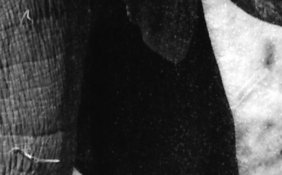
IMG_20160307_0035.jpg
 
Before you worry about cleaning the film you need to re-fix it with fresh fixer. Most likely it hasn't been fully fixed.
 
Yes, refix the film as soon as possible.
 
As colleagues have said in the posts above re-fix the negatives with fresh fixer.
Your fixer did not work well.
Silver concentration is high (more fixer used) or thiosulphate concentration of fixer is small.
I check the fixer with a small piece of film that needs to be clarified (transparent) in about 40 seconds.
Fixer with ammonium thiosulfate works faster than with sodium thiosulphate.
Problem : Particle—black lines and comets.
Possible Cause : Flocculent silver flakes that were not removed from the fixer—the fixer solution crossover device smears adhering flakes into lines or comets.
http://motion.kodak.com/KodakGCG/up..._en_motion_support_processing_h2415_h2415.pdf

George
 
It's unlikely that the precipitate on the film is just metallic silver. If it appears black then it is a mixture of sulfur coated with a small of silver on the surface. If it is white or pale yellow it is sulfur. In either case the only way to remove it is mechanically using something like cotton balls and alcohol as Kodak suggests. If this does not work then the OP is SOL as there is no solvent available that will not damage the film. Always good to remember to check the appearance of processing solutions before starting work. Even better to not overwork them. Sorry for the bad news.
 
Last edited:
So I did a fixer test, and it cleared in 32 seconds. I fixed the above mentioned film for 5 minutes. So based on the clearing test, I think my fixer is still good, but I did mix up a new batch tonight.

The 'silver' (or sulfur, it's gray) that is on the negatives was at the bottom of the fixer bottle. In other words, I poured the entire contents of my fixer bottle into the tank, and the sediment on the bottom went into the tank. That's what is staying on the film that I want to clean off.

I'm going to give it the Kodak cleaning, and see how that goes. If need be, I can re-fix.
 
So I did a fixer test, and it cleared in 32 seconds.
A clearing test does not check the amount of retained silver in your fixer, it only tests the activity of the fixing chemicals.

This why a clip test does not do the entire job.

For fixer to still do its job, it must both have chemical activity available and not be saturated with silver. Tracking usage and filtering is how you avoid the problem of silver saturation.
 
So if the chemical activity is still good, can I pour the fixer through a coffee filter (or is there something better?) to 'clean it up'?
 
So if the chemical activity is still good, can I pour the fixer through a coffee filter (or is there something better?) to 'clean it up'?
Not if it is already saturated with silver.

You could use silver recovery equipment to remove the silver, but that truly isn't practical unless your volumes are commercial.
 
Once a batch of fixer starts to sulfurize the reaction continues at an ever faster pace. Filtering the sulfur out is only a temporary solution. Toss it and get fresh.
 
Fixer used in film negatives processing should not be used excessively.
You can use two bathrooms fixers , the latter being fresh.
The appearance in fixer a sludge deposits requires replacement of fixer.
After cutting and perforation of film the emulsion resulting powder is mixed with different compounds that result from fixer and sludge containing silver.
By excessive use of fixer increases the concentration of silver in fixer and then the diffusion rate of silver salts from the film in solution decreases.
The film fixer harder.
If you love negatives used as fresh fixer!
Solution of fixer with deposition, even if filtered and fix them well use them to paper.

George
 
I developed 3 rolls of Fomapan 100 120 last night at the same time in the same tank last night. Tank is a Paterson 5-roll, which can do u to 3 rolls of 120. The amount of fixer I had available was just enough to fill the tank, and the last bit of fixer was silver-lading. I swallowed hard as I saw it going in, but I really didn't have much of a choice but to use it.

Did an extra long rinse, and extended my photoflo time, but when I took the rolls off the spools, lots of gray matter (silver) was on the bottom roll. I re-rinsed it in hoes of getting it off, but looking at the scans, there is still quite a bit of silver on the negatives from the one roll.

Kodak says to use 98% alcohol to clean negatives, and I have 95% alcohol, so I'm thinking of using that with a microfibre cloth, but I have my concerns.

Is the unwanted silver now embedded in the film, or will it come off without causing problems to the negatives? Or is there something else I can/should do to remove it? Running my fingers along a bad (the shot came out bad) frame yielded no silver on my fingers, although when I did the same thing when it was wet, I got loose silver on my fingers. I guess I'm worried that what would be required to remove the (assumed) surface silver would cause the silver making the image come off as well, but I don't know.

Help is appreciated.

Here's a crop showing the specks on the images (in positive form):

View attachment 152062
refix in fresh fixer and for the future consider a 2-bath fixing procedure!
 
After me, the film was filed miseries of fixer.
One of the components of misery is gelatin is that falls from cutting and perforating film.
This misery gelatin emulsion containing all adhere to gelatin.
It is possible that some of the undeveloped silver not to be completely removed from the film.
A fresh fixer is welcome.
Before placing it in fixer I recommend placing in a sodium carbonate solution
~ 15-20 g / l with photoFlo for 5 minutes. under agitation.
Carbonate solution will swell the film emulsion and makes it easier to remove impurities deposited film.
Removal with chamois leather.
The film with carbonate should be washed after about 5 minutes at 20 C.
Fixing fresh ~ 10 minutes at 20 C.

George
 
After me, the film was filed miseries of fixer.
One of the components of misery is gelatin is that falls from cutting and perforating film.
This misery gelatin emulsion containing all adhere to gelatin.
It is possible that some of the undeveloped silver not to be completely removed from the film.
A fresh fixer is welcome.
Before placing it in fixer I recommend placing in a sodium carbonate solution
~ 15-20 g / l with photoFlo for 5 minutes. under agitation.
Carbonate solution will swell the film emulsion and makes it easier to remove impurities deposited film.
Removal with chamois leather.
The film with carbonate should be washed after about 5 minutes at 20 C.
Fixing fresh ~ 10 minutes at 20 C.

George
If I use stock developer I need to filter for chips and debris.
Fixer is the critical stage you can develope in coffee or vitamin and have good negs.
If the fixer is not fresh you have just destroyed a batch of negatives.
I always make up fresh fixer from powder and discard fix after use.
You also need to wash out the fix properly HCA saves water and time.
You need to alter your process.
 
Photrio.com contains affiliate links to products. We may receive a commission for purchases made through these links.
To read our full affiliate disclosure statement please click Here.

PHOTRIO PARTNERS EQUALLY FUNDING OUR COMMUNITY:


Ilford ADOX Freestyle Photographic Stearman Press Weldon Color Lab Blue Moon Camera & Machine
Top Bottom
