
• Welcome to Photrio!
    Registration is fast and free. Join today to unlock search, see fewer ads, and access all forum features.
    Click here to sign up

Cleaning glass bottles

Recent Classifieds

Forum statistics

Threads
202,830
Messages
2,846,115
Members
101,553
Latest member
SeattleMC
Recent bookmarks
0

baachitraka

Member
Joined
Apr 6, 2011
Messages
3,651
Location
Bremen, Germany.
Format
Multi Format
In the past year I use to mix many formulas of the photo developer and fixer and stored them in brown glass 1l bottles. Unfortunately I did not name them clearly.

Is there a easy way to clean them all for storing fixer and stopbath only?
 
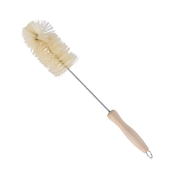
Redecker-Wirebeechwoodbottlebrush-1300px.jpg
 
Warm water and a bottle brush is effective, and then rinse the bottle a couple of times. If there aren't any deposits from the chemicals then a couple of rinses should be enough. Remember to give the bottle cap a good rinse too.
 
Warm water and a bottle brush is effective, and then rinse the bottle a couple of times. If there aren't any deposits from the chemicals then a couple of rinses should be enough. Remember to give the bottle cap a good rinse too.

I will try this method.
 
Last edited:

Yeah, that's how I started out. Until I learned the trick of taking a small scrap of *whatever* (sponge, scouring pad, etc.) put into bottle, fill bottle for about 10% with water and then shake like a madman. Most of whatever was stuck to the walls of the bottle will rinse away easily after this. You can do the same procedure with a cleaning agent of your choice; it doesn't have to be water. I find this procedure a lot easier and more effective than the 'appropriate' cleaning tool.
 
As a home brewer who occasionally forgets to wash out a bottle after emptying it, I learned that a stubborn deposit in the bottom can easily be removed by adding a small amount of water and a few pieces of pea gravel. It's sort of like doing a wet media blasting.
 
If you are going to use them for stop bath and fixer, use a bit of vinegar (or acid stop) in water as your cleaning solution. Plus all the suggestions above.
 
For bottles with deposits I use a dish cleaner formula listed by Ilford in their famous Manual. However, I hesitate to repeat it here because it requires sulphuric acid and potassium permanganate, both chemicals to handle with care. It’s probably better sense to commit those bottles to recycling and buy fresh ones.
 
If you happen to use a rotary processor….

I have put some nuts bolts screws and washers into the bottle with soap and water and then rotate for 15 minutes and reevaluate.
 
IMO, you can just rinse them out a few times. No need to discard them. Especially if you are putting stop and fixer in them. Developer gets carried over into stop and fixer all the time, so if you put stop/fixer in a bottle that used to have developer, it shouldn't cause a problem. Where one needs to be a little more careful is putting developer into a bottle that used to have stop or fixer, since remnant acid could inactivate the developer. However, rinsing several times should dilute any remnants to insignificance, unless you have a lot of precipitate in the bottles.
 
Yeah, that's how I started out. Until I learned the trick of taking a small scrap of *whatever* (sponge, scouring pad, etc.) put into bottle, fill bottle for about 10% with water and then shake like a madman. Most of whatever was stuck to the walls of the bottle will rinse away easily after this. You can do the same procedure with a cleaning agent of your choice; it doesn't have to be water. I find this procedure a lot easier and more effective than the 'appropriate' cleaning tool.

Actually my bottle brush has a sponge on the end, but it needs a longer handle.
I always had trouble retrieving anything I stuck down a bottle or beaker.
 
When you rinse out a bottle for developer, add a spoonful of sodium carbonate to the water. That'll kill any acid.

The sulphuric acid/potassium permagnate cleaner is pretty much to get rid of silver-build-up. I had a plastic beaker I routinely forgot to empty of used developer and it actually got a shiny lining (gone now since I started using it to mix potassium ferricyanide bleach).

These bottles don't need to be "clean" - they only need to not contain anything that's going to screw up your chemistry.
 
Actually my bottle brush has a sponge on the end, but it needs a longer handle.

Yeah, I've used something like that. The shake trick works better for me. I retrieve whatever I dump in there by just shaking it out (point downwards into the sink). Never misses as long as you ensure the objects you put in there aren't too big.
 
In the lab we used to use chromic acid to clean stubborn stuff in lab glassware. Not too environmentally friendly and hazardous to boot, so its use for this purpose is frowned on today.
 
Another thread on this subject here:

 
As a home brewer who occasionally forgets to wash out a bottle after emptying it, I learned that a stubborn deposit in the bottom can easily be removed by adding a small amount of water and a few pieces of pea gravel. It's sort of like doing a wet media blasting.

Scratching the inside of the glass could allow it shatter, if roughly handled.
 
For plastic trays and glass bottles I use diluted household bleach.
Leave to soak overnight and give a good wash out before use.

If storing empty glass bottles for some time I use the the homebrewing technique of putting an inch of DILUTED Sodium metabisulphate in each bottle before capping. Obviously they need a good rinse immediately before use.
The Sodium met. stops mold growing in the damp bottles. Any homebrewing site will give you the correct rate of dilution. I usually mix a full teaspoon with a pint of COLD water. Do not use hot water as the fumes will not be nice.
Have a care though not to sniff the bottles as it is irritant, but not that bad as it is allowed in foodstuffs.
 
IMO, you can just rinse them out a few times. No need to discard them. Especially if you are putting stop and fixer in them. Developer gets carried over into stop and fixer all the time, so if you put stop/fixer in a bottle that used to have developer, it shouldn't cause a problem. Where one needs to be a little more careful is putting developer into a bottle that used to have stop or fixer, since remnant acid could inactivate the developer. However, rinsing several times should dilute any remnants to insignificance, unless you have a lot of precipitate in the bottles.

I'm with him, no need to go overboard here.
 
For plastic trays and glass bottles I use diluted household bleach.
Leave to soak overnight and give a good wash out before use.

If storing empty glass bottles for some time I use the the homebrewing technique of putting an inch of DILUTED Sodium metabisulphate in each bottle before capping. Obviously they need a good rinse immediately before use.
The Sodium met. stops mold growing in the damp bottles. Any homebrewing site will give you the correct rate of dilution. I usually mix a full teaspoon with a pint of COLD water. Do not use hot water as the fumes will not be nice.
Have a care though not to sniff the bottles as it is irritant, but not that bad as it is allowed in foodstuffs.

Wine and beer making shops have sodium metabisulphate at good prices, locally, so this is no a chemical you have to depend on a photo shop to send out.
 
Photrio.com contains affiliate links to products. We may receive a commission for purchases made through these links.
To read our full affiliate disclosure statement please click Here.

PHOTRIO PARTNERS EQUALLY FUNDING OUR COMMUNITY:


Ilford ADOX Freestyle Photographic Stearman Press Weldon Color Lab Blue Moon Camera & Machine
Top Bottom