

• Welcome to Photrio!
    Registration is fast and free. Join today to unlock search, see fewer ads, and access all forum features.
    Click here to sign up

Chemistry of darkroom - do you have any links?

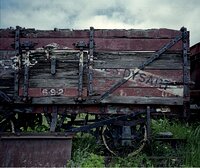
A coal wagon

A
A coal wagon

  • 1
  • 0
  • 21
Morning Birdie

D
Morning Birdie

  • 0
  • 2
  • 24

Forum statistics

Threads
203,142
Messages
2,850,471
Members
101,692
Latest member
eviosl
Recent bookmarks
0

Andrey

Member
Allowing Ads
Joined
Jan 14, 2008
Messages
299
Format
35mm
I'm too lazy to get a book on it.

Is there a nice link which describes this stuff? I would like the developer and fixer components broken down one by one, I'd also like to see what reacts with what in formulas. :smile:

I've done a chemistry major halfway
 
Seems to me that you should do the other half of your chemistry major.
 
You want photographic processing chemistry explained to you, right?

Ok, to do that, you have to have some understanding of the subject. That is my take on it.

But, you don't need a full major in Chemistry to do that. Basic first year college chemistry should do the trick. Molecular weights, molarity, molality and redox equations are taught in first year chemistry and that should do the trick.

PE
 
Is there a nice link which describes this stuff?
I would like the developer and fixer components
broken down one by one, I'd also like to see what
reacts with what in formulas.

There is good coverage of the chemistry specific
to the photographic process at, www.unblinkingeye.com .
Quite a few other technical articles offer insight. Dan
 
You have to be careful of Online sources, the worst of all for errors is Silvergrain.org. Digitaltruth is good, and quickly updated if a mistake is found.

A huge number of errors come from the Photo Lab Indexes which were riddled with typos and errors, unfortunately many US books of formulae used these as there source without cross checking the original manufacturers sources/publications.

The new 3rd Edition of The Darkroom Cookbook, Steve Anchell, contains the correct (manufacturers) published versions of many formulae and is well worth buying.

Ian
 
I would have to agree with Ian here on the websites cited. I cannot comment on Steve's latest book though as I don't have a copy.

The Handbook of Chemistry and Physics has formulas that have errors in them as do the various Photo Lab indexes.

Part of the problem, which I have argued for a while, is the fact that many in the US use "English" units for the gallon that differ from the Imperial Gallon and etc. Conversion from drams to ounces to grams is often chancy and contain many rounding errors or outright errors in division or multiplication. Perhaps it was due to the lack of calculators back then. :wink: IDK. I have found few formulas but my own to be reliable! I use my own stuff for the most part.

PE
 
Interesting to hear of the inaccuracies in Photo Lab Index... Are the latest editions any better in that respect?

Duane
 
Interesting to hear of the inaccuracies in Photo Lab Index... Are the latest editions any better in that respect?

Duane

No they were all riddled with the same errors. As Ron says there are errors from Unit conversion, UK Imperial, US & Metric, as well as wrong assumptions on types of various compounds, anhyrous, monohydrated, crystalline etc. All thats before the actually typos and transcription errors.

Ian
 
No they were all riddled with the same errors....

Ian

I'm very sorry to hear that, having just bought a copy... I guess for $12 though, it should at least give me an idea for formulas that I wasn't aware of, and can research further from there.

Duane
 
For $12 it's definitely still worth having a copy, there will be formulae not in other publications, and it's also a good starting point. Many Agfa (Ansco) and older Kodak etc publications can be found online.

It's also worth bearing in mind that all the photographic companies offered reasonably similar products/formulae, so personally I chose a variety of devs for printing from just one manufacturer, for a soft working dev, contrast dev, blue-tone, warm tone etc. It's only the more specialist formulae ultra fine grain, etc that differ substantially.

Ian
 
Photrio.com contains affiliate links to products. We may receive a commission for purchases made through these links.
To read our full affiliate disclosure statement please click Here.

PHOTRIO PARTNERS EQUALLY FUNDING OUR COMMUNITY:


Ilford ADOX Freestyle Photographic Stearman Press Weldon Color Lab Blue Moon Camera & Machine
Top Bottom