• Welcome to Photrio!
    Registration is fast and free. Join today to unlock search, see fewer ads, and access all forum features.
    Click here to sign up

Cheapest 24mm Barnack Lens ? No vignet or distortion , older is better

Forum statistics

Threads
203,435
Messages
2,854,672
Members
101,841
Latest member
Jannis
Recent bookmarks
0

Mustafa Umut Sarac

Member
Allowing Ads
Joined
Oct 29, 2006
Messages
4,965
Location
İstanbul
Format
35mm
I love Orson Welles , Citizen Kane and I want to switch to 24mm as he uses it. Thinking about manmade compositions are great relaxing and I found I need that lens. Could you please help me what is available .

I know Russar but its 700 euros or more. I have limited budget , if it is good , I can collect 200 dollars or so.

Thanks,

Umut
 
The Russar is 20mm not 24. The Orion is a 28mm, I know Canon made a 25mm topogon like lens but I doubt it's cheap.
 
I learned canon 25mm goes from 500 dollars.
 
Eid Mubarak!

Where is no cheap lenses for Leica from Leitz. Even cheap Elmar 90 and this you have 135mm aren't so cheap, in normal situations. They are something like $90.
The wider you go the expensive it gets. I bet, LTM Skopar Snapshot 25 would be cheapest one from easy to find and get and they have it on e-bay with viewfinders at higher $200 range.
Sometimes you could get it with working Bessa L camera attached to the lens for almost at the same price.


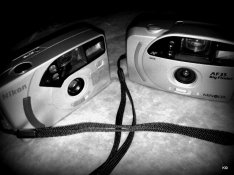
And If you want it at most reasonable price with fine performance, get $5 P&S with 24, 25mm lens. I had two with AF.

attachment.php


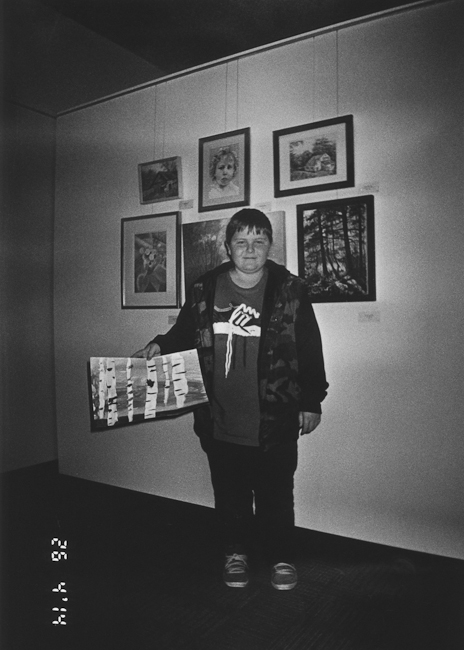
This is the scan of the print from one of them.


Antony, his art and art. by Kostya Fedot, on Flickr

Shooting wide isn't as relaxed as it seems. Actually with 24-25mm it is harder comparing to tele.
 

Attachments

  • NikonANDMinolta.JPG
    NikonANDMinolta.JPG
    123.8 KB · Views: 242
You ask for the cheapest but want no vignetting or distortion? I think you need to rethink what you want.
First, lenses that wide were rare and expensive in the early days.
Second, while most screws mount lenses are pretty low distortion, a lens that wide will likely have vignetting.

Your best bet is probably one of the latter voigtlander lenses. I believe there is a 25mm f4? Someone correct me if I am wrong.
 
I personally own the 21mm f4 Color-Skopar Voightlander lens and it is a gem. Rectilinear with no vignetting, and SHARP! The lens diameter is 39mm, so no need to get any odd sized filters. Vignetting may occur with glass filters at that focal length because, presumably, the light travels through more glass at the corners.Otherwise it is a fine lens and compares favorably with any Leica lens.
 
You may consider an slr 24mm lens with an inexpensive body to mount it on.
 
Greg Toland actually used a lens of 25mm. for the interiors on Citizen Kane. New more powerful arc-lights, designed for Technicolor allowed small apertures— ceilings had to be provided on sets to accommodate the wide field. The deep focus was augmented with split-diopter lens when needed. Film was Super XX stock,newly available.

The radical wide-angle framing was new to Hollywood, where the 50mm. lens was standard.

Now the thing is, cine film was run cross-film essentially half-frame compared to the long Leica Format. Toland was effectively using the Leica equivalent of a 50mm lens. Most cinematography was done with the Leica Equivalent of a 100mm— this is the perspective people were accustomed to seeing at the movies. ( The relative apertures hold, however. a 25mm. will give much greater apparent depth of focus at the same F stop ( or T stop )

Wells was influenced by German Expressionistic film; and Toland was up to giving him what he wanted. I'm sure that Welles would have loved the effect of a 13mm. — the equivalent of your desired 24mm ( Leica format )
 
Timestep,

Thank you very much for awaking me and others.

- Film format was 12 mm x 36 mm ?

- Than how its been enlarged and cropped ?

Thank you ,

Umut
 
The equivalent of a 50mm lens on 35mm still film is approximately 40mm for 35mm 4 perf pulldown academy (1.33:1) aspect motion picture shooting. 35mm still film frame size is 24x36mm as we all know, 35mm motion picture frame size (4 perf pulldown, academy ratio) is 16x24mm. So the equivalent of Toland's 24mm lens on his Mitchell would be about 28mm for a 24x36mm still camera frame. That shouldn't be too hard to find.
 
The equivalent of a 50mm lens on 35mm still film is approximately 40mm for 35mm 4 perf pulldown academy (1.33:1) aspect motion picture shooting. 35mm still film frame size is 24x36mm as we all know, 35mm motion picture frame size (4 perf pulldown, academy ratio) is 16x24mm. So the equivalent of Toland's 24mm lens on his Mitchell would be about 28mm for a 24x36mm still camera frame. That shouldn't be too hard to find.

Yes an 28mm FSU Orion is cheap, but they normally film wide and mask?
https://en.m.wikipedia.org/wiki/Full_frame
 
Timestep,

Thank you very much for awaking me and others.

- Film format was 12 mm x 36 mm ?

- Than how its been enlarged and cropped ?

Thank you ,

Umut


No, it was 18 by 24mm. You know, like you get with a "half-frame" camera like your Olympus Pen. A 12 by 36 would be a panoramic look.

A good cheap 24mm lens that does not vignette is going to be very hard to find because a wide angle lens, even the best Leica lens, will naturally vignette because of the physics of the design. The Canon 25mm lens you mention is a really sweet lens, but does vignette.

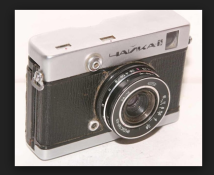
You could pick up a 24mm lens on a cheap Russian camera called the Chaika II -- it uses a Pentax screw mount, no idea what the film-to-lens distance it is designed for is, and it might not even cover a full-frame, but maybe it could be adapted, I dunno, or just use the Russki camera:

Screen shot 2015-09-24 at 10.18.19 PM.png
 
Yes an 28mm FSU Orion is cheap, but they normally film wide and mask?
https://en.m.wikipedia.org/wiki/Full_frame

With digital scanning full frame became a standard, many widescreen formats can be extracted from it, including 2:35:1 CinemaScope aspect ratio. Back in Toland's day most films were contact printed so the camera negative had to match the projection print dimensions exactly, and "academy" aperture had space on one side for the optical soundtrack. That's why the sound era films used the new standard.
 
No, it was 18 by 24mm. You know, like you get with a "half-frame" camera like your Olympus Pen. A 12 by 36 would be a panoramic look.

A good cheap 24mm lens that does not vignette is going to be very hard to find because a wide angle lens, even the best Leica lens, will naturally vignette because of the physics of the design. The Canon 25mm lens you mention is a really sweet lens, but does vignette.

You could pick up a 24mm lens on a cheap Russian camera called the Chaika II -- it uses a Pentax screw mount, no idea what the film-to-lens distance it is designed for is, and it might not even cover a full-frame, but maybe it could be adapted, I dunno, or just use the Russki camera:

attachment.php

It isn't 24 and it is half-frame.
 
I learned Chaika lens on 24x36 , vignettes like crazy. Its for half frame as others reported.
 
For clarification,

- I want to take 16x24 mm frames. What would be the Greg Toland lens original focal lenght ? 50mm or 28 mm or 24mm or 100mm ?

I am sorry but I could not be sure , please lets put your ideas on the table and clarify .

Second question

- What is the original frame size of Clint Eastwood Italian Cowboy movies , especially when the cowboys looks elongated from down to up and what was the original focal lenght for that panoramic shot ?

Thanks,

Umut
 
Remember that cine film ran vertically through the camera. I'm not sure of the actual dimensions of the cine negative—but the long dimension must be less than the width of the film: 12 x24 might be a good guess allowing for the sound track.

I was certainly thrown off when reading of the use of a 25mm lens, thinking in terms of the 24 x 36 negative ( Leica Format ). On the small cine frame 25mm. would be equivalent of the "Normal" 50mm on Leicas ( Other than the rare half-frame Leicas )

The digital crowd faces this focal length problem today ( DX vs. FX ).
 
For clarification,

- I want to take 16x24 mm frames. What would be the Greg Toland lens original focal lenght ? 50mm or 28 mm or 24mm or 100mm ?

I am sorry but I could not be sure , please lets put your ideas on the table and clarify .

Second question

- What is the original frame size of Clint Eastwood Italian Cowboy movies , especially when the cowboys looks elongated from down to up and what was the original focal lenght for that panoramic shot ?

Thanks,

Umut
The 'elongated' look is with a anamorphic lens. This compressed the image vertically, then when projected the anamorphic projection lens was oriented horizontally to give a wider aspect ratio in projection.
I don't know exactly what you are trying to achieve, but it doesn't sound like you are going to do it for $200

That's the good, the bad, and the ugly of it I'm afraid.
 
Hello Ciniframe ,

I bought even a LOMO Cine Roundfront Anamorphic lens Its never used . I will use the lens in front of Fluro Ektar 111mm f: 1.5 and in behind of ektar , there is leitz hektor 135mm. All works together and all I need a diy bracket and big tripod.
 
Even modestly wide angles can appear wider if cropped top and bottom slightly. As an aside, has anyone adapted APS-C lenses to a sub-35mm film body?
 
Hello Ciniframe ,

I bought even a LOMO Cine Roundfront Anamorphic lens Its never used . I will use the lens in front of Fluro Ektar 111mm f: 1.5 and in behind of ektar , there is leitz hektor 135mm. All works together and all I need a diy bracket and big tripod.

I got my Orion28mm inside your budget.
 
Photrio.com contains affiliate links to products. We may receive a commission for purchases made through these links.
To read our full affiliate disclosure statement please click Here.

PHOTRIO PARTNERS EQUALLY FUNDING OUR COMMUNITY:


Ilford ADOX Freestyle Photographic Stearman Press Weldon Color Lab Blue Moon Camera & Machine
Top Bottom