• Welcome to Photrio!
    Registration is fast and free. Join today to unlock search, see fewer ads, and access all forum features.
    Click here to sign up

Chasing the right grain

The Chicken

A
The Chicken

  • 3
  • 4
  • 80
Amour - Paris

A
Amour - Paris

  • 1
  • 0
  • 83

Recent Classifieds

Forum statistics

Threads
203,241
Messages
2,851,921
Members
101,743
Latest member
Pablino
Recent bookmarks
0

Krzys

Member
Allowing Ads
Joined
May 28, 2009
Messages
505
Location
Brisbane, QL
Format
35mm
I have been printing various 35mm negatives to 12x16 recently and can really see the difference between sharp grain and mushy grain. I like sharp crystal looking grain and push film to achieve it with the added speed as a bonus (I also like stopping down).

I have been reading some conflicting reports regarding grain and dilution. Some folks are saying that high dilutions with increased time lead to more grain and actuance. This is true for my experience with rodinal. However others say that the longer wet time leads to a lack of sharpness and mushy grain.

This is concerning as I plan to develop my Hp5@1600 in Hc110 and would like to use half of dilution B with double the time.

Could somebody please clear this up, thank you :smile:
 
It depends entirely on the developer.

With high sulphite solvent developers like D76/ID-11 then dilution to 1+3 does increase the grain size, but gives better acutance. Rodinal has a high sulphite level but is sued quite dilute,and of course diluting further reduces the sulphite as well.

The lack of sharpness and mushy grain is not related to wet time because some of the sharpest high acutance developers have long process times. You need to try your chosen combination yourself.

Ian
 
Ian, I understand that there are far too many variables involved and it's hard to make objective comments, but doesn't the pH drop when diluting a developer? And doesn't a lower pH with already low sulfite levels (as in diluted Rodinal) result in less grain clumping (I hope that's the correct term)?
 
pH does drop but not that much by doubling dilution, the solvency effects are probably more important. There are too many variable because if you use a developer like PQ Universal the more you dilute it the finer the grain.

May & Baker's equivalent Suprol was once used as a fine grain developer for Photofinishing at high dilution, and the grain was fine.

Ian
 
I don't see much granular difference varying HC110 dilution, I have found the dilution and time that gives me results I like and just use it when I want that developer (1:60 from the syrup, agitation every minute).
I read somewhere in this forum that HC110 was not necessarily a good candidate for stand or semi stand (no benefits), so I never tried it that way.

With Rodinal, for me, a dilution of 1:50 with agitation every minute produces more pronounced, but very even and attractive grain, and high acutance. At a dilution of 1:100, semi stand (agitation every 4 minutes) produces much finer grain, and very smooth. The grain also doesn't appear as sharp, and the visual effect of acutance are not as pronounced, but I think this is just because the grain is tighter. I find, over the years, that this quality we call acutance can be physically (objectively) described, but evaluation of results is highly subjective, and depends on other factors, such as film properties, technique, enlargement size, viewing distance, etc.
As Ian suggests, you need to find your own combo.
Fred Picker used to say, "Try it, Try it, Try it."

The title of your thread is on the mark.
 
I don't know about others' experience, but I never found HC-110 to produce particularly fine, sharp grain, at least with Tri-X 35mm. It always appeared kind of clumpy and mushy. Your results may vary. Rodinal always seems to produce sharp grain, almost a squared-off look.

Peter Gomena
 
Can never find the link when you want it, but I saved a copy

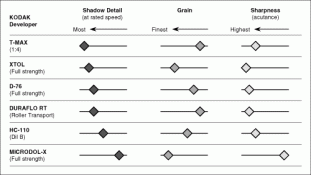
Kodak's quick comparison chart is quite useful, Xtol is their best all round B&W developer and I'd have to agree. Personally I'm not a fan of HC 110 or the Ilford equivalent Ilfotec HC (or LC)

Ian
 

Attachments

  • kodak_comp.gif
    kodak_comp.gif
    8 KB · Views: 134
Now myself have found diluting Rodenol & extending time out has reduced grain & reduced sharpness. But in my case I was trying to do so with out of date HP4 in 1 to 100 Rodenol for 1 hour. Lucky film done in 1 to 100 has almost no grain.
 
Can never find the link when you want it, but I saved a copy

Kodak's quick comparison chart is quite useful, Xtol is their best all round B&W developer and I'd have to agree. Personally I'm not a fan of HC 110 or the Ilford equivalent Ilfotec HC (or LC)

Ian

I have the same problem with finding that chart. They put it near the "Sell Sheet" for B&W developers:

http://wwwtr.kodak.com/global/en/professional/products/chemistry/bwFilmProcessing/selecting.jhtml?pq-path=14053
 
I share this experience... Strange. I used Rodinal a lot with Plus-X 120, at 1:200 dilution and stand development for an hour.
Compared to negs processed according to standard agitation, the grain was substantially less pronounced. The photos were pinhole shots, so judging sharpness was not going to make a difference either way.

I agree with Ian that Xtol is a really good allround developer, which gives super sharp negatives with very fine and acute grain. Especially as replenished. But one man's ceiling is another man's floor.

Now myself have found diluting Rodenol & extending time out has reduced grain & reduced sharpness. But in my case I was trying to do so with out of date HP4 in 1 to 100 Rodenol for 1 hour. Lucky film done in 1 to 100 has almost no grain.
 
Don't forget that poorly buffered developers (like Rodinal) will have greater affects in regards to pH buffering as they are diluted.
 
Photrio.com contains affiliate links to products. We may receive a commission for purchases made through these links.
To read our full affiliate disclosure statement please click Here.

PHOTRIO PARTNERS EQUALLY FUNDING OUR COMMUNITY:


Ilford ADOX Freestyle Photographic Stearman Press Weldon Color Lab Blue Moon Camera & Machine
Top Bottom