
• Welcome to Photrio!
    Registration is fast and free. Join today to unlock search, see fewer ads, and access all forum features.
    Click here to sign up

Changing Speeeds On Cocked Shutter

Recent Classifieds

Forum statistics

Threads
203,596
Messages
2,856,903
Members
101,917
Latest member
Swarls
Recent bookmarks
0

Tom1956

Inactive
Allowing Ads
Joined
May 6, 2013
Messages
1,989
Location
US
Format
Large Format
There has always been confusion as to the wisdom of changing shutter speeds on a cocked shutter. After spending a good many hours of re-working and studying an actual shutter, I can unequivocally say that it is not at all recommended. To clear up confusion as to the "why" of it is to first dispel worry of stripping a gear (in this case the Graphex shutter). There is no danger of instant destruction of that sort. You won't "break off"anything.
However, you will soon ruin any accuracy the shutter has, or had. The cocking of the shutter puts pressure upon the speed cam, which is made of a fairly soft brass. In this case the drive gear segment has a peg that rides on the speed setting cam. Turning the cam (changing speeds) causes wear in a short period of time, which increases the travel of the drive gear segment, which in turn causes speeds to grow slower and slower. The time frame for this wear is surprisingly short--on the order of mere weeks for an old-time newspaper photog with his Speed Graphic. Months at most.
When changing speeds with the shutter uncocked, the peg does not even touch the cam at all, so no wear. All this said, these iris shutters have such an infinitesimally small adjustment range that mere weather, hot or cold alone, can cause expansion or contraction issues as much as 3/4 of a stop. A shutter serviceman who slightly over-tightens the faceplate after a service job can add to the problem by another 1/2 stop. Additively, I can easily see that errors of a whole stop or more can occur when factoring in wear from changing speeds with the shutter cocked.
One f/stop is a lot. Anyone who spends half his darkroom time just making test strips can relate to the annoyance.
Don't change speeds on a cocked shutter.
 
hi tom

i always knew this to be true on dial shutters but is this true with shutters like (older) betax where there are variable speeds inbetween the speeds?
thanks
john
 
i always knew this to be true on dial shutters but is this true with shutters like (older) betax where there are variable speeds inbetween the speeds?

True for dial-set Compurs, as you say. The recco to not change speeds on a cocked shutter was related to the high speed helper spring more than microscopic wear on the speed ring. Interesting point: Zeiss lenses on Hasselblad are ALWAYS speed changed on cocked shutter. Are they stupid or misleading us with erroneous engineering so we wear them out fast and have to buy replacements every 6 months?
 
True for dial-set Compurs, as you say. The recco to not change speeds on a cocked shutter was related to the high speed helper spring more than microscopic wear on the speed ring. Interesting point: Zeiss lenses on Hasselblad are ALWAYS speed changed on cocked shutter. Are they stupid or misleading us with erroneous engineering so we wear them out fast and have to buy replacements every 6 months?

This thread is in the large format section. I was talking about the rim set shutter such as Wollensak. You do what you want.
 
Dial set Compurs were used for large format cameras too.
 
The Compur and Prontor shutters of Hasselblad follow the same design as shutters for large format cameras.
 
This thread is in the large format section. I was talking about the rim set shutter such as Wollensak. You do what you want.

I will, since no problems have ever arisen from such actions... and I will also defer to the knowledge of the manufacturer.

From the Graphex rim-set (AKA Wollensak) shutter operation instructions (part of the Graphic camera manual): "The speed settings can be changed before or after cocking the shutter, but is more easily accomplished before cocking." :whistling:
 
There has always been confusion as to the wisdom of changing shutter speeds on a cocked shutter. After spending a good many hours of re-working and studying an actual shutter, I can unequivocally say that it is not at all recommended. To clear up confusion as to the "why" of it is to first dispel worry of stripping a gear (in this case the Graphex shutter). There is no danger of instant destruction of that sort. You won't "break off"anything.
However, you will soon ruin any accuracy the shutter has, or had. The cocking of the shutter puts pressure upon the speed cam, which is made of a fairly soft brass. In this case the drive gear segment has a peg that rides on the speed setting cam. Turning the cam (changing speeds) causes wear in a short period of time, which increases the travel of the drive gear segment, which in turn causes speeds to grow slower and slower. The time frame for this wear is surprisingly short--on the order of mere weeks for an old-time newspaper photog with his Speed Graphic. Months at most.
When changing speeds with the shutter uncocked, the peg does not even touch the cam at all, so no wear. All this said, these iris shutters have such an infinitesimally small adjustment range that mere weather, hot or cold alone, can cause expansion or contraction issues as much as 3/4 of a stop. A shutter serviceman who slightly over-tightens the faceplate after a service job can add to the problem by another 1/2 stop. Additively, I can easily see that errors of a whole stop or more can occur when factoring in wear from changing speeds with the shutter cocked.
One f/stop is a lot. Anyone who spends half his darkroom time just making test strips can relate to the annoyance.
Don't change speeds on a cocked shutter.


Is it off topic to ask if this holds true for TLRs? I'm talking specifically about mine (of course), which has a Compur shutter.
 
The Compur and Prontor shutters of Hasselblad follow the same design as shutters for large format cameras.

When I advance the film on my Hassy (503 CX), it cocks the shutter - without the film advanced, and shutter cocked the viewfinder is blank and I am not able to take a meter reading, which means that by necessity, the speed is always changed on a cocked shutter - I can't believe that they would design things this way if it was bad for the shutter. What the OP is saying implies that there is some fundamental difference between my LF shutters and the ones in my MF lenses - which just doesn't make sense to me.....
 
I posted it in the spirit that most Speeds and Crowns were fitted with Wollensak style rim-set shutters. Perhaps the moderators will see fit to just remove the dmn thread.
Edit I'm talking about these America-made shutters with dials made out of chrome-plated cheap soft brass, and you guys are throwing German-made Compurs at me to dispel the advice. Are we going to compare a Sherman tank to a Tiger tank too? Because there again, the Tiger can blow up dozens of American tanks without getting more than a dent. It's about the same analogy.
 
Last edited by a moderator:
Yes, the spirit may have been well-intentioned but your information is speculative and incorrect. If you want the thread removed you can always ask a mod to do so and they seem to generally comply.
 
Edit I'm talking about these America-made shutters with dials made out of chrome-plated cheap soft brass, and you guys are throwing German-made Compurs at me to dispel the advice.

The manual for that "America-made" shutter dispelled the advice, not "you guys throwing German-made Compurs".
 
Moderators, please remove the thread. It has attracted a heckler. Thank you.
 
Not a heckler. You are being to sensitive. It has attracted someone who has additional knowledge to add to the discussion. This is a discussion forum after all, and discussion often involved diversity of opinion and fact. If that offend you, well...
 
Oh, and at the risk of offending anyone any more than already and unintentionally done... the slots in the speed ring (cam assembly) of a Graphex shutter are designed to be greased, as stated in the Graphex repair manual. Friction wear of any magnitude is unlikely if shutter is properly overhauled/maintained. This is not my opinion, it is documented in Fig 14 of the repair manual (and just happens to be consistent with that of German-made Compur shutters).
 
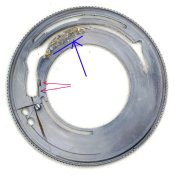
Pardon me for being testy today Brian. I stayed up till nearly 3 in the morning like a fool, peening on this stupid cam to get my shutter speeds up. It was a mess. Not only was it worn out, but some boob had been filing on it. Either that, or it was plain slap worn out. Look at all the peening I had to do to get the speeds up (in the most-used ranges of 50-100). It was evidence enough for me to inspire the post. Look at this mess. But I finally got the speeds up to par.
 

Attachments

  • Shutter ring back.jpg
    Shutter ring back.jpg
    366.7 KB · Views: 187
Having serviced Graphex, Supermatic, Compur shutters the major cause for wear that results in a speed dial that has to be swedged to get the speeds correct is heavy use or running them until the stop working. The shutters that I have serviced that were run until they stopped working or were so far off that compensating was difficult were the ones that needed the most swedging to get correct. They were the ones that had broken parts. They are the ones that the speeds were all over the place requiring the most tweaking of a single speed or two to get them all within tolerance. The heavy wear shutters were consistent across the speed range and easier to adjust once cleaned and correctly lubed. All rim set shutters weather made by US or them other countries are similar in operation and mechanical make up. The pins, posts and levers that contact the main dial are all spring tensioned. In the uncocked state there is no tension applied to them so they put little pressure on the main dial which results in the dial being easier to turn than it is when the shutter is cocked.

Then there are those self cocking "press" shutters that are always in the cocked state until tripped.:smile:
 
Having serviced Graphex, Supermatic, Compur shutters the major cause for wear that results in a speed dial that has to be swedged to get the speeds correct is heavy use or running them until the stop working. The shutters that I have serviced that were run until they stopped working or were so far off that compensating was difficult were the ones that needed the most swedging to get correct. They were the ones that had broken parts. They are the ones that the speeds were all over the place requiring the most tweaking of a single speed or two to get them all within tolerance. The heavy wear shutters were consistent across the speed range and easier to adjust once cleaned and correctly lubed. All rim set shutters weather made by US or them other countries are similar in operation and mechanical make up. The pins, posts and levers that contact the main dial are all spring tensioned. In the uncocked state there is no tension applied to them so they put little pressure on the main dial which results in the dial being easier to turn than it is when the shutter is cocked.

Then there are those self cocking "press" shutters that are always in the cocked state until tripped.:smile:

That was interesting. I have a question. Being as this is apparently just chrome plated brass what would be your opinion of adding metal through soldering or with a small torch? While it may be destructive to the chroming, metal added could be possibly a way to renew the dial plate damaged through wear and excessive peening? Although absurd in the amount of trouble, could adding metal be feasible?
 
Tom. Just a suggestion but you might want to quit while you are already behind. That shutter appears to be a real 'fuster cluck".
 
Thanks, but the shutter is actually clean as a whistle and on-speed now. Before, I had nothing. Now I have accuracy from 5-10% up to 100. There is no 400, and I have to put it on 400 to get 200. but before, 400 was 130, 100 was 65, 1/2 was .702, and 1 second was .800. The only speed that worked was 1/50, which was dead-on, and I left it alone.
On top of that, the front lens element was so full of cleaning marks that it was worthless. I liberated a beautiful front element out of another 135 Optar where somebody had shattered element #2.
Now I have something I can use with confidence.

I don't give up. I can repair ANYTHING.
 
Last edited by a moderator:
Well... I commend you for persistence, and if you don't need 400 then you are good-to-go.
 
What's a '400'? I use a 'T' most of the time, the other times I use the '1' or maybe the '2'... :wink:
 
Photrio.com contains affiliate links to products. We may receive a commission for purchases made through these links.
To read our full affiliate disclosure statement please click Here.

PHOTRIO PARTNERS EQUALLY FUNDING OUR COMMUNITY:


Ilford ADOX Freestyle Photographic Stearman Press Weldon Color Lab Blue Moon Camera & Machine
Top Bottom