• Welcome to Photrio!
    Registration is fast and free. Join today to unlock search, see fewer ads, and access all forum features.
    Click here to sign up

Certificates of Authentication

Finis Lineae

H
Finis Lineae

  • 0
  • 0
  • 17
Angular building 6

A
Angular building 6

  • 3
  • 0
  • 39

Recent Classifieds

Forum statistics

Threads
202,555
Messages
2,842,265
Members
101,379
Latest member
deckeda
Recent bookmarks
0

stevenje

Subscriber
Allowing Ads
Joined
Aug 3, 2013
Messages
58
Format
Multi Format
I was looking at Tim Rudman’s website and noticed his prints came with a certificate of authentication.

For the members out there that sell prints, do you have certificates of authentication for your prints?

How important is it and is it really necessary?

How are the certificate of authentication records kept so they are searchable and verifiable?

Thanks.
 
Which is easier to fake, a print or a certificate of authenticity?

How are the certificate of authentication records kept so they are searchable and verifiable?

I don't believe they are.
 
A long time ago now, but when printing Ilfochrome Classic prints at ChromaColour in South Australia, Certificate of Authenticity was provided with each bespoke print, enumerated by the photographer (title, edition, file number) and signed by them, and not with an AutoPen!) These Certificates were the preserve of the production manager, the printer and the photographer, nobody else. They are not the things one keeps in an electronic archive, nor searchable, just a solid, verifiable accompaniment to a print, a reassurance to the purchaser (from the lab/production facility that the 'chromes are the real deal.
If you are not producing works of high value and skill, like Tim Rudman's, a Certificate of Authenticity is not going to give you star power.

There is still debate whether a CofA provides any additional monetary value over and above the print it accompanies.


Which is easier to fake, a print or a certificate of authenticity?

Both. I have seen faked Ilfochrome Classic prints about 30 years ago, described as "quality Cibas" but found to be RA4 prints on high-gloss material! Anybody can dream up a Certificate of Authenticity and big-note themselves that such a scrap of card with a gold-embossed logo will add thousands of dollars to a mediocre print. My own Ilfochromes were accompanied by a Certificate of Authenticity — there are likely still a few stashed away accompanying matted/wrapped IC prints.
 
Last edited:
If they are individually numbered, and their issuance and the accompanying delivery of prints is done by entities that make careful records of such things as the identity of purchasers, then they can assist in establishing provenance.
 
If they are individually numbered, and their issuance and the accompanying delivery of prints is done by entities that make careful records of such things as the identity of purchasers, then they can assist in establishing provenance.

I've got a certificate of authentication for my purchase of the Golden Gate Bridge but alas had not got any of the above, Matt . I'd have been better saving Kim Novak underneath the Bridge that day instead of buying the Bridge itself.

pentaxuser
 
Last edited:
If they are individually numbered, and their issuance and the accompanying delivery of prints is done by entities that make careful records of such things as the identity of purchasers, then they can assist in establishing provenance.

In other words, of no value unless they are issued by some kind of organization that can be consulted in case of a dispute.
 
In other words, of no value unless they are issued by some kind of organization that can be consulted in case of a dispute.

… presumably with credible credentials too.
 
I don’t sell many prints but when I do it is directly to the buyer or sold through a gallery. I haven’t done this but I know a photographer who has: design a unique embossing stamp,generally sign the back of the print with a pencil and emboss including a part of the signature. While I guess this too could be copied someone would have to go to a lot of trouble to copy it and would have to have access to the embossing stamp design.
 
I was looking at Tim Rudman’s website and noticed his prints came with a certificate of authentication.

For the members out there that sell prints, do you have certificates of authentication for your prints?

How important is it and is it really necessary?

How are the certificate of authentication records kept so they are searchable and verifiable?

Thanks.

I don't provide them and I don't exprct them either when I by a print.
 
I remember Nick Carvery doing a video on this. He keeps a spreadsheet tracking all the prints and certs he has issued.
 
In other words, of no value unless they are issued by some kind of organization that can be consulted in case of a dispute.

Correct.
A reputable gallery that has been around for a while being one example.
An entity with a long term interest in provenance issues.
 
A long time ago now, but when printing Ilfochrome Classic prints at ChromaColour in South Australia, Certificate of Authenticity was provided with each bespoke print, enumerated by the photographer (title, edition, file number) and signed by them, and not with an AutoPen!) These Certificates were the preserve of the production manager, the printer and the photographer, nobody else. They are not the things one keeps in an electronic archive, nor searchable, just a solid, verifiable accompaniment to a print, a reassurance to the purchaser (from the lab/production facility that the 'chromes are the real deal.
If you are not producing works of high value and skill, like Tim Rudman's, a Certificate of Authenticity is not going to give you star power.

There is still debate whether a CofA provides any additional monetary value over and above the print it accompanies.


Both. I have seen faked Ilfochrome Classic prints about 30 years ago, described as "quality Cibas" but found to be RA4 prints on high-gloss material! Anybody can dream up a Certificate of Authenticity and big-note themselves that such a scrap of card with a gold-embossed logo will add thousands of dollars to a mediocre print. My own Ilfochromes were accompanied by a Certificate of Authenticity — there are likely still a few stashed away accompanying matted/wrapped IC prints.

If you're buying an expensive photo, the CofA may not add cost. But it adds more assurance that the photo is not a fake, especially if a well known seller or gallery or auction provides a certificate. In addition, photos are easier to duplicate than a unique oil painting.
 
I've got a certificate of authentication for my purchase of the Golden Gate Bridge but alas had not got any of the above, Matt . I'd have been better saving Kim Novak underneath the Bridge that day instead of buying the Bridge itself.

pentaxuser

My certificate for the bridge is labelled 001. What number is yours?
 
If you're buying an expensive photo, the CofA may not add cost. But it adds more assurance that the photo is not a fake, especially if a well known seller or gallery or auction provides a certificate. In addition, photos are easier to duplicate than a unique oil painting.

That is why we, as 'chrome printers at the time, had the sole responsibility of issuing Certificates direct to the client. Certificates were never, not once seconded to any galley to issue, sign or otherwise embellish – it is not a gallery's business, and there was the belief it was simply too open to abuse. Only the printers, in the presence of the photographer (including Lík, Dobré, Duncan et al) had authority to issue and inspect CofAs. The prints were, in so very many cases costing as much as a decent small car to produce (Lík's especially!) and then add the colossal frame-up! All in all, the production and issuing of Certificates was most certainly not a back-room, after work hobbyist operation. It was in effect, reserved particularly for the very successful, internationally known and respected artists (Tim Rudman is in that league in monochrome print production editions); it added prestige and bragging rights for the purchaser, but fundamentally not extra value.
 
Correct.
A reputable gallery that has been around for a while being one example.
An entity with a long term interest in provenance issues.

As in painting and fine art printmaking (lithography, silkscreen, etc), the only one who can authenticate an artwork is the creator or the estate or an expert authority with the depth of knowledge of the artist's work. Not the gallery. A gallery is the last one I would trust as a matter of fact.
 
As in painting and fine art printmaking (lithography, silkscreen, etc), the only one who can authenticate an artwork is the creator or the estate or an expert authority with the depth of knowledge of the artist's work. Not the gallery. A gallery is the last one I would trust as a matter of fact.

Absolutely!|
 
As in painting and fine art printmaking (lithography, silkscreen, etc), the only one who can authenticate an artwork is the creator or the estate or an expert authority with the depth of knowledge of the artist's work. Not the gallery. A gallery is the last one I would trust as a matter of fact.

I'm thinking of the Equinox Gallery in Vancouver, who were instrumental in Fred Herzog becoming a well known photographer, outside of a very small and local group of fans.
Most of Fred Herzog's work was still in the form of slides before the Equinox Gallery made the print series' happen, which in turn led to the books.
The people behind the Equinox also served as Fred Herzog's agent.
If it weren't for the Equinox, most people would either never have known of Mr. Herzog, or know him as a result of seeing a slide show in a church or community centre basement.
Ib would include well known and reputable museums among the Galleries whose interest in provenance would make them reliable.
 
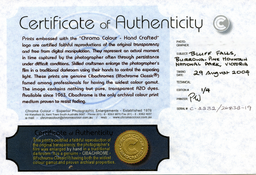
This is an actual sample of the Certificates that were issued by us at Chromacolour (Ciba/Ilfochrome Classic specialist printers) in South Australia (the business closed down, was soon demolished and is now home to multistorey townhouses). The error with this Cert. that makes it invalid is the mixed-up file numbers.

My own Ilfochrome Classic prints (not a big time photographer, but as a printer of Ilfochromes!) always went out with a Certificate enclosed in the clear overwrap at the back.

I think today Certificates of Authenticity are not so generally useful when you have now, for example, a lot of photographers commonly detailing print, subject, technical and photographer information on the verso (as a label, or archival slip) and signed.
 

Attachments

  • CofA_error_FileNumericDouble_PW_2004.png
    CofA_error_FileNumericDouble_PW_2004.png
    1.4 MB · Views: 62
I was looking at Tim Rudman’s website and noticed his prints came with a certificate of authentication.

For the members out there that sell prints, do you have certificates of authentication for your prints?

How important is it and is it really necessary?

How are the certificate of authentication records kept so they are searchable and verifiable?

Thanks.

It seems to work for Mr Rudman and a-lot of peoples.
 
This is an actual sample of the Certificates that were issued by us at Chromacolour (Ciba/Ilfochrome Classic specialist printers) in South Australia (the business closed down, was soon demolished and is now home to multistorey townhouses). The error with this Cert. that makes it invalid is the mixed-up file numbers.

My own Ilfochrome Classic prints (not a big time photographer, but as a printer of Ilfochromes!) always went out with a Certificate enclosed in the clear overwrap at the back.

I think today Certificates of Authenticity are not so generally useful when you have now, for example, a lot of photographers commonly detailing print, subject, technical and photographer information on the verso (as a label, or archival slip) and signed.

Who issued that sample of CofA? There's no one listed? So who's authenticating it? Without that, there is no authentication as far as I can tell.
 
Who issued that sample of CofA? There's no one listed? So who's authenticating it? Without that, there is no authentication as far as I can tell.

Look again, the issuer and authenticator is stated on the certfiicate: Chroma Colour, the printer.
 
Last edited:
I'm thinking of the Equinox Gallery in Vancouver, who were instrumental in Fred Herzog becoming a well known photographer, outside of a very small and local group of fans.
Most of Fred Herzog's work was still in the form of slides before the Equinox Gallery made the print series' happen, which in turn led to the books.
The people behind the Equinox also served as Fred Herzog's agent.
If it weren't for the Equinox, most people would either never have known of Mr. Herzog, or know him as a result of seeing a slide show in a church or community centre basement.
Ib would include well known and reputable museums among the Galleries whose interest in provenance would make them reliable.

Nice, but it has nothing to do with a certificate of authenticity. If anything, the more well-known a photographer is, the more likely that unauthorized copies of the work would be floating around.
 
Nice, but it has nothing to do with a certificate of authenticity. If anything, the more well-known a photographer is, the more likely that unauthorized copies of the work would be floating around.

The point is that the Gallery and the agent were instrumental in causing the printed work to come into being, and it was they that were instrumental in managing the distribution to initial buyers, so they were perfect parties to both issue and track, if necessary, certificates of authenticity.
 
Photrio.com contains affiliate links to products. We may receive a commission for purchases made through these links.
To read our full affiliate disclosure statement please click Here.

PHOTRIO PARTNERS EQUALLY FUNDING OUR COMMUNITY:


Ilford ADOX Freestyle Photographic Stearman Press Weldon Color Lab Blue Moon Camera & Machine
Top Bottom