
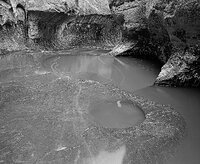
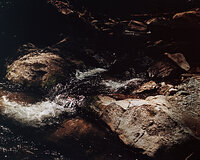

With carbon transfer, one of the challenges is to get a smooth transition from paper white to the first visible tone. Optical density consists of the physical thickness of the gelatin matrix that survives warm-water development. So very low densities (delicate highlights) are very, very thin gelatin layers which are literally very delicate. There's a minimum thickness that will survive the warm water development bath, and this can cause jagged transitions between paper white and a distinct grey tint, so a coarse transition. This phenomenon is referred to as the 'tonal threshold' by Calvin Grier, who has documented the issue very well.
In my experience, the tonal threshold problem is far more pronounced/problematic with DAS sensitized carbon tissue than when using dichromate. For obvious reasons, people are moving away from dichromate, so it's relevant to address the tonal threshold issue. Btw, the tonal threshold problem can and in fact does also occur with dichromate. The classical solution is to use a very low pigment load and a thick tissue, but this also has other implications that are not always desirable.
Calvin proposed some time ago to use a clear layer on top of the pigmented tissue to ensure that even the lightest visible tone is made physically more robust by essentially adhering it to an unpigmented layer of significant thickness. He calls this clear top coat a 'super coat' and has demonstrated the concept in an e-book and accompanying YouTube video.
In the months since publication, reports have started to pop up of people experiencing success with this approach. Most notably Vlad Yurkov's spectacular prints:
And he's not alone: https://groups.io/g/carbon/topic/supercoating_first_results/119005127
My initial attempts didn't work; I saw no improvement and/or even more severe adhesion problems: https://tinker.koraks.nl/photograph...et-first-test-with-supercoated-carbon-tissue/
However, subsequent attempts resulted in success: https://tinker.koraks.nl/photography/top-the-coat-another-try-with-super-coated-carbon/
I've been making prints using this method over the past few weeks and my impression so far (but "the night is still young" on this one) is that it's (1) a game-changer and (2) practically quite doable. I've not been able to explain my initial failures, although I've been (and likely continue to) running into challenges on the way in adapting this concept for my own workflow.
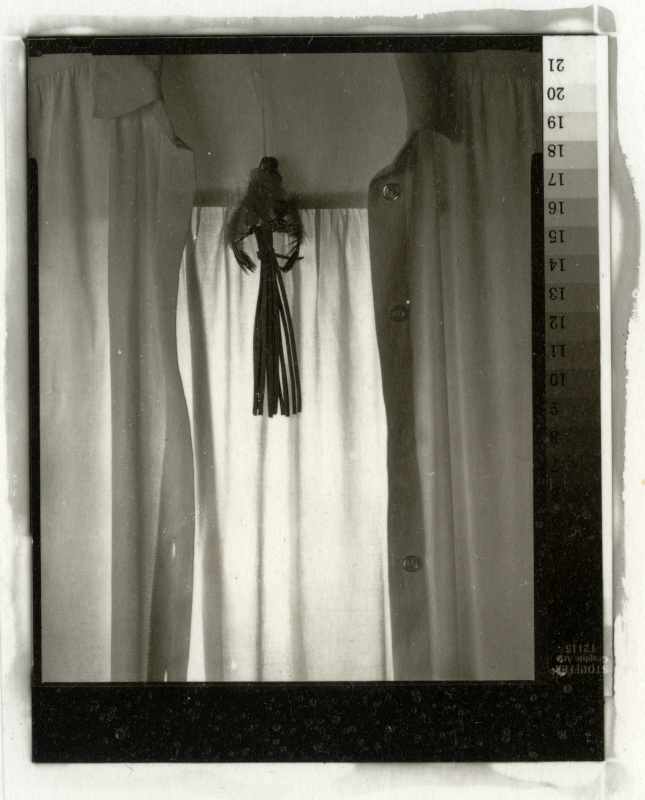
A few of the issues I've been running into so far:
Exposures are really long. The clear supercoat just adds a layer that you need to print through, so effectively the response curve shifts to the right considerably. This can easily make the exposure 1-2 stops slower, and DAS is already quite slow. So this benefits from a powerful light source.
It's challenging to apply a thin layer of consistent thickness on top of an existing pigmented layer of gelatin. It takes some experimentation to figure out a way to manage this. So far my best success has been simply spreading the supercoat emulsion with my fingers on top of the still wet, but already set pigmented layer. The visual effect of thickness variation in the clear supercoat layer is quite massive, which is why it's so important to try and maintain consistent thickness.
To help coat a thin layer of gelatin and assist drying (I suppose), Calvin adds ethanol to the clear supercoat emulsion. However, if you add too much, the dissolved gelatin congeals, rendering it unusable. So there's a limit to how much ethanol can be used (up to ca. 30% of the total volume seems OK).
I've had quite a few prints where the supercoat emulsion blistered in areas of high exposure. Apparently this is a delamination effect between both the gelatin layers. I'm not quite sure yet what causes this and how it can be controlled. For now this is perhaps the most pressing issue. I'm sure I'll find a solution though.
I've not had much time to make tissues, so I've not been able to do nearly as much testing as I would have liked to. I hope others will be stimulated to try this technique for themselves and share their insights & experiences here, positive or negative.
In my experience, the tonal threshold problem is far more pronounced/problematic with DAS sensitized carbon tissue than when using dichromate. For obvious reasons, people are moving away from dichromate, so it's relevant to address the tonal threshold issue. Btw, the tonal threshold problem can and in fact does also occur with dichromate. The classical solution is to use a very low pigment load and a thick tissue, but this also has other implications that are not always desirable.
Calvin proposed some time ago to use a clear layer on top of the pigmented tissue to ensure that even the lightest visible tone is made physically more robust by essentially adhering it to an unpigmented layer of significant thickness. He calls this clear top coat a 'super coat' and has demonstrated the concept in an e-book and accompanying YouTube video.
In the months since publication, reports have started to pop up of people experiencing success with this approach. Most notably Vlad Yurkov's spectacular prints:
And he's not alone: https://groups.io/g/carbon/topic/supercoating_first_results/119005127
My initial attempts didn't work; I saw no improvement and/or even more severe adhesion problems: https://tinker.koraks.nl/photograph...et-first-test-with-supercoated-carbon-tissue/
However, subsequent attempts resulted in success: https://tinker.koraks.nl/photography/top-the-coat-another-try-with-super-coated-carbon/
I've been making prints using this method over the past few weeks and my impression so far (but "the night is still young" on this one) is that it's (1) a game-changer and (2) practically quite doable. I've not been able to explain my initial failures, although I've been (and likely continue to) running into challenges on the way in adapting this concept for my own workflow.
A few of the issues I've been running into so far:
Exposures are really long. The clear supercoat just adds a layer that you need to print through, so effectively the response curve shifts to the right considerably. This can easily make the exposure 1-2 stops slower, and DAS is already quite slow. So this benefits from a powerful light source.
It's challenging to apply a thin layer of consistent thickness on top of an existing pigmented layer of gelatin. It takes some experimentation to figure out a way to manage this. So far my best success has been simply spreading the supercoat emulsion with my fingers on top of the still wet, but already set pigmented layer. The visual effect of thickness variation in the clear supercoat layer is quite massive, which is why it's so important to try and maintain consistent thickness.
To help coat a thin layer of gelatin and assist drying (I suppose), Calvin adds ethanol to the clear supercoat emulsion. However, if you add too much, the dissolved gelatin congeals, rendering it unusable. So there's a limit to how much ethanol can be used (up to ca. 30% of the total volume seems OK).
I've had quite a few prints where the supercoat emulsion blistered in areas of high exposure. Apparently this is a delamination effect between both the gelatin layers. I'm not quite sure yet what causes this and how it can be controlled. For now this is perhaps the most pressing issue. I'm sure I'll find a solution though.
I've not had much time to make tissues, so I've not been able to do nearly as much testing as I would have liked to. I hope others will be stimulated to try this technique for themselves and share their insights & experiences here, positive or negative.


