




Andreas Thaler
Subscriber
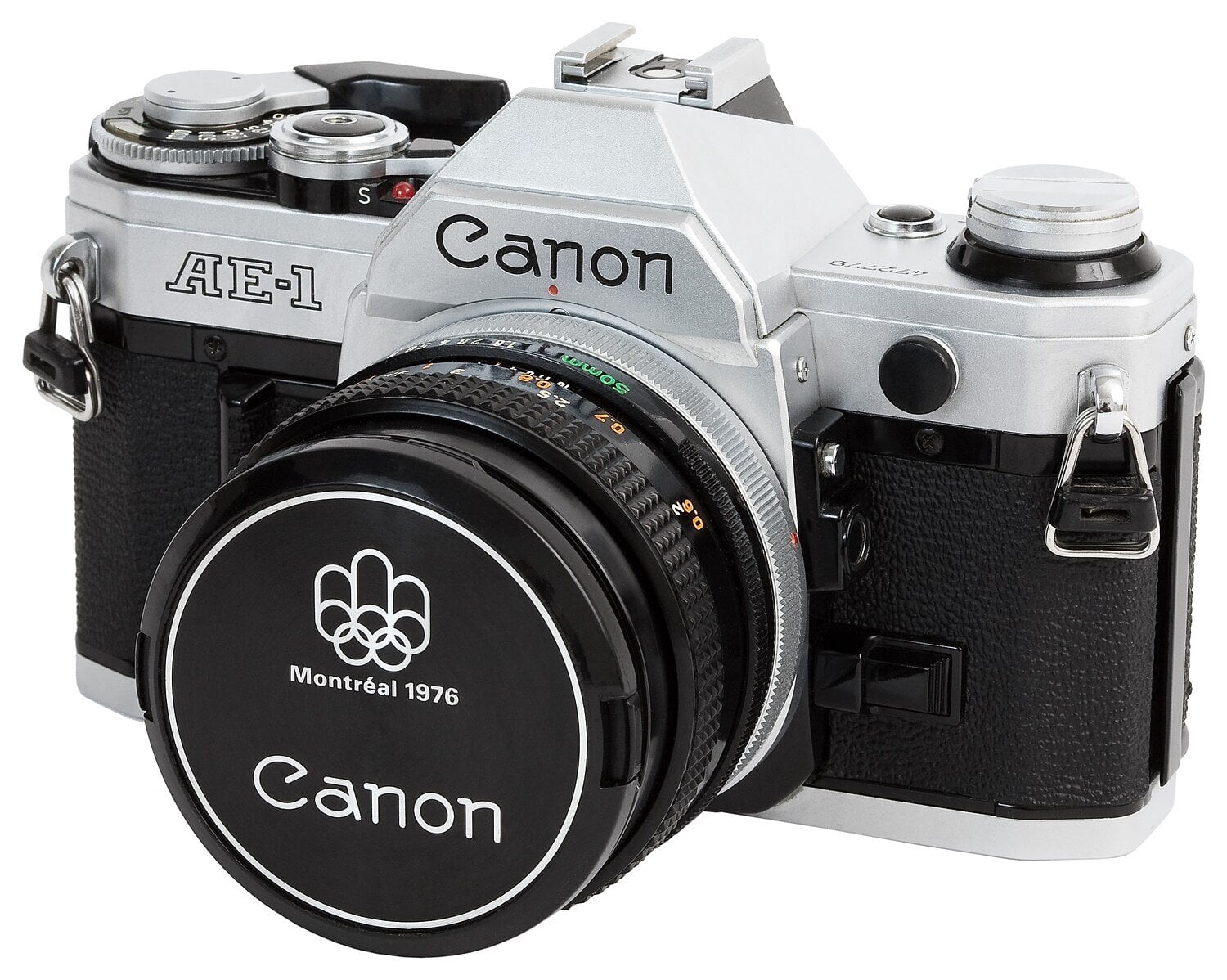
https://commons.wikimedia.org/wiki/File:Canon_AE-1_with_50mm_f1.8_S.C._II.jpg
I’m preparing for my next service and repair project and am researching the Canon AE-1, the first in the Canon Series A line and predecessor of the Canon T90. Fortunately there are more articles and videos available on the AE-1 than on the T90.
Crucial for my own work is that there are articles about the Canon AE-1 in the SPT Journal and in The Camera Craftsman, the latter comprehensive and detailed also regarding the sophistic digital electronic control, sporting a microprocessor. There is also s service guide from National Camera, all available here.
Beside this there's already a wealth of repair information on the AE-1 online, including videos. So I won't be able to offer much new information there, but perhaps I'll be able to with the digital circuitry which was revolutionary back in 1976.
In any case, I have plenty of repair candidates and am curious to see how I'll get on with the horizontal focal plane shutter. And the tungsten wire that transmits signals via rollers - I think you can find it here

Agenda:
- Presentation of the available literature,
- removal of the covers and first orientation in the camera,
- rough documentation of the circuit as far as possible.
https://www.youtube.com/@FotofixVintageCameras/search?query=AE-1
https://www.youtube.com/@GarrysCameraRepair/search?query=AE-1
https://www.youtube.com/@FixOldCameras/search?query=AE-1
This is an excellent video, released by Garry's Camera Repair, showing the disassembly of the AE-1 and service work:
There is a complete 69-page guide for the Canon AE-1 by Larry Lyells which I am working through. Mechanics, electronics, and function are explained in detail. I know of a similar case for the Minolta XD/XD-7/XD-11.
Later digitally controlled SLRs were already too complex to be covered in full. The control took place in highly integrated ICs that were not documented by the manufacturers. This would have made no sense due to the complexity; instead, the product brochures and special publications for the top SLRs included block diagrams that showed how the circuits worked.
From a repair perspective, it's sometimes just a matter of determining whether an IC is working or not. If it's defective, it can be replaced with one from an SLR of the same type. This requires a high level of soldering technology, as numerous fine pins have to be soldered onto flexible, uneven printed circuit boards that are often difficult to access.
Fortunately, ICs are always the last thing suspected when there are problems. Dirty solenoids and switches are more likely.
Studying the AE-1 thus offers the opportunity to fundamentally understand a digital electronic SLR circuit. This is one of the goals of this project.
In the next post, I'll take a look at the area beneath the base plate. There, you'll find an electromagnet and a hybrid (combination) magnet for the shutter and mirror, among other things. The function is best understood through practice; photos will follow.
Tour of the Canon AE-1
In the following, I refer to Larry Lyells' article Canon AE-1: The AE-1 Sales Sensation in The Camera Craftsman, issues starting in July/August 1977.
My goal is to understand the essential functional processes of the AE-1.
Details can be found in this excellently written series of articles, including illustrations.
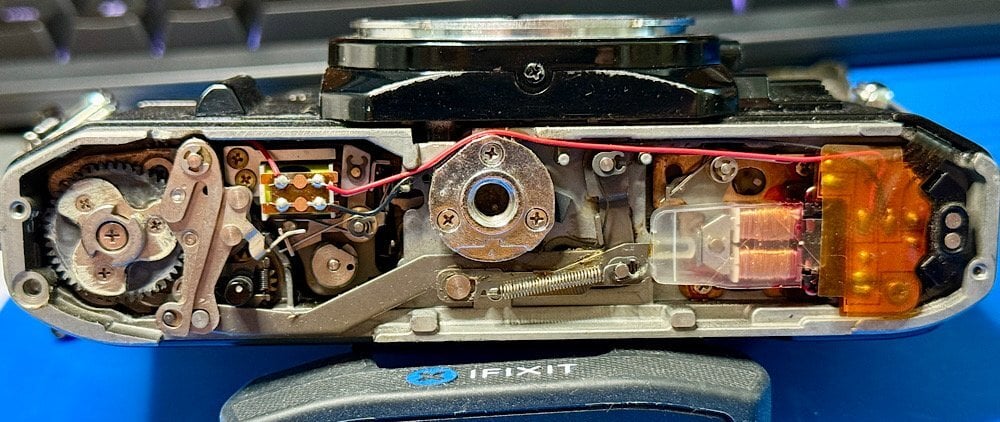
Area under the bottom plate
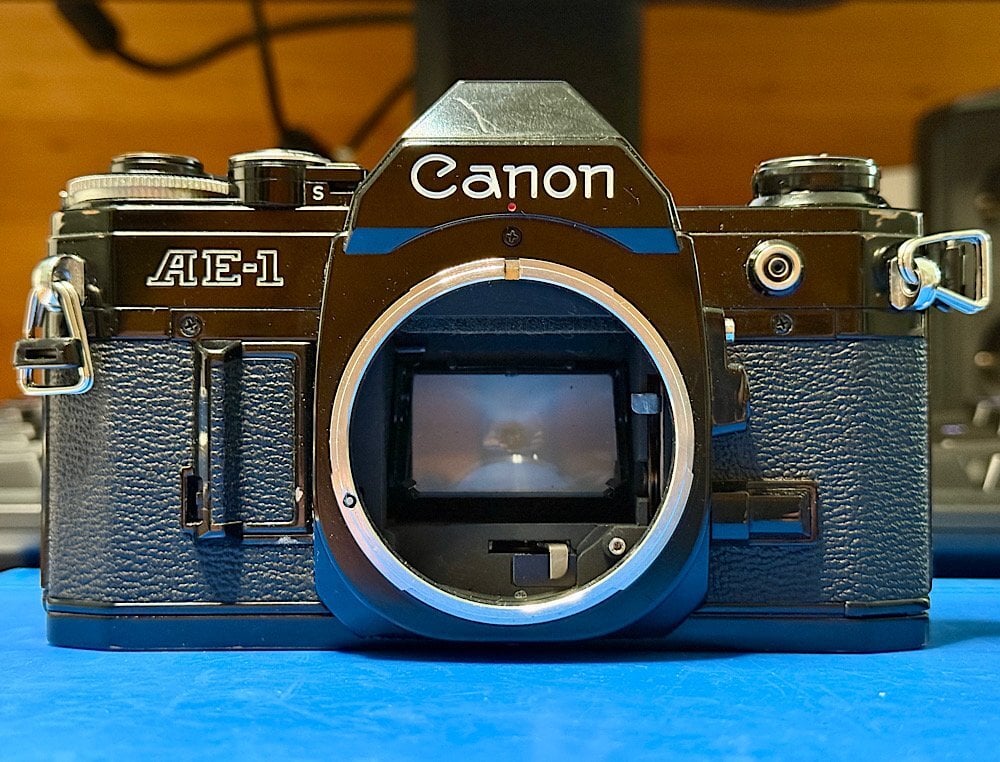
My partner for this article, a working AE-1 in the black version, which, unlike the silver version, is not seen so often.
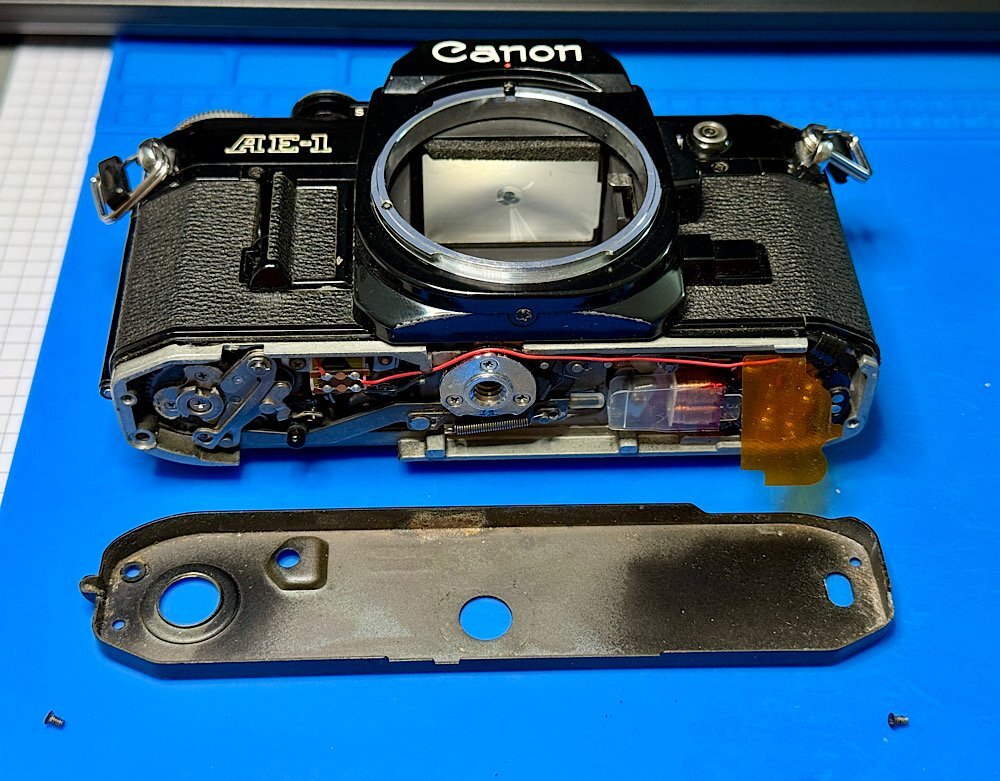
2 screws.
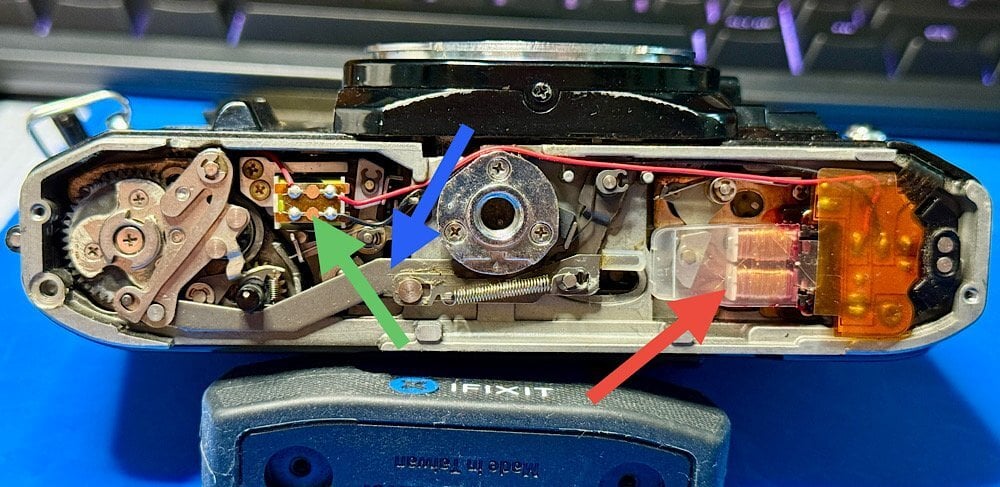
Status: The camera has triggered, the mirror is not cocked, the shutter has released and the aperture is open.
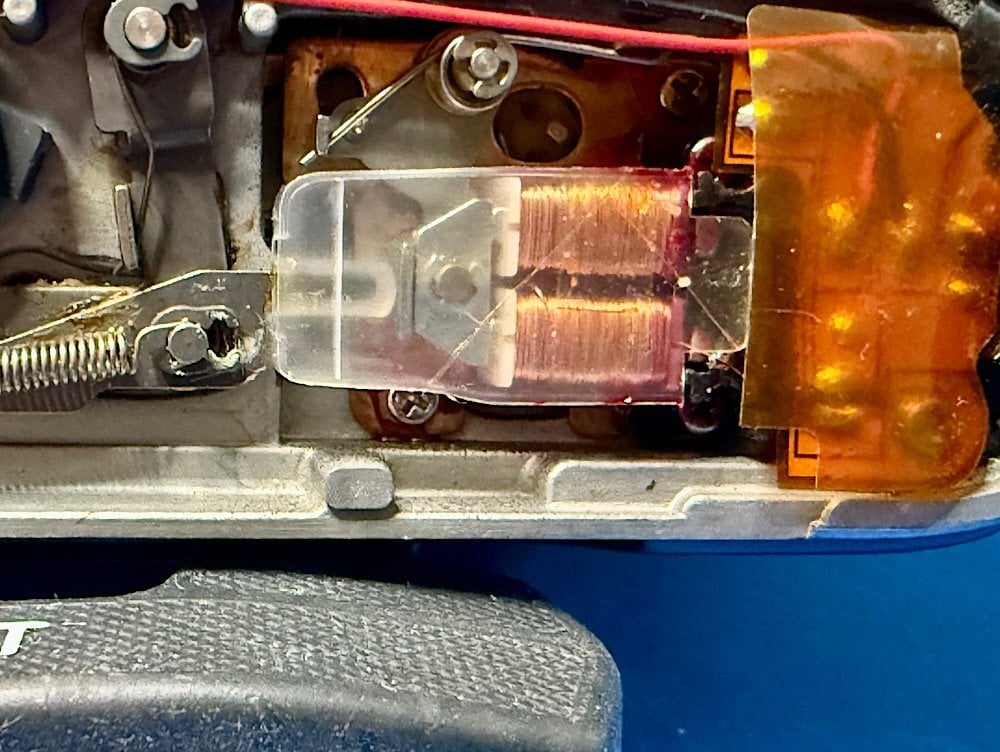
Two of the AE-1's three solenoids are visible.
- Green: closing curtain electromagnet (Mg3),
- Red: mirror-release combination magnet (Mg2).
The electromagnet holds its armature in place when current flows through its coils, creating a magnetic field. When the current flow stops, the armature releases.
The combination magnet holds its armature in place using two permanent magnets. When current flows through the two coils, the resulting magnetic field cancels out the magnetic field of the permanent magnets, and the armature releases.
This each creates an electronically controlled switch with ON and OFF.
Status: The wind-lever is half-pulled.
The charge lever has moved toward Mg2 and is pressing its armature against both permanent magnets.
Both permanent magnets now hold the armature.
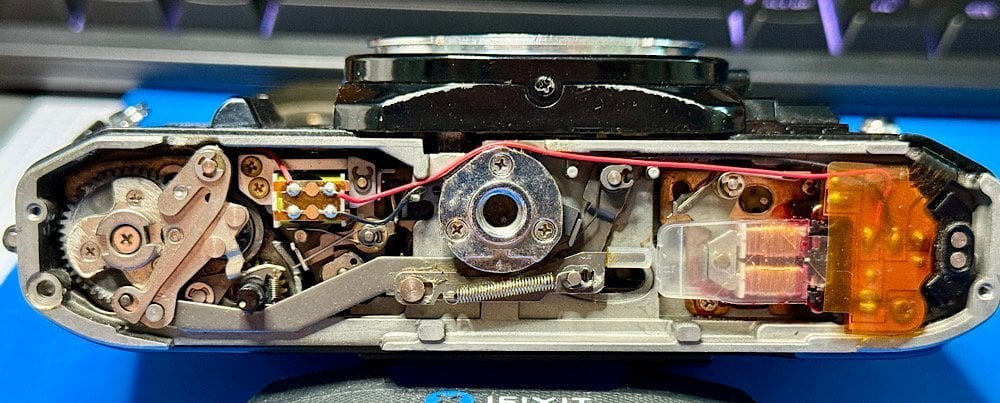
Status: The wind-lever is fully pulled.
The mirror, shutter, and aperture are cocked.
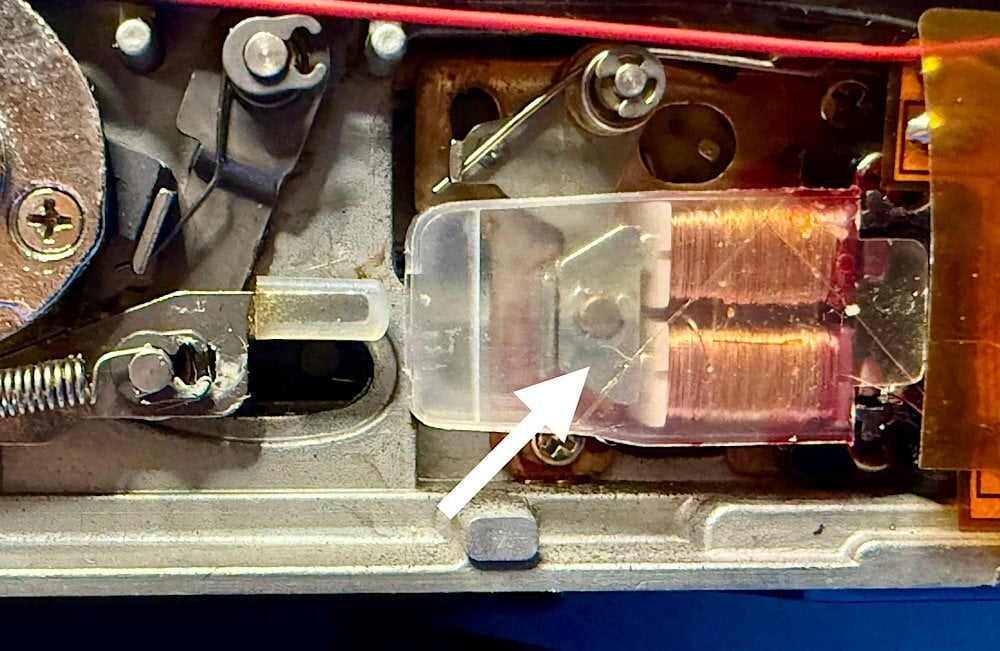
Mg2 holds its armature now by its own force.
The charge lever has moved back to the left.
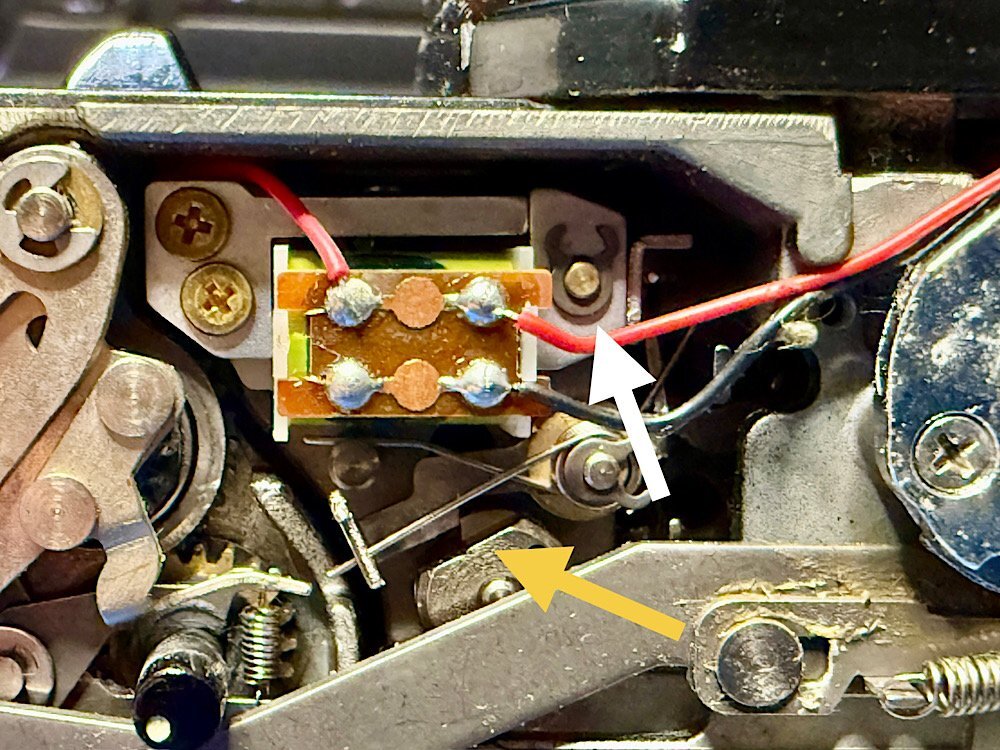
The armature of Mg3 is held mechanically (white).
The armature of Mg3 holds the closing-curtain winding roller (yellow).
The camera is ready to fire.
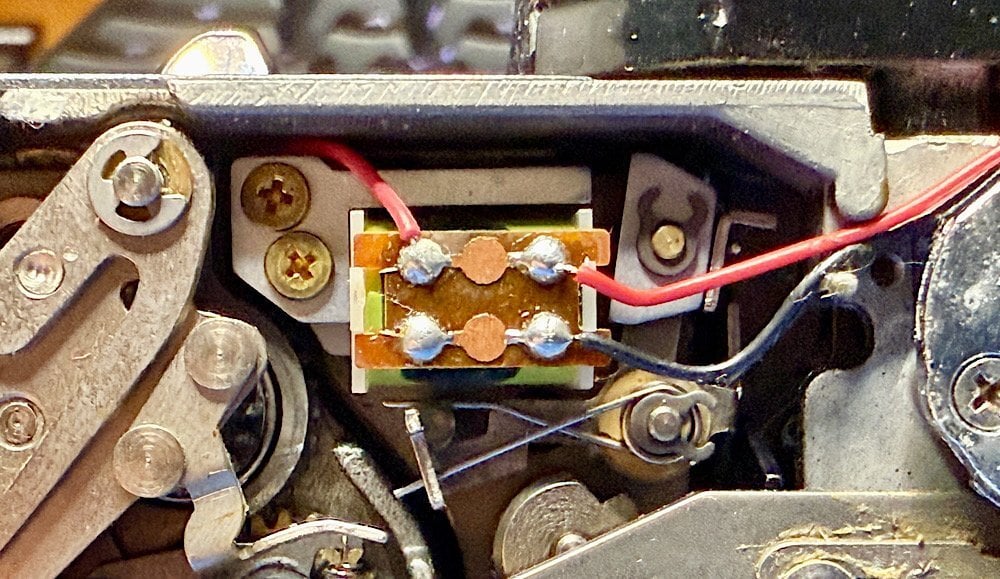
Status: The camera has triggered.
The mirror flipped up and down, both shutter curtains have run down, the aperture has closed and reopened.
The shutter is controlled by an electronic timing system. A capacitor discharges through resistors with different resistance values.
Larry:
Selecting the shutter speed decides how long the Mg3 armature holds the closing curtain. The speed selector connects a certain resistance value in series with a timing capacitor - in this respect, conventional circuitry for an electronically controlled shutter. When the timing capacitor (under the top cover) reaches a certain voltage, a sensing circuit shuts off the current flowing through Mg3. Mg3 then releases its armature to disengage the closing curtain cam. And the closing curtain crosses the aperture to end the exposure.
ibid, p. 22
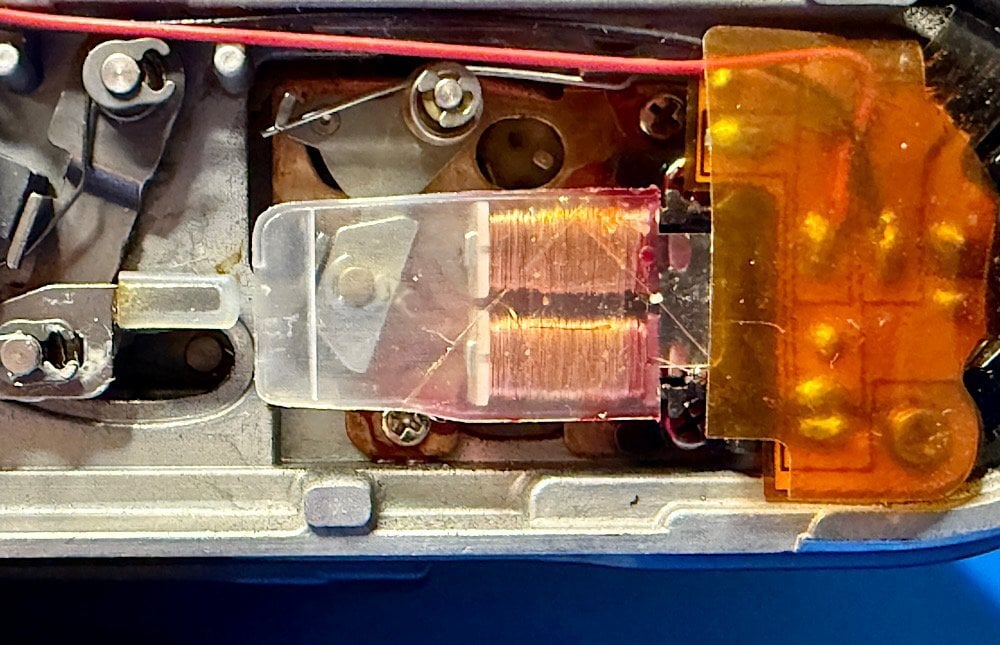
Mg2 in the released status.
For troubleshooting, it's helpful to have a basic understanding of these processes. However, it's not necessary to know all the details.
Troubleshooting instructions guide you through the troubleshooting process, and experience helps to learn more about the camera.
When it comes to electronic control, the doors to understanding mostly remain closed, as the processes in integrated circuits are not documented in detail and are too complex. Here, the IC can only be replaced if it is defective. However, a basic understanding can be achieved; the article by Larry includes a block diagram describing the processes in the three AE-1 ICs.
In the next post, we'll look at how to check the Mg2 mirror release combination magnet.
This will provide you with some practical repair knowledge. Magnets are always the prime suspect in problems caused by dirt.
For the full project report see on photo.net:
Exploring the Canon AE-1: Disassembly, service, technology
+++
 A word of caution
Please keep in mind that you’ll be using highly flammable solvents for service work, and their fumes are harmful to your health. Soldering also produces fumes that should not be inhaled. Dangerous high voltages can be present when handling electronics, especially in conjunction with electronic flash units and mains. Therefore, familiarize yourself with the safety regulations beforehand and ensure your safety. Depending on the activity, protective gear may be advisable.
All information provided without guarantee and use at your own risk.
Acknowledgments
Without the work of Master Larry Lyells, in particular, we wouldn’t have the detailed technical information we need today for service/repair of SLRs.
The SPT Journal and The Camera Craftsman, which he helped shape significantly as an author, and which contain all the necessary information and instructions are available for a fee through Learn Camera Repair.
We owe our access to them to Eugene Pate, the founder of Learn Camera Repair.
Last edited:
