




Andreas Thaler
Subscriber
https://commons.m.wikimedia.org/wiki/File:Canon_A-1_(26329506138).jpg#mw-jump-to-license
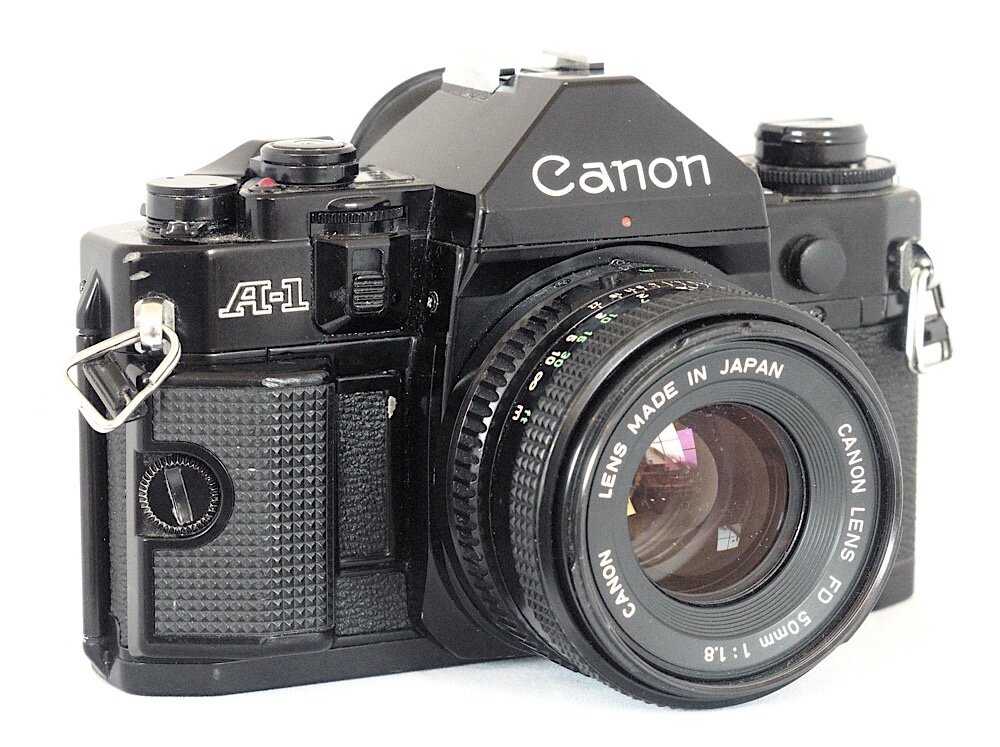
After the Canon AE-1, which we have looked at in detail here, its direct successor - the Canon A-1 - will now be explored and examined for service options.
Several A-1 in unknown condition are available for our project. We'll look at how the A-1 can be disassembled for service, how it's adjusted, and perhaps even a repair job will arise.
Full digital control
Following the Canon AE-1, which became a huge market success from 1976 as an electronically controlled SLR with a microchip, the A-1 followed in 1978. Unlike the AE-1, this SLR is fully digitally controlled.
The A-1 offers full automatic exposure control for the first time, with the camera setting shutter speed and aperture based on subject brightness, ASA, and the lens's maximum aperture - Programmed Automatic Exposure (AE).
With additional shutter priority, aperture priority, and manual setting, the A-1 features the classic exposure functions set found in current cameras for the first time.
Advantages of digital signal transmission
In contrast to analogue signal transmission (as a continuous voltage transmission), digital signal transmission (with only two, clearly separated voltage values) among other things offers these advantages:
Quote
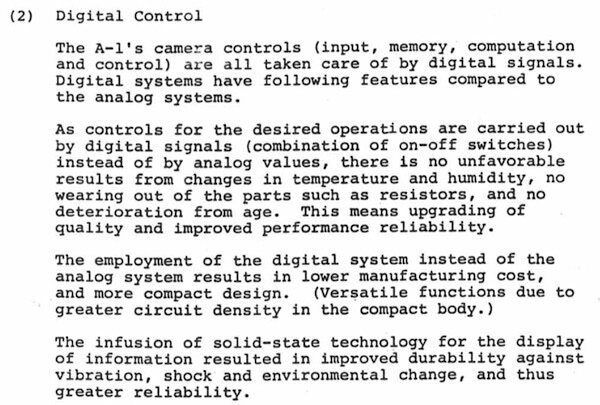
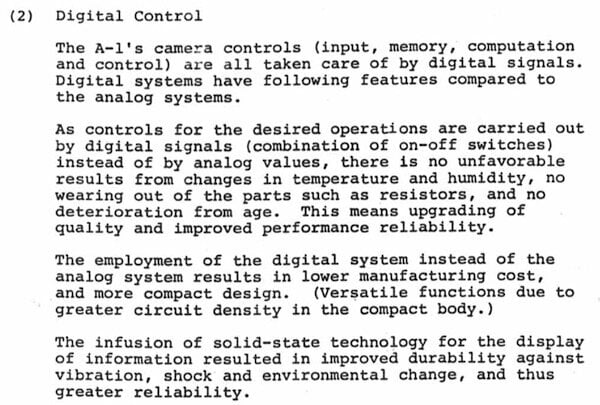
Canon A-1 Repair Guide, p. 32
Similarities with the Canon AE-1
As the direct successor to the AE-1, the mechanical design of the A-1 is identical or similar. Therefore, the Canon A-1 Repair Guide refers to the documentation for the AE-1 (which cannot be found online, originally from Canon).
So we can directly apply the service and repair experience gained here with the AE-1 to the A-1, see
Exploring the Canon AE-1: Disassembly, service, technology
Available technical information
For service and repair of the Canon A-1, the following technical documents and media are available:
Canon A-1 Repair Guide
SPT Journal: September-October 1981
Canon A-1 CLA Tutorial by Gene Pate
C & C Associates Troubleshooting Guide for the Canon A-1
Canon A-1 - Complete overhaul and CLA by Garry‘s Camera Repair (video)
For more information on the Canon A-1, I would like to refer you to this excellent article:
Canon A-1: All the Canon you’ll ever need.
An ideal repair candidate: dirty, non-functional, needs service
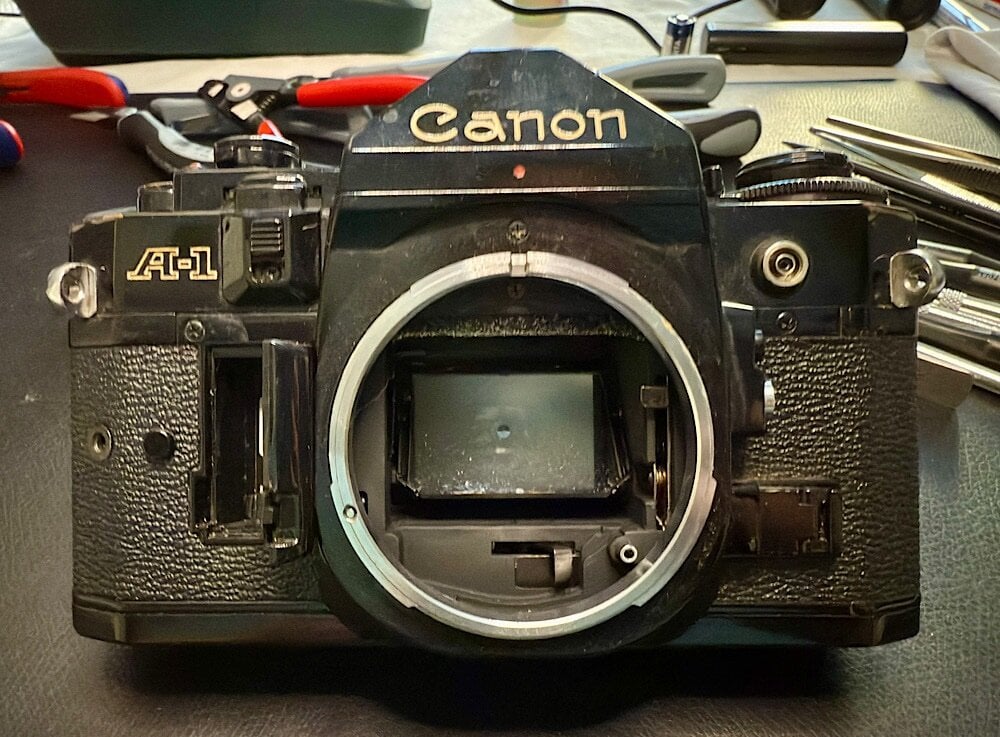
Finding a Canon A-1, even a defective one, at a reasonable price can take time. This one costed under 100 EUR/116 USD and meets all the requirements for our project:
It's unkempt, doesn't function after inserting the battery, and the winding lever is jammed - a true black box that needs service and perhaps even repair.
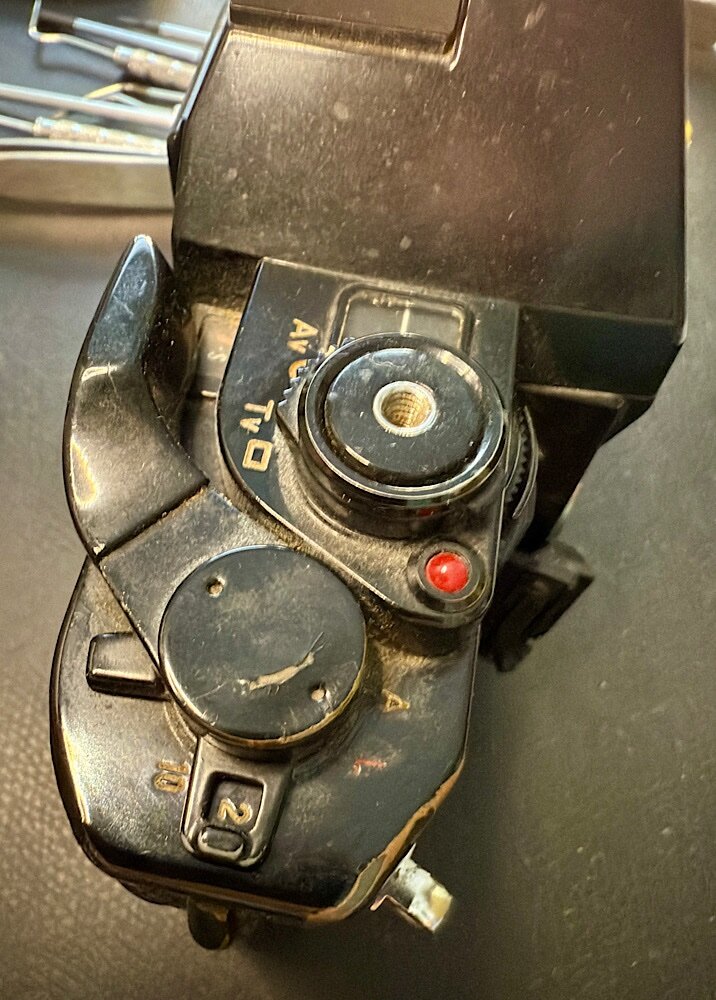
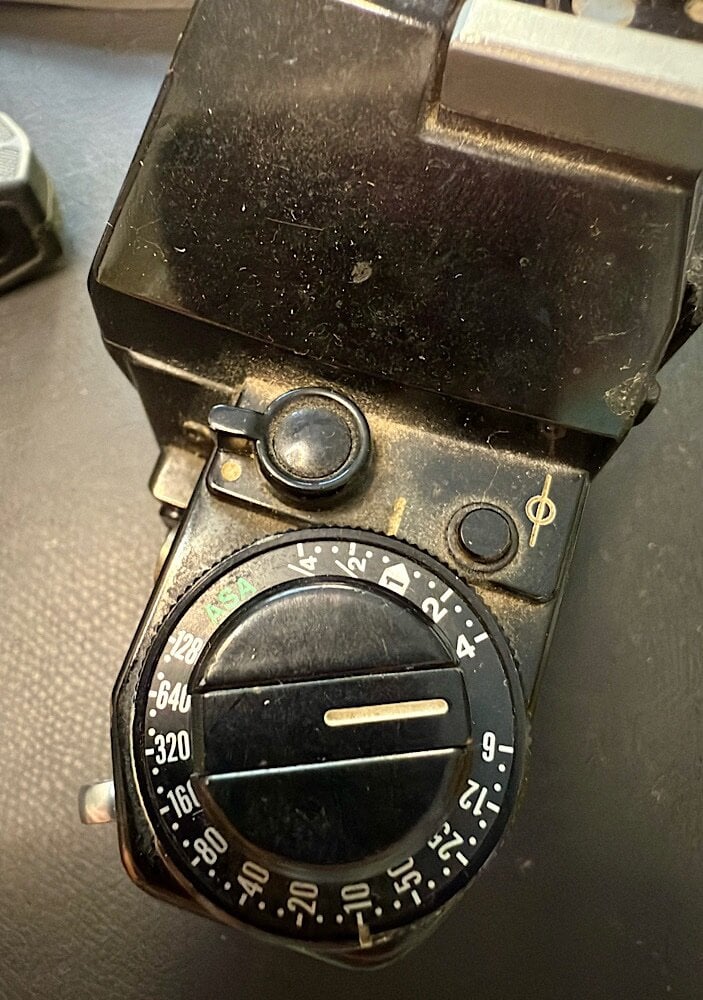
It has also been heavily used and some minor dents show that it has not always been treated gently.
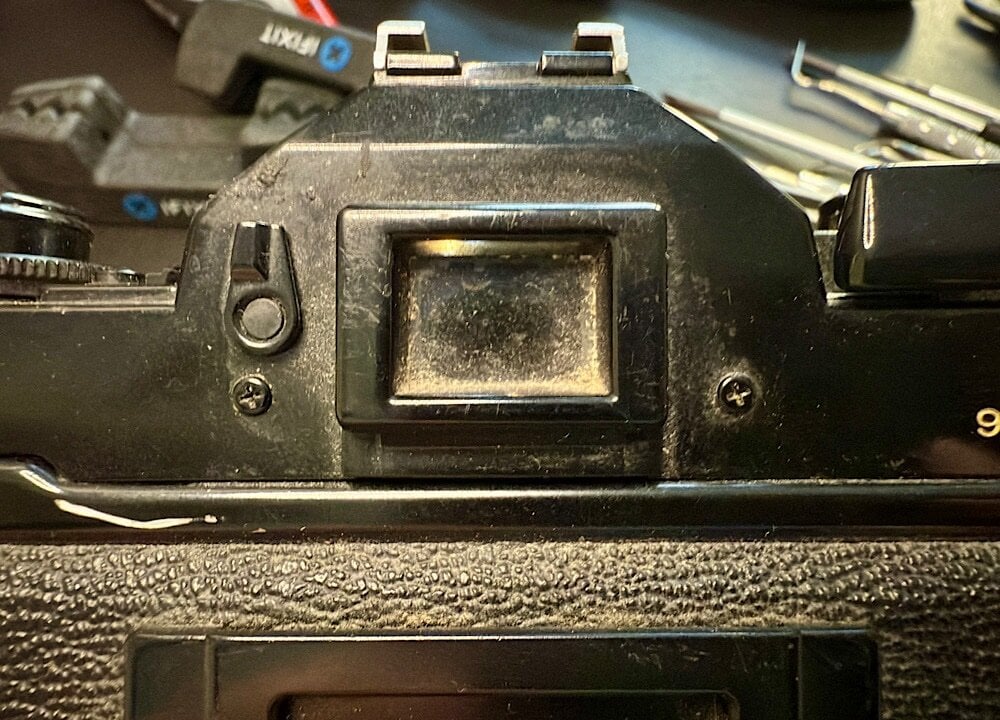
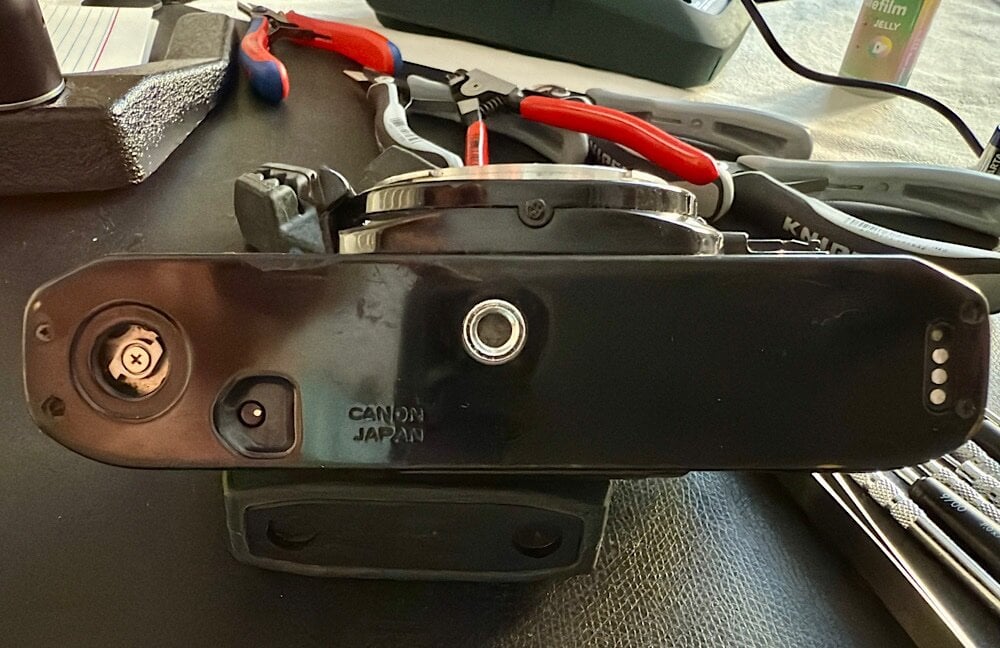
We'll open the A-1, examine it, try to get it working again, service, and finally, if it's working, clean it.
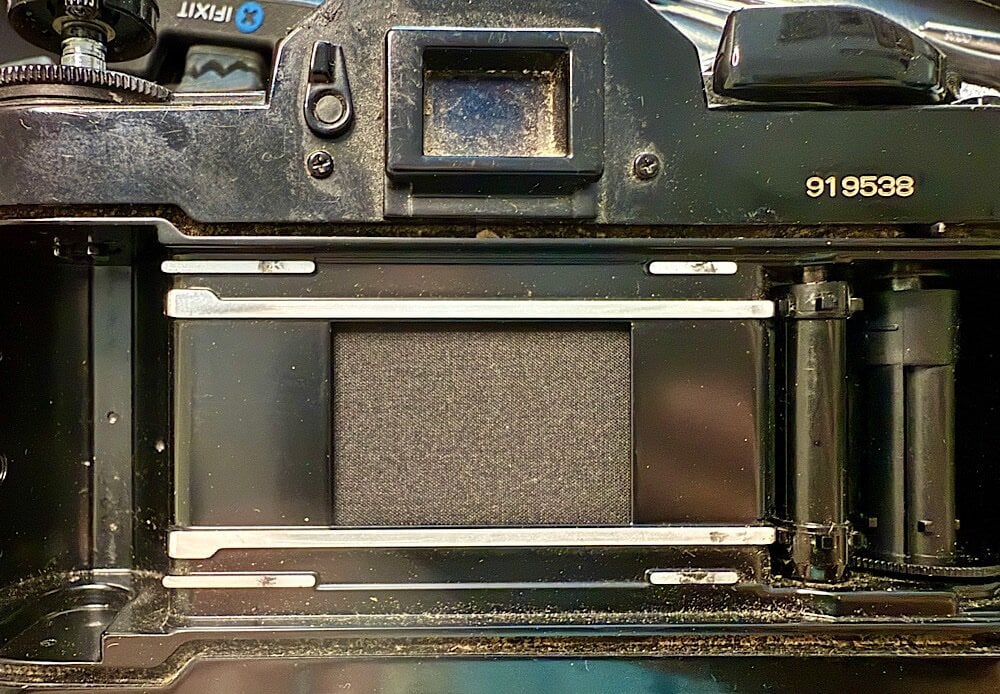
If that doesn't work, it will definitely provide insights and spare parts for the next project.
Clean the battery contacts and the A-1 has woken up

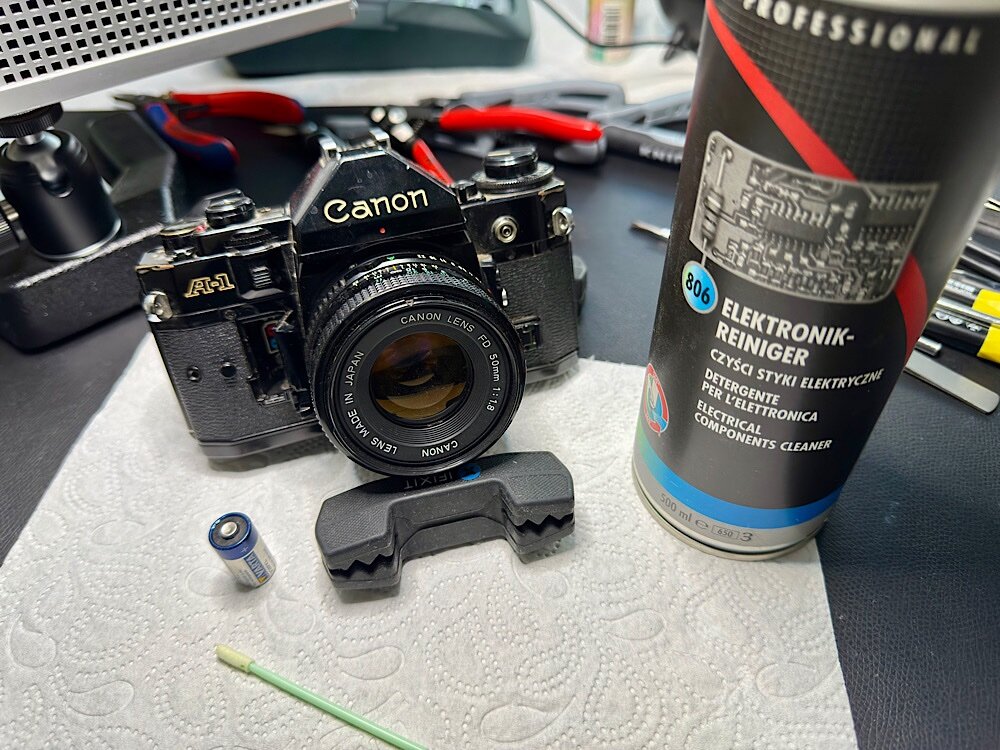
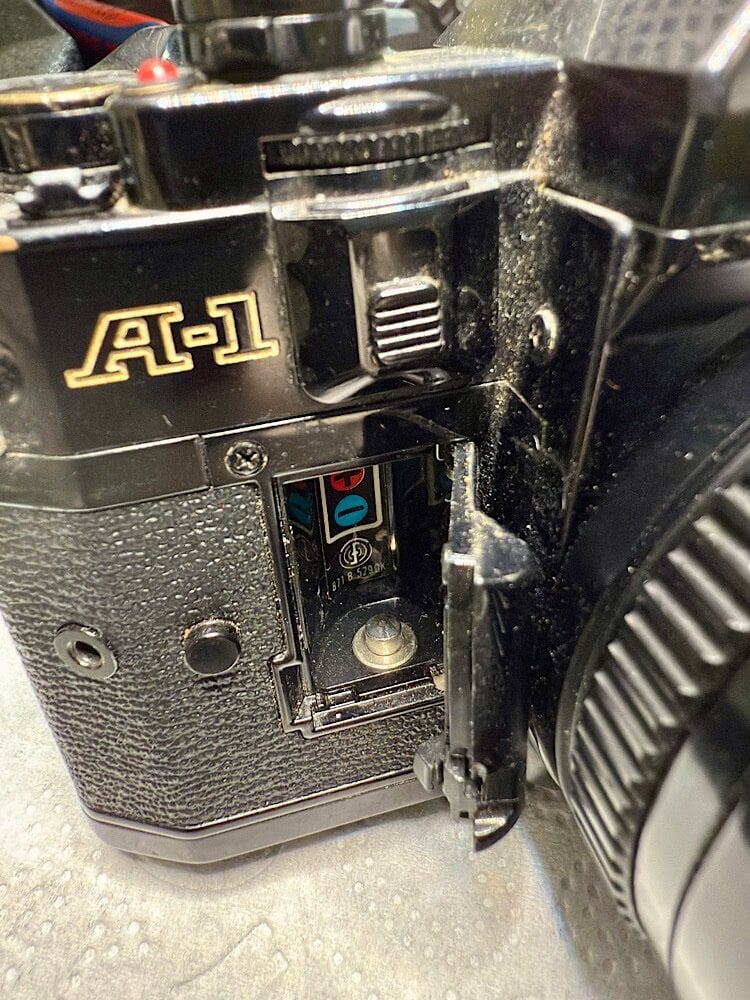
After I treated the contacts in the battery compartment with electronics cleaner on a cleaning swab, the A-1 woke up. All functions are working properly.
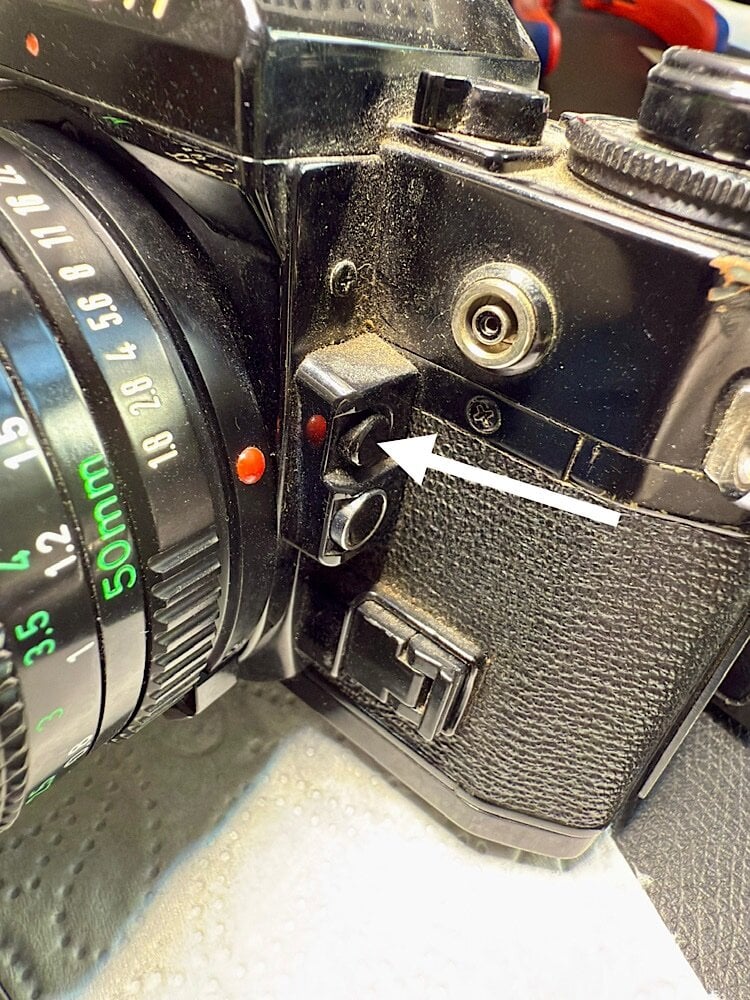
Only the button for saving the measured values (exposure memory switch) is not working.
Also this A-1 has the typical "asthma" when releasing the shutter: a squawking noise that indicates a lack of oil in the aperture control.
So we have a service project with clean, lube, adjust.
We will remove the mirror box, clean the inside where necessary, and lubricate, thus resolving the asthma.
Next, we will check the electronics settings and use the camera tester to measure the curtain travel times, shutter speeds, and exposure error (EE) in automatic mode. We will also look at the A-1's technology.
The following isn't intended as a tutorial, but rather as a brief overview of the disassembly steps. For detailed step-by-step instructions, please see the references above in this thread.
Removal of bottom cover and top cover
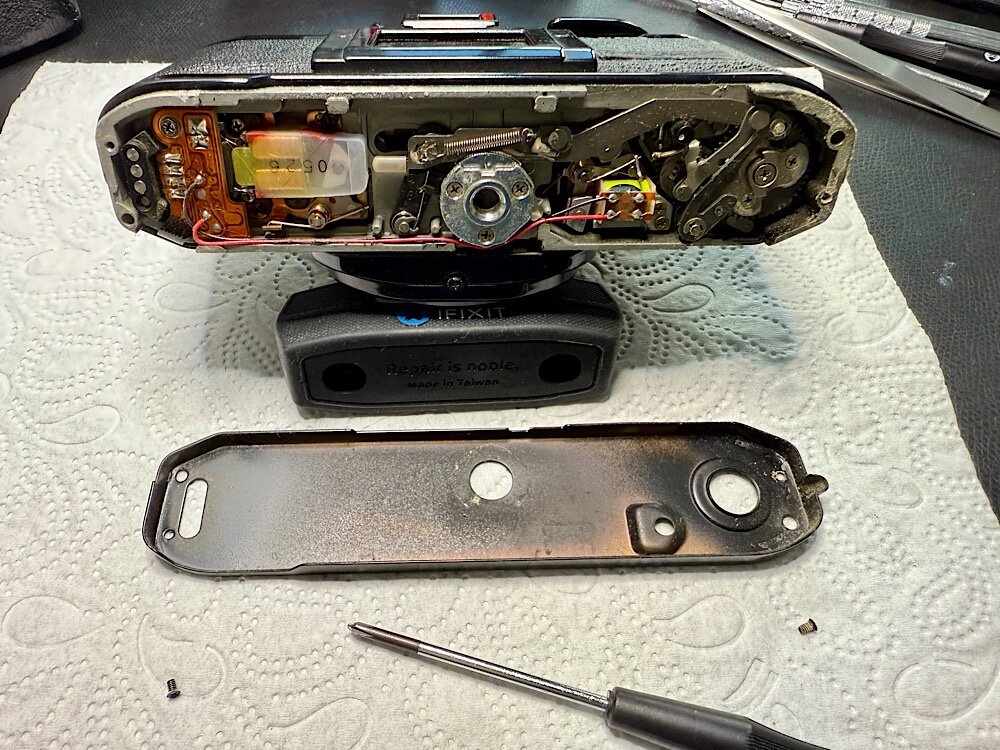
2 screws.
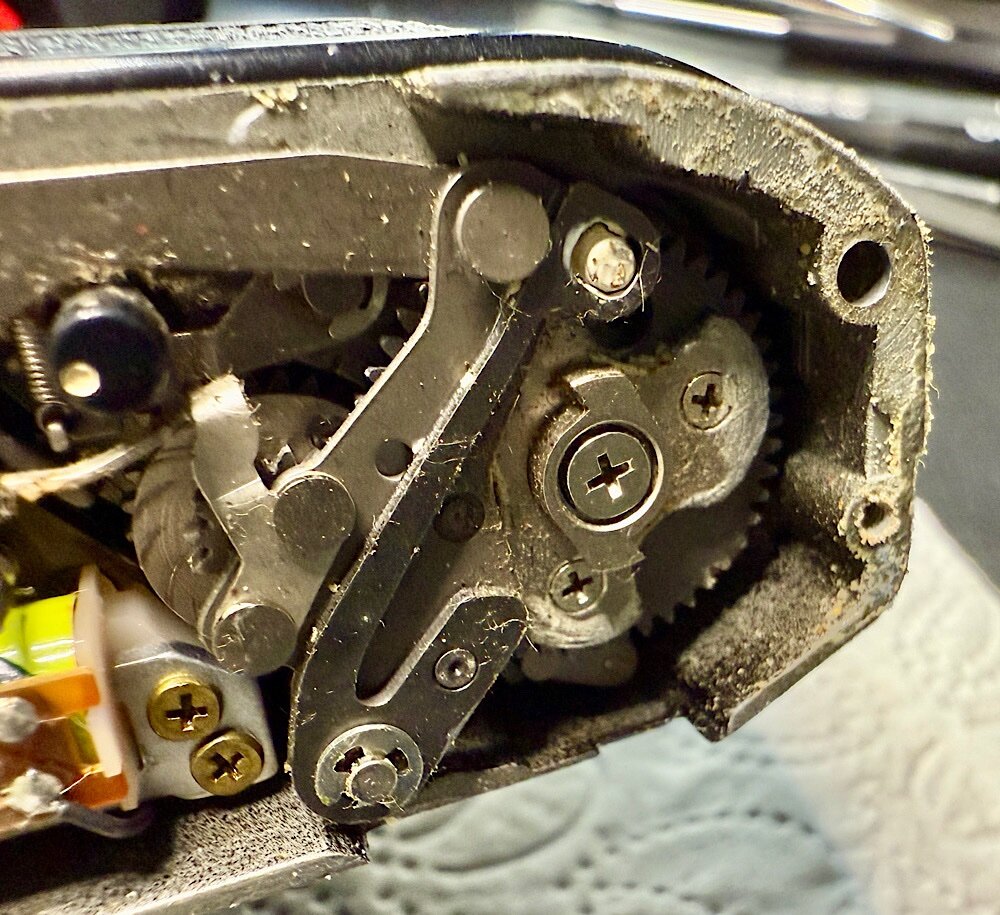
Some dirt has accumulated.
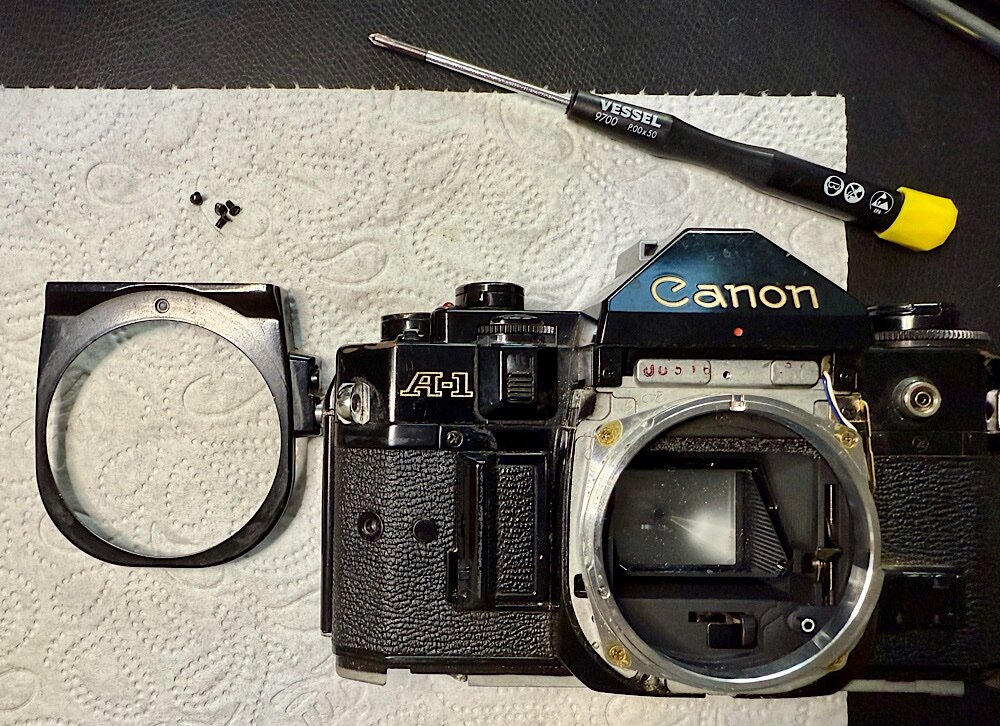
Front cover, 4 screws.
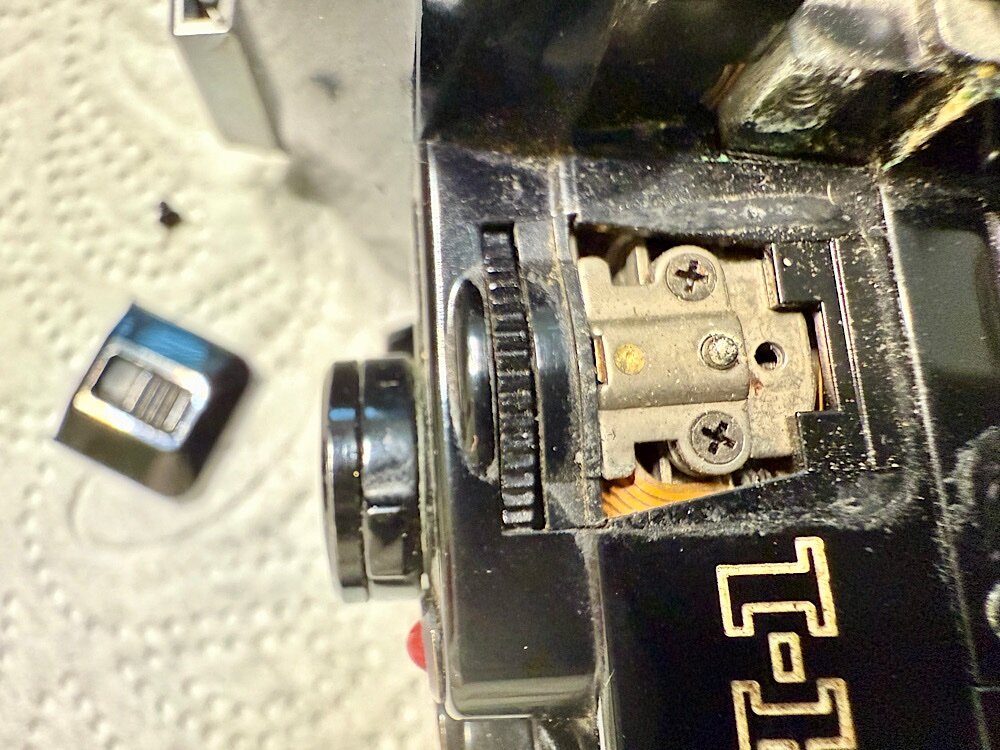
Remove AT dial guard. Be careful of the silver ball detent lose.
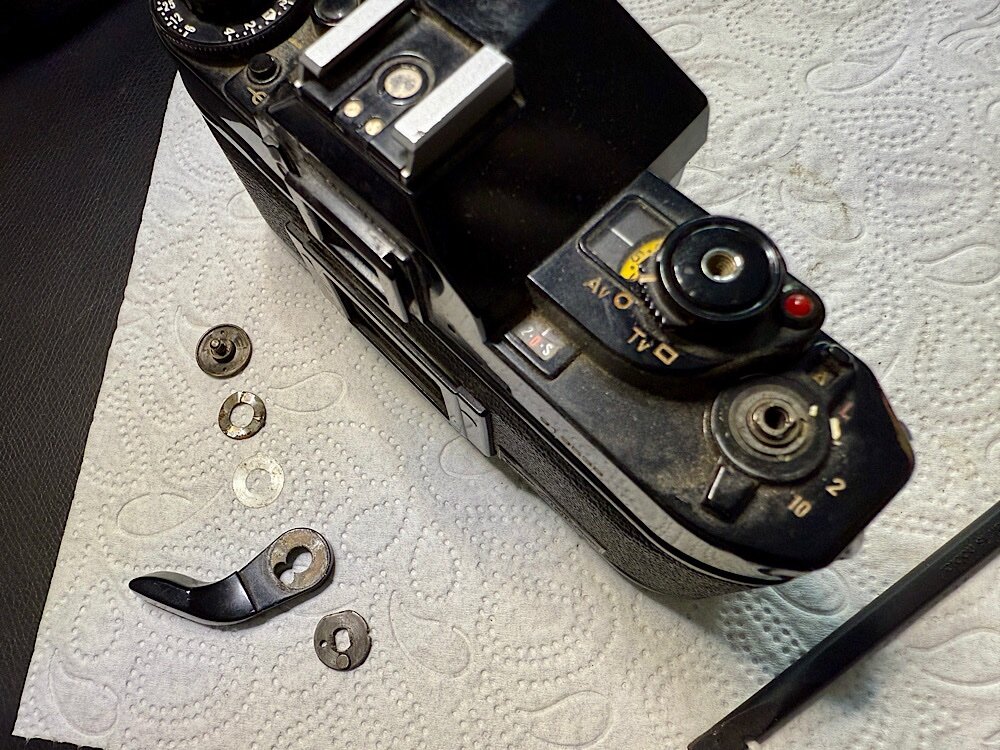
Dismounting the winding lever, …
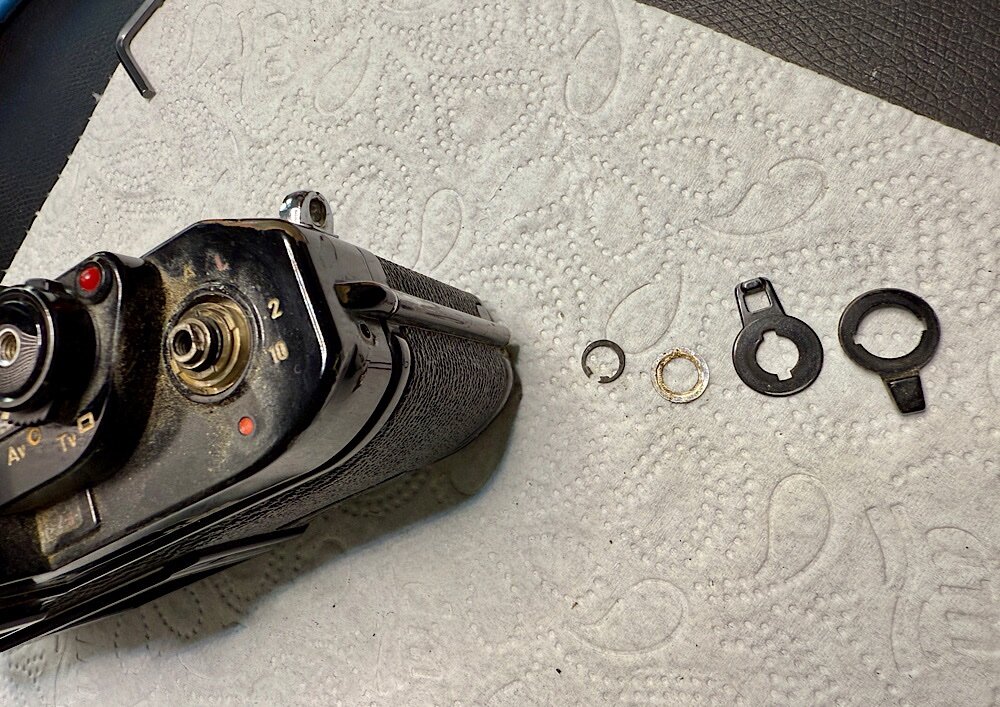
… main-switch lever and multiple-exposure lever.
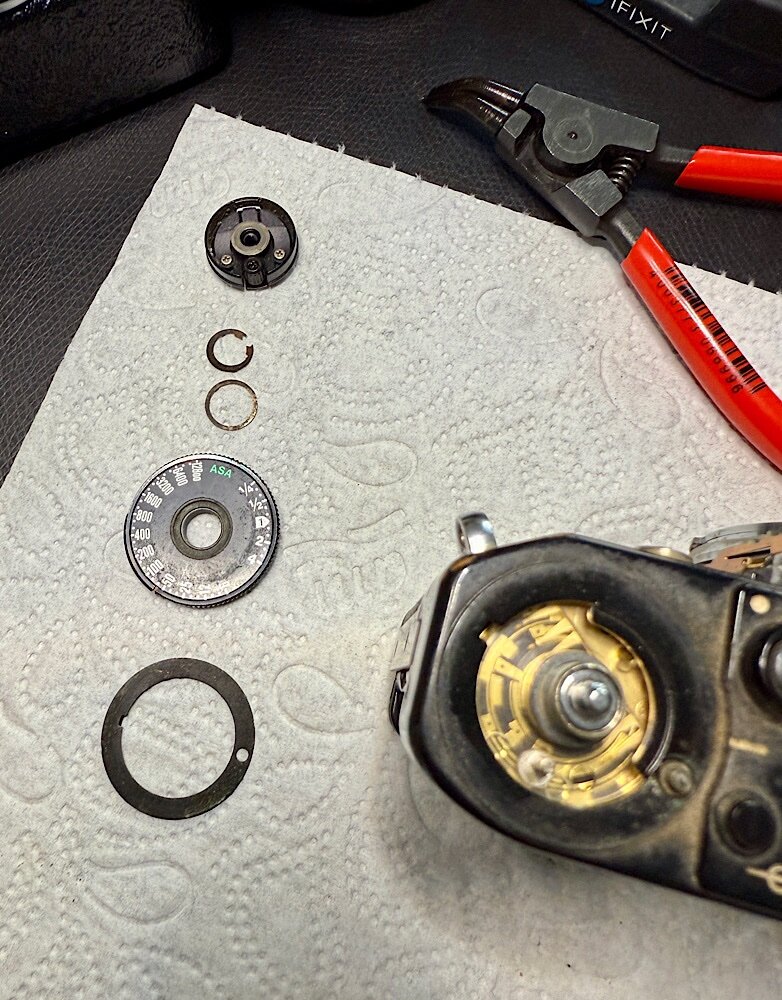
Rewind knob and film-speed dial off.
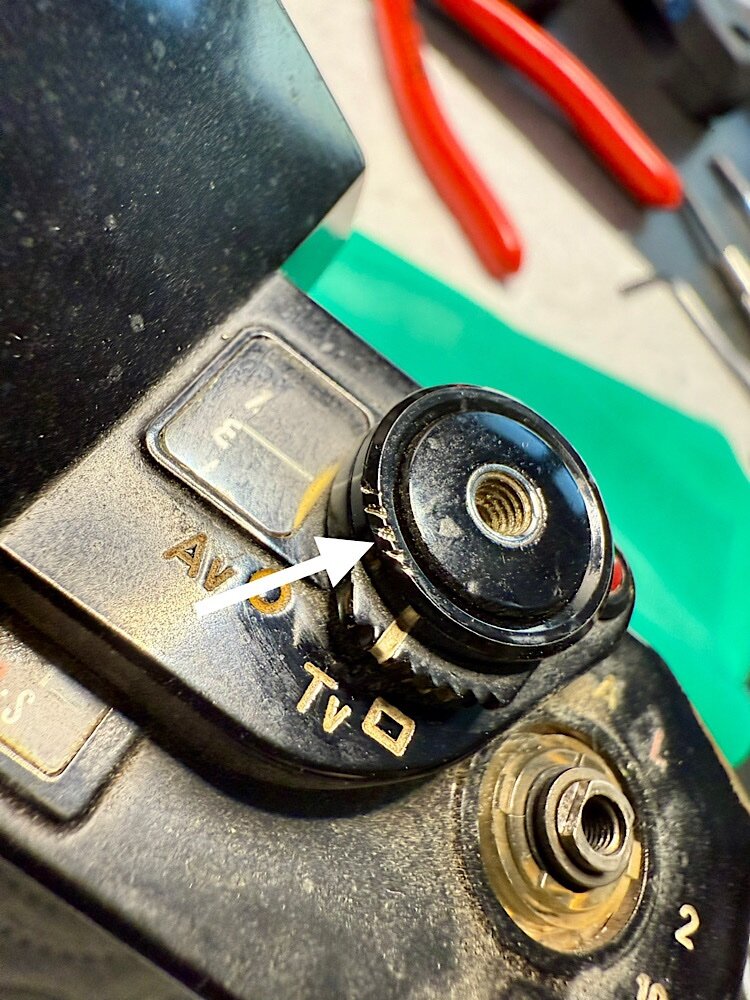
Here, I made an avoidable mistake while unscrewing the retaining ring for the release button.
The rubber pad for the pliers' jaws slipped off, and I damaged the ring. This can be covered with black paint, but I definitely need to find a better technique.
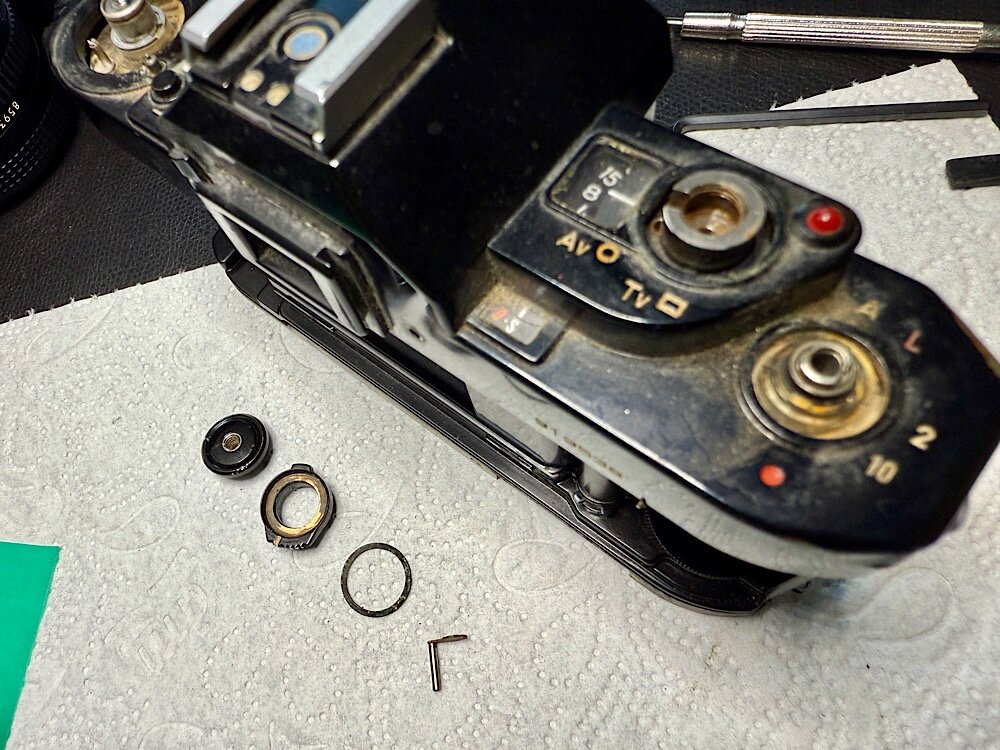
Release button removed.
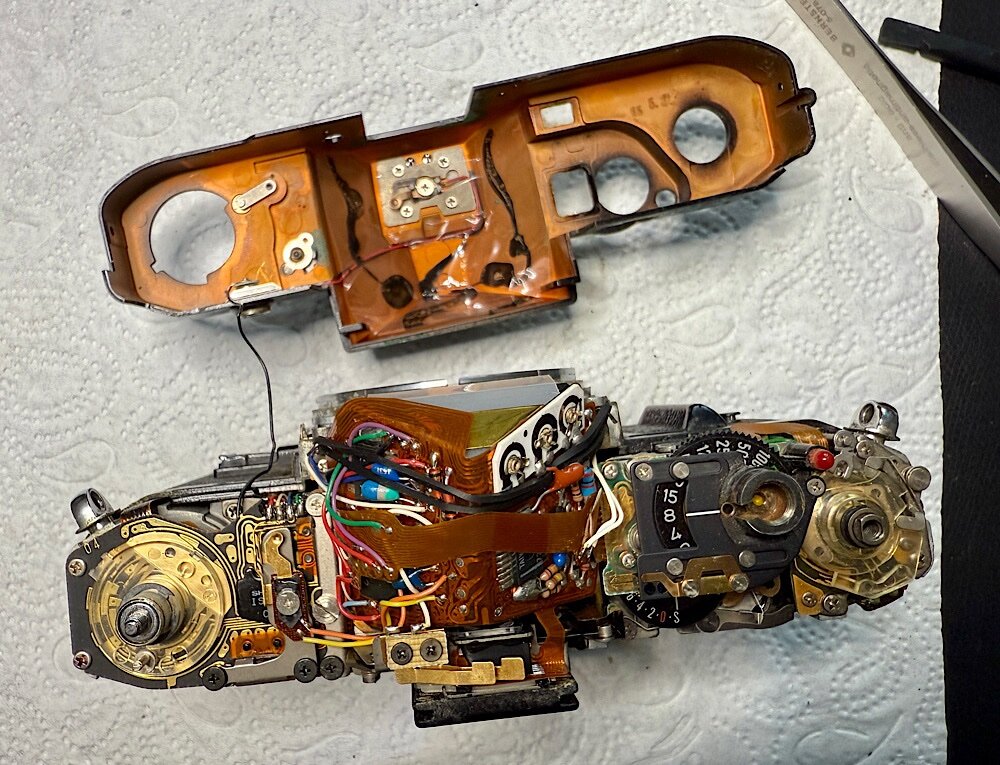
Top cover off.
For the full project report see on photo.net:
Canon A-1: A closer look at service and technology of the first fully digital SLR
+++
 A word of caution
Please keep in mind that you’ll be using highly flammable solvents for service work, and their fumes are harmful to your health. Soldering also produces fumes that should not be inhaled. Dangerous high voltages can be present when handling electronics, especially in conjunction with electronic flash units and mains. Therefore, familiarize yourself with the safety regulations beforehand and ensure your safety. Depending on the activity, protective gear may be advisable.
All information provided without guarantee and use at your own risk.
Acknowledgments
Without the work of Master Larry Lyells, in particular, we wouldn’t have the detailed technical information we need today for service/repair of SLRs.
The SPT Journal and The Camera Craftsman, which he helped shape significantly as an author, and which contain all the necessary information and instructions are available for a fee through Learn Camera Repair.
We owe our access to them to Eugene Pate, the founder of Learn Camera Repair.
Last edited:
