• Welcome to Photrio!
    Registration is fast and free. Join today to unlock search, see fewer ads, and access all forum features.
    Click here to sign up

Can you explain why HCB chose this photo?

Two Waves.jpg

A
Two Waves.jpg

  • 0
  • 0
  • 0
Chinese tourists

A
Chinese tourists

  • 2
  • 2
  • 59

Recent Classifieds

Forum statistics

Threads
202,675
Messages
2,843,975
Members
101,461
Latest member
Spechti
Recent bookmarks
0
if the content of Vivian Maier's storage locker would have been thrown away as junk, would she still be a great photographer

"Great" is a term that carries a certain weight, when used to discuss someone who is known for something. Since she would not be known for any such thing, she could still be a "good" photographer, since she was very skilled and talented at taking photos. The objective quality of her ability to take photos is undeniable, but it would be unknowable, if her storage-locker contents had been tossed in a dumpster.
 
Aren't you guy just discussing semantics. It HCB wanted to show that image in OP then why not. He is a brilliant photographer and many of us understand exactly what he is doing.
 
Of course she would. Just nobody would know. Greatness has nothing to do with notoriety, it is about talent and ability.

I agree. I think the ressurgence and new-found popularity of the photobook has helped reveal the greatness of many photographers whose talent and abilities were until then known to very few.
 
"Great" implies a level of influence that would not be available to someone who is unknown to everyone. She would have been just as talented and just as good but she could not have been great. If you want the word "great" to just mean "very good" then that's basically meaningless.

Aren't you guy just discussing semantics. It HCB wanted to show that image in OP then why not. He is a brilliant photographer and many of us understand exactly what he is doing.

What exactly is he doing, then?
 
"Great" implies a level of influence that would not be available to someone who is unknown to everyone. She would have been just as talented and just as good but she could not have been great. If you want the word "great" to just mean "very good" then that's basically meaningless.


What exactly is he doing, then?

I am unsure how you come to the conclusion the "great" implies influence. Many "great" artists go undiscovered during their lifetimes. Many more are never discovered. Does that make their art less "great"? The old if a tree falls in the woods, you know.
 
Did you watch the documentary I posted? There is a passage that, while not directly linked to the photo in question, is relevant to our conversation. It's the passage where a museum curator shows a photograph Cartier-Bresson took in China. He talks about the fact that no context is provided, no explanation, and why the mystery, the "not knowing" actually enriches to photograph. It's at the 36:30 mark in the film.

In many places elsewhere, Cartier-Bresson hints at the same thing. That there is nothing to be "understood".
I did watch that video a while back, but I will watch it again to make sure I’m understanding you correctly. Meanwhile, ‘not explaining’ is, IMHO, what makes many photos by HCB and others ‘surreal’. The mind searches internally for ways to make sense of the mystery. The real context may be quite banal, and to reveal it would destroy the mystery/wonder.

I think there being nothing to understand is a different point. In HCB’s paradigm, the image is sufficient in itself. If its ‘point’ could be explained in words, one might as well do just that. Somewhere I read that in the case of his USSR photos, not providing detailed captions was a way to avoid appearing to either approve or criticise what he saw - that judgement was passed on to the viewer. Here was what he saw on his trip … except that of course these were not random snaps.
 
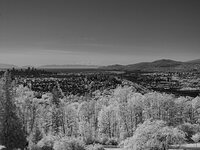
Getting back to the photo in question, I think it's terrible. It's cluttered, has no subject, the foreground is out of focus, and there is a black square in the middle left that I can't figure out what it is. The only thing interesting is the nest or fungal growth in the tree at the top right. I hope this photo is not considered one of HCB's best by Szarkowski. What should we learn from it?
 
I did watch that video a while back, but I will watch it again to make sure I’m understanding you correctly. Meanwhile, ‘not explaining’ is, IMHO, what makes many photos by HCB and others ‘surreal’. The mind searches internally for ways to make sense of the mystery. The real context may be quite banal, and to reveal it would destroy the mystery/wonder.

I think there being nothing to understand is a different point. In HCB’s paradigm, the image is sufficient in itself. If its ‘point’ could be explained in words, one might as well do just that. Somewhere I read that in the case of his USSR photos, not providing detailed captions was a way to avoid appearing to either approve or criticise what he saw - that judgement was passed on to the viewer. Here was what he saw on his trip … except that of course these were not random snaps.

That's exactly it! It's like we're constantly floating between context/absence of context, meaning/absence of meaning, judgement/absence of judgement, never completely able to ancher oneself in one or the other.

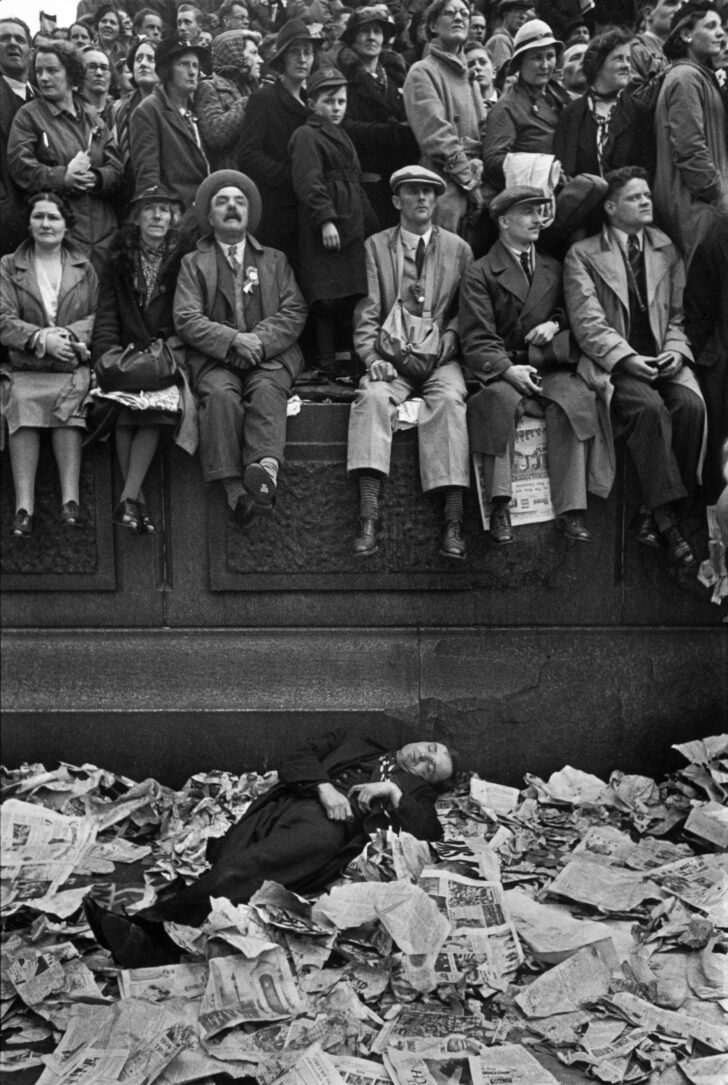
I believe it may be because the formal perfection is so dominating that it pulls you out of the "reality" you're inclined to investigate. This photograph, for example. There could be so much to talk about in terms of context, and of judgement. But when one tries one keeps being derailed by the pure admiration one feels about the photograph itself.

So much could be said about it, but nothing needs to be said about it.

1-728x1085.jpg


As someone brilliantly states in the documentary, the difficulty of Henri Cartier-Bresson is that he forces you to look at photographs as paintings.
 
"Great" implies a level of influence that would not be available to someone who is unknown to everyone. She would have been just as talented and just as good but she could not have been great. If you want the word "great" to just mean "very good" then that's basically meaningless.


What exactly is he doing, then?

With regard to that particular image, I have no idea. I was referring to his photography in general.
 
I did watch that video a while back, but I will watch it again to make sure I’m understanding you correctly. Meanwhile, ‘not explaining’ is, IMHO, what makes many photos by HCB and others ‘surreal’. The mind searches internally for ways to make sense of the mystery. The real context may be quite banal, and to reveal it would destroy the mystery/wonder.

I think there being nothing to understand is a different point. In HCB’s paradigm, the image is sufficient in itself. If its ‘point’ could be explained in words, one might as well do just that. Somewhere I read that in the case of his USSR photos, not providing detailed captions was a way to avoid appearing to either approve or criticise what he saw - that judgement was passed on to the viewer. Here was what he saw on his trip … except that of course these were not random snaps.

To persue this thought a little further, I'm trying to remember if I've come across other examples in photojournalism, not by HCB, in which context became in time annihilated, so to speak, by aesthetic contemplation while being essential at the moment the photo was taken. It's a rare feat. One of the few that comes to mind is Gene Smith's Minamata photo, Tomoko Uemura is Bathed by her Mother. Smith achieved his perfection totally diffently than Cartier-Bresson—i.e., mostly in the darkroom. But even then, one can wonder if context is totally avoidable here.

Not saying it's necessary that it be avoidable in order to have great documentary photography. Robert Frank's The Americans is all about context. As is the work of Gordon Parks.
 
To persue this thought a little further, I'm trying to remember if I've come across other examples in photojournalism, not by HCB, in which context became in time annihilated, so to speak, by aesthetic contemplation while being essential at the moment the photo was taken. It's a rare feat. One of the few that comes to mind is Gene Smith's Minamata photo, Tomoko Uemura is Bathed by her Mother. Smith achieved his perfection totally diffently than Cartier-Bresson—i.e., mostly in the darkroom. But even then, one can wonder if context is totally avoidable here.

Not saying it's necessary that it be avoidable in order to have great documentary photography. Robert Frank's The Americans is all about context. As is the work of Gordon Parks.

Surely one could suggest several photographers for whom context has become largely irrelevant to the images. Among my favourites I would think of Lartigue, Koudelka, Tony Ray Jones, …
 
Conjecture: I think that it is important in the context of the discussion of the particular photo that was in the OP that one takes into consideration that HCB thought of himself as a Surrealist. As such, his images do not require explanation, just interpretation. The Surrealists channelled the unconscious, so it is possible that HCB was not photographing with intent dictated by reason, letting his "eye" determine the moment and the composition. No explanation needed be given for an image that it was possibly created without rational intent.
 
Surely one could suggest several photographers for whom context has become largely irrelevant to the images. Among my favourites I would think of Lartigue, Koudelka, Tony Ray Jones, …

Koudelka is a great example of how difficult it is to generalize about this (which I'm guilty of). Granted, there are many photos in the Prague 68 series that now transcend their context.

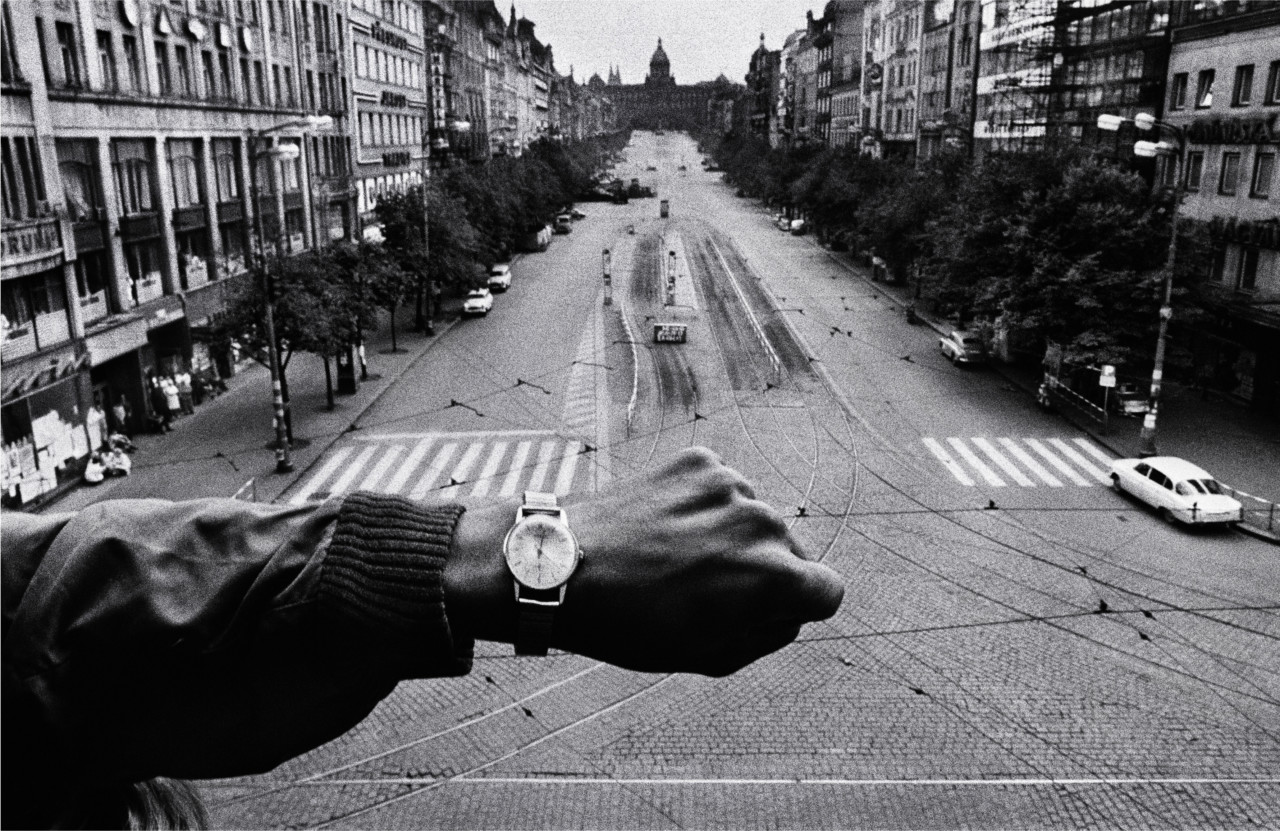
That said, this photo absolutely doesn't. It only makes sense within its context. It's all about context. You can only feel the tension because you know that in a few seconds Russian tanks are going to start rolling at the end of that street (actually in an hour, Koudelka got the hour of their arrival wrong). As opposed to the Cartier-Bresson photographs we've been discussing (like the one I posted above), this is not, from a compositional point of view, a great photo, per se. You probably wouldn't stop and admire it were it be hanging on a museum wall. It begs context, it begs understanding. It's a very powerful photo but it becomes a powerful photo because of its context.

And also because Koudelka thought of taking that photo, had the instinct to take that photo, a photo revealing the tension, anticipation of the moment just before. Takes a special kind of genius to do that. I certainly wouldn't have thought of it. I would have taken the photo with the tanks in the street. And it wouldn't have been as good a photo.



par65493-teaser-story-big.jpg
 
Koudelka was a good friend of Bresson and they both had a similar desire to depict life.
 
Koudelka was a good friend of Bresson and they both had a similar desire to depict life.

There's a fantastic passage in the documentary I posted in which Koudelka comes into the Magnum offices when Cartier-Bresson is there. You can see they have honest, sincere joy to see each other.
 
Getting back to the photo in question, I think it's terrible. It's cluttered, has no subject, the foreground is out of focus, and there is a black square in the middle left that I can't figure out what it is. The only thing interesting is the nest or fungal growth in the tree at the top right. I hope this photo is not considered one of HCB's best by Szarkowski. What should we learn from it?

The black square is a garden shed with snow on the roof; the roof is hidden for the most by branches in the foreground, but if you look at the trunk of the tree behind this square you can see that it`s cut off by the snowy roof before meeting the black square.
As there is a wire fence in the blurred foreground this blur could be by intention. HCB was in prison for three years before he took this picture, maybe he did not wanted to see wire fences at this time and that`s why he blurred it.
 
Getting back to the photo in question, I think it's terrible. It's cluttered, has no subject, the foreground is out of focus, and there is a black square in the middle left that I can't figure out what it is. The only thing interesting is the nest or fungal growth in the tree at the top right. I hope this photo is not considered one of HCB's best by Szarkowski. What should we learn from it?

You were so confident that you had solved the mystery way back in post #117. What happened?
 
Koudelka is a great example of how difficult it is to generalize about this (which I'm guilty of). Granted, there are many photos in the Prague 68 series that now transcend their context.
Even as I wrote Koudelka’s name up above, I realised that the Prague invasion series doesn't fit because of its very specific context. I was thinking more of his gypsies, and photos of Ireland. This one, for instance.
1735111689728.png

But I don’t think there is anyone who achieved the magic as consistently as HCB.
 
Last edited:
I am unsure how you come to the conclusion the "great" implies influence. Many "great" artists go undiscovered during their lifetimes. Many more are never discovered. Does that make their art less "great"? The old if a tree falls in the woods, you know.

Then you are free to use "good" or "nice". He's a "great photographer" = he's a "good photographer" = he's a "cute photographer" = he takes nice photos.

While you're at it, rename WWI to The Good War.

And that 17th century tsar of Russia can be called Peter the Nice.
 
Koudelka is a great example of how difficult it is to generalize about this (which I'm guilty of). Granted, there are many photos in the Prague 68 series that now transcend their context.

That said, this photo absolutely doesn't. It only makes sense within its context. It's all about context. You can only feel the tension because you know that in a few seconds Russian tanks are going to start rolling at the end of that street (actually in an hour, Koudelka got the hour of their arrival wrong). As opposed to the Cartier-Bresson photographs we've been discussing (like the one I posted above), this is not, from a compositional point of view, a great photo, per se. You probably wouldn't stop and admire it were it be hanging on a museum wall. It begs context, it begs understanding. It's a very powerful photo but it becomes a powerful photo because of its context.

And also because Koudelka thought of taking that photo, had the instinct to take that photo, a photo revealing the tension, anticipation of the moment just before. Takes a special kind of genius to do that. I certainly wouldn't have thought of it. I would have taken the photo with the tanks in the street. And it wouldn't have been as good a photo.


par65493-teaser-story-big.jpg

This picture would be important part of a three-picture essay. An earlier shot of people and traffic moving normally, then this one, then tanks in the street. And a fourth if the tanks damaged structures.
 
This picture would be important part of a three-picture essay. An earlier shot of people and traffic moving normally, then this one, then tanks in the street. And a fourth if the tanks damaged structures.
Man, no disrespect, but you really need to read a bit about the ‘68 invasion of Prague, and what this photo recorded.
 
Then you are free to use "good" or "nice". He's a "great photographer" = he's a "good photographer" = he's a "cute photographer" = he takes nice photos.

While you're at it, rename WWI to The Good War.

And that 17th century tsar of Russia can be called Peter the Nice.

I want what you’re drinking.
 
I enjoy many of HDC's photography because just looking at some of them, no words are needed to discuss them. They stand on their own without words or even a title.
 
Man, no disrespect, but you really need to read a bit about the ‘68 invasion of Prague, and what this photo recorded.

I wasn;t trying to describe the Prague Invasion; just pointed out how a three-picture essay could work. As an aside, what three pictures would describe the Prague invasion?
 
Photrio.com contains affiliate links to products. We may receive a commission for purchases made through these links.
To read our full affiliate disclosure statement please click Here.

PHOTRIO PARTNERS EQUALLY FUNDING OUR COMMUNITY:


Ilford ADOX Freestyle Photographic Stearman Press Weldon Color Lab Blue Moon Camera & Machine
Top Bottom