
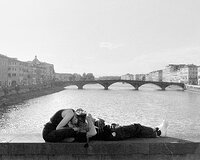

I am reminded of Edward Steichen's beloved Shad Bow tree. It meant something to him too, I suppose

I couldn't find any in the three Cartier-Bresson books I have, except for this one, made in 1968, same year he stopped photography to devote himself to painting.
I keep wondering if this one doesn't also have a very personal meaning. It was made in Brie, and Cartier-Bresson was born in Chateloup-en-Brie, but as there a a few towns called Brie in France, tough to say if there is a relation.


I couldn't find any in the three Cartier-Bresson books I have, except for this one, made in 1968, same year he stopped photography to devote himself to painting.
I keep wondering if this one doesn't also have a very personal meaning. It was made in Brie, and Cartier-Bresson was born in Chateloup-en-Brie, but as there a a few towns called Brie in France, tough to say if there is a relation.

Surely this one is ‘just’ a point-perfect composition?
No need to look for personal meaning here, although there could be.

Alex, out of curiosity - rather than to prove a point - I've just counted 12 landscapes without people in the collection referred to in post #1, not including the topic of this thread or the exquisite composition from Brie.I couldn't find any in the three Cartier-Bresson books I have, except for this one, made in 1968, same year he stopped photography to devote himself to painting.
I couldn't find any in the three Cartier-Bresson books I have, except for this one, made in 1968, same year he stopped photography to devote himself to painting.
I keep wondering if this one doesn't also have a very personal meaning. It was made in Brie, and Cartier-Bresson was born in Chateloup-en-Brie, but as there a a few towns called Brie in France, tough to say if there is a relation.

Alex, out of curiosity - rather than to prove a point - I've just counted 12 landscapes without people in the collection referred to in post #1, not including the topic of this thread or the exquisite composition from Brie.
Now that I pay more attention, I see that 5 of the 14 capture shapes, lines or blocks akin to abstract art of the period. Eight are whimsical, poignant or ironic in a typically HCB way, while the last is the Isle de la Cité in Paris.

 www.delpireandco.com
Alex, out of curiosity - rather than to prove a point - I've just counted 12 landscapes without people in the collection referred to in post #1, not including the topic of this thread or the exquisite composition from Brie.
Now that I pay more attention, I see that 5 of the 14 capture shapes, lines or blocks akin to abstract art of the period. Eight are whimsical, poignant or ironic in a typically HCB way, while the last is the Isle de la Cité in Paris.

Well, just got an answer from the HCB Foundation. They tell me they have very little information on our photograph.
It shall remain a mystery.

I have this picture in my mind of a bunch of beret wearing (and Galoises smoking?) French Foundation representatives sitting around a copy of the photograph and saying things like:
"What should we say to Monsieur Benjamin? I've never figured out why HCB liked this one, have you figured it out?"
"No, none of us know - we will just tell him we have very little information on it"

I was unaware of that one too. Definitely worth a look. Does anyone in the forum have a copy?I just saw that Delpire published in 2001 a book of his titled Paysages. I'm wondering if your photo is in it and if there is more info about it.
You are much more enterprising than I was. But I wonder whether you would have received the same answer about any HCB photograph? I don't know, but I suspect it was HCB who originated the idea that a photo needs no more notes than place and date. At any rate, for a man who destroyed the negatives adjacent to his 'keepers', it seems entirely consistent that he would avoid leaving any extra notes, and that the guardians of his legacy would maintain a similar silence. I am speculating, of course! Possibly some living Magnum photographers hold insights about the Touraine photo, but I am not on the same Christmas card list.Well, just got an answer from the HCB Foundation. They tell me they have very little information on our photograph.
It shall remain a mystery.
I was unaware of that one too. Definitely worth a look. Does anyone in the forum have a copy?
You are much more enterprising than I was. But I wonder whether you would have received the same answer about any HCB photograph? I don't know, but I suspect it was HCB who originated the idea that a photo needs no more notes than place and date. At any rate, for a man who destroyed the negatives adjacent to his 'keepers', it seems entirely consistent that he would avoid leaving any extra notes, and that the guardians of his legacy would maintain a similar silence. I am speculating, of course! Possibly some living Magnum photographers hold insights about the Touraine photo, but I am not on the same Christmas card list.
This has been a very worthwhile thread for me. Thanks to everyone.
And that's why it's in the book. Great detective work!OK. Dug a little deeper. Can confirm that it's a photo of the kitchen garden of the farm where his wife Ratna Mohini took shelter during the war, taken in 1944.
Yet all that information does not make it a good photo.

We need to bear in mind that it's a photo of some neige blanche, and the French are keen on that stuff.
Yup. He didn't chose it because it was a good photo but it because it meant something to him.

I have this picture in my mind of a bunch of beret wearing (and Galoises smoking?) French Foundation representatives sitting around a copy of the photograph and saying things like:
"What should we say to Monsieur Benjamin? I've never figured out why HCB liked this one, have you figured it out?"
"No, none of us know - we will just tell him we have very little information on it"
Even with the assumption it is meaningful and even with the full knowledge of what that meaning is, the viewer is still just as likely to glance at this photo and turn the page.
OK. Dug a little deeper. Can confirm that it's a photo of the kitchen garden of the farm where his wife Ratna Mohini took shelter during the war, taken in 1944.
+1. Or a Gitane, where the packet itself was a work of art.Matt, you have just reminded me, how in my younger days when I use to smoke, how after consuming a beautiful meal in Paris, how wonderful it was to smoke a Galoise with a rich glass of red wine.
There is no such thing as "THE viewer". There are as many types of viewers as there are people, and each brings to his viewing his own background, sensibility, knowledge, questionings, etc. Viewing is never a neutral relationship between an inanimate object and an indefinite persona. It's a dialogue between a complex (no matter how simple it may seem) and unique work and a complex and unique person. The one advantage the person has over the work is that it can chose the mode and terms of the conversation, including dismissing it entirely.
There's no right or wrong. Many may glance and turn the page, others be intrigued, others enthralled, etc.
And that's why it's in the book. Great detective work!
Absolutely brilliant sleuthing! How on earth did you find that out?
). The link with his wife I found in two different sources, one of them the MoMA website.| Photrio.com contains affiliate links to products. We may receive a commission for purchases made through these links. To read our full affiliate disclosure statement please click Here. |
PHOTRIO PARTNERS EQUALLY FUNDING OUR COMMUNITY:  |
