• Welcome to Photrio!
    Registration is fast and free. Join today to unlock search, see fewer ads, and access all forum features.
    Click here to sign up

Can you explain why HCB chose this photo?

Recent Classifieds

Forum statistics

Threads
202,674
Messages
2,843,950
Members
101,459
Latest member
ldbrousseau
Recent bookmarks
0
Well, learning his title tossed my theory. There is a weird, dark blob of considerable size on a tree at the upper right and I was thinking "Squirrel's Nest" or "Trapped Kite." An artist I know in this area used to do stuff like a major watercolor painting having a view looking into a forest with lots of green and earth tones might get the title "Red." And it might take more than a few minutes of searching to discover a small image of a bird with some red plumage up against the trunk of a tree deep to the left side of the image. He claimed it was to get viewers to spend some time looking the piece over.
 
I would agree that it is not one of his best, but he does like echoes in his images and the trees in the foreground are echoed by the trees in the background. Also, the snow makes the image all black & white with hardly any shades of grey. Simplicity of vision as matched to his simplicity of MO.
 
I don't like it. It is so tempting to say that if he'd gone out with his Zenit or his Pentax instead of his Leica, he wouldn't have tolerated that OOF foreground. It's not interesting; it just gets in the way of the stuff further back which is. I can imagine making a photo out of the big row of trees, or the two rows one in front of the other; I'd want the middle foreground to be sharp though, and I'd avoid that front row of material altogether (perhaps by stepping forwards and shooting over the wire.)
 
This is a good answer, except it invites the further question: "Why?"

Perhaps the out of focus area this side of the fence helps to keep the viewer out of the garden.
 
It is all guess work but I think it is possible it is the first work he did that he thought was completely abstract expressionist. It might have been a land mark for him into another type of vision. I personally like it for the abstract quality though I am not a fan of soft focus.
 
Chalk and soot and no focus.........it's not a criticism, it's just the first thing that comes to mind. The fact that it's HCB's chalk and soot photograph is really of no consequence to how it strikes me.
 
Chalk and soot and no focus.........it's not a criticism, it's just the first thing that comes to mind. The fact that it's HCB's chalk and soot photograph is really of no consequence to how it strikes me.
Considering it was taken a few months after WW2 ended, it might have been apt for its time.
 
If any of us took that photo and posted it in the gallery, no one would like or comment. No one would look twice. The only reason anyone gives it a glace is due to the photographer.

It's vacuous. Looks like the camera went off by accident. I'm pretty sure it's the worst photo of his I've ever seen. There's no reason to try to defend it, he was delusional if he thought there was something worth seeing there.
 
Chalk and soot and no focus.........it's not a criticism, it's just the first thing that comes to mind. The fact that it's HCB's chalk and soot photograph is really of no consequence to how it strikes me.

Isn’t that a photogravure? Could explain the chalk-and-soot.
 
Isn’t that a photogravure? Could explain the chalk-and-soot.

No it's just a terrible photograph.


I'm a bit fed up of bananas on a wall!

Real art includes.
 
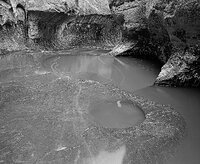
At first glance it looks like a mirror pond reflection. But as soon as you start to look in the reflection for the orb in the tree you can’t find it and it takes a bit of puzzling out to realize it’s snow and everything in the front is different than everything above. Even though they match in terms of contents at first glance, above is organized and below is chaotic.
 
Could this be just trolling or bragging? Maybe he had a drink buddy whom they got bored together one day and he said: "Bro! I bet I could publish anything because I'm a such a badass. Point your finger at a pile of garbage and I bet your ass it will end up in a book". The drunk friend suggested his back yard, and the rest is history.
 
Could this be just trolling or bragging? Maybe he had a drink buddy whom they got bored together one day and he said: "Bro! I bet I could publish anything because I'm a such a badass. Point your finger at a pile of garbage and I bet your ass it will end up in a book". The drunk friend suggested his back yard, and the rest is history.

I did some research. The print is in ICP's collection. It was part of an exhibition in the late 70s curated by Henri Cartier-Bresson. He saw something in it that seems to elude this audience.
 
I did some research. The print is in ICP's collection. It was part of an exhibition in the late 70s curated by Henri Cartier-Bresson. He saw something in it that seems to elude this audience.

The date and place are clues.

In February 1943, when he escaped from a German camp in Karlsruhe, Cartier-Bresson found his way to France and hid for three months with fellow prisoner Claude Lefranc in a farm near the town of Loches, which is in Touraine, an old province of France.

No doubt this photo, very un-Cartier-Bresson-like, had personal meaning linked with that "decisive" moment. It would explain the total absence of people in the photo—an extremely rare case with the photographer, who left very little landscapes (I can only think of one other one in which not a single human can be seen, taken in Brie in 1968). Hard to think of any other reason for him to be in Touraine—we know he rarely travel throughout France to photograph, and that most of his French photographs we made in Paris. This place had meaning.

The idea that he may have gone back to see an important place in his life also makes sense once you realize that he was at a turning point in his career. He spent 1944-1945 essentially doing portraits. Soon after this photograph was taken, he left for New York, where Beaumont Newhall was organising a retrospective of his works at MoMA.

The turning point is also a philosophic one, as, because of the war and its aftermath, he had dediced to devote himself to photojournalism and documentary, a new way of seeing and photographing that is in evidence in the photographs he made in the US in 1946-47 and in India 1947-48. Magnum was founded in 1947.
 
Can we explain why HCB photographed any scene at all?

Much of his work was fleeting or spontaneous – being in the right place at the right time, or just raise the camera and shoot. There are many of his images which are memorable. Others still entirely forgettable. It is what HBC saw in his eye — the mind's eye, that mattered to him. The result is open to interpretation to the subsequent viewers gazing in wonder, amusement, bewilderment, frustration or glee.

The scene pictured is to me, ordinary and unremarkable. It does not speak to me evocatively or pragmatically as, for example, many like-scenes by Tim Rudman, whose studies, resplendant of visual arrangement, made good use of symmetry, subjects in isolation, high key and subtle tonal ranges. In the HCB image, the obvious lack of symmetry and interference from the concrete wall at left is jarring. Indistinct, disrupted/spurious reflections indicate it was just a spur of the moment, 'passing snap' , instead of a carefully planned and executed photograph that may have benefited from assiduous scoping and a conscionable focus on clean visual arrangement.

End of the day, if HCB liked the ordinary, everyday scene (one of so very many that he recorded), he took the photo and moved on; we are none the wiser as witnesses to his collective works as to why, without him amongst us to tell the us the bigger story.
 
Last edited:
See art composition books, especially "The Painter's Secret Geometry". Or else Google "The armature of the rectangle" or "Harmonic Symmetry".

IDK. What irks me with approaches like these that try to capture why a composition works, is that they suggest a logic by drawing basically every shape onto the image that they can think of and then argue something is happening in parallel with the lines, on crosspoints, in certain sections etc. The problem with this is that it's evident that if you criss-cross the entire image with a sufficient number of lines (as happens in particular in the armature trick), there's always something happening in relation to those lines. And if the armature doesn't work, we can always throw the golden ratio at it.

The way I see it:
* There are no rules to composition. I think we all agree on this when it comes to making an image, but oddly, it doesn't apply once we try to understand why an image 'works'. Worse yet, maybe there are rules to making effective images, maybe there are rules to understanding effectiveness, and maybe effective images are effective because they break the rules - or yet again, maybe there are no rules. Truth is: "anything goes" (in the meaning of Feyerabend! Read the quote in its context, don't take it at face value - the context is essential.)
* Whatever works well, compositon-wise, is difficult to disentangle from other aspects of the image, like subject matter, contrast and color. The visual and emotional impact is always the combined effect of the total image.
* What 'works' in terms of composition is inherently culturally programmed. We like what we see if we've seen a lot along similar lines before. So it's debatable in the first place how universal 'rules' for composition are. It's an interesting question to what extent there's anything inherently human (or even reptile brain) about how we view images - or that it's basically all programming. Nature/nurture, if you will. The relevance of this is that the nurture argument would make all attempts to understand effective composition tautological - it's effective because we've always done it that way, and that's in turn what makes it work. The argument becomes void of meaning.
* I think there's something like 'visual logic' and it's debatable whether it can be captured into something as simple as a mesh of lines overlayed on top of an image. It's debatable even whether it can be captured in words (and I've had a pretty heated argument on that one with a good friend of mine - I'm still on the fence about it). It's a bit like trying to smash an effective poem into a rhyme pattern (many poems work despite/because they don't have one, to begin with!), or a classic movie into an archetypical storyline. The pattern is discernable, but it's at best only part of the essence underlying the question 'why it works'.

When it comes to the image in this thread, I really wouldn't be able to see whether it 'works' from a universal viewpoint. Apparently not. I still like it, personally. Why? Maybe it's because of a winter scene in a landscape that's familiar to me. It has something to do with the rhythm of the trees. The elusiveness of the foreground that tries to escape definition (something that reflections often do). The contrast relations. And yes, the ratios between lines, and dark and light surface area also does something. I couldn't pinpoint one particular aspect that "does it", let alone that I think it's meaningful to try and flatten it into a system of lines that you could put on top of the image. I don't think (in general, and especially in this case) that such an approach could ever capture the visual logic of an image like this. It may (will, does) work for illustrations and patterns used in e.g. wallpapers and also in geometric Islamic art. But that's a whole different ballgame (see also 'cultural programming' above).

 
If any of us took that photo and posted it in the gallery, no one would like or comment. No one would look twice. The only reason anyone gives it a glace is due to the photographer.

It's vacuous. Looks like the camera went off by accident. I'm pretty sure it's the worst photo of his I've ever seen. There's no reason to try to defend it, he was delusional if he thought there was something worth seeing there.

You look but you don't see.
 
The date and place are clues.

In February 1943, when he escaped from a German camp in Karlsruhe, Cartier-Bresson found his way to France and hid for three months with fellow prisoner Claude Lefranc in a farm near the town of Loches, which is in Touraine, an old province of France.

No doubt this photo, very un-Cartier-Bresson-like, had personal meaning linked with that "decisive" moment. It would explain the total absence of people in the photo—an extremely rare case with the photographer, who left very little landscapes (I can only think of one other one in which not a single human can be seen, taken in Brie in 1968). Hard to think of any other reason for him to be in Touraine—we know he rarely travel throughout France to photograph, and that most of his French photographs we made in Paris. This place had meaning.

The idea that he may have gone back to see an important place in his life also makes sense once you realize that he was at a turning point in his career. He spent 1944-1945 essentially doing portraits. Soon after this photograph was taken, he left for New York, where Beaumont Newhall was organising a retrospective of his works at MoMA.

The turning point is also a philosophic one, as, because of the war and its aftermath, he had dediced to devote himself to photojournalism and documentary, a new way of seeing and photographing that is in evidence in the photographs he made in the US in 1946-47 and in India 1947-48. Magnum was founded in 1947.
Thanks for this, Alex. I didn't know these biographical details. He must have returned to Touraine more than once, looking at the dates of his photos online, although the dates attached to any one photo s seem quite variable, and anyway I suppose it's not surprising that he would visit another part of France repeatedly.

Can we explain why HCB photographed any scene at all?
To a large extent, yes, I think we can understand that. But anyway, the question here is why he short-listed it, rather than why he took it.

I am attracted to the explanation that HCB saw a parallel with the abstract art of people like Kandinsky or Klee, and maybe that's why he took the photo in the first place. But he wasn't by any means the first to use photography to isolate shapes and thus make abstract images, so that can hardly be his reason for short-listing it. If it was just the arrangement of lines that appealed, why did he not have it printed to a higher contrast, cutting out the mid-tones? The photo must have meant something more to him, given the various shortcomings in execution that we can all see (and I am greatly relieved to see that it's not just me).

I guess this is likely to remain an enigma unless someone who was close to him happens to explain it one day.
 
You look but you don't see.

That's more vacuous than the photo.

With a photo, if a viewer looks and doesn't see, what does that make the photo? If the majority of viewers look and don't see, then what? And what about when the only people who come up with something to say don't say anything about the actual photo but about the history of the photographer at the time the photo was taken, then what?
 
That's more vacuous than the photo.

With a photo, if a viewer looks and doesn't see, what does that make the photo? If the majority of viewers look and don't see, then what? And what about when the only people who come up with something to say don't say anything about the actual photo but about the history of the photographer at the time the photo was taken, then what?
Would you say that about the second photo on this page too? http://photogrvphy.com/josef-koudelka-invasion-68-prague/ It is often reproduced alone. Of course, its context is pretty well known, but presumably not by every viewer. And then what about this one, also by Koudelka?

Selection/exclusion is a legitimate tool for the photographer. But there is an obvious danger in a photographer's refusal to caption, that viewers may fail to comprehend. Should we have to dig into the photographer's life history to understand? Personally, I can't always be bothered if all the work is enigmatic - but I can be bothered in the case of someone like HCB or Koudelka. And sometimes other people can make me see what I couldn't grasp before.
 
Photrio.com contains affiliate links to products. We may receive a commission for purchases made through these links.
To read our full affiliate disclosure statement please click Here.

PHOTRIO PARTNERS EQUALLY FUNDING OUR COMMUNITY:


Ilford ADOX Freestyle Photographic Stearman Press Weldon Color Lab Blue Moon Camera & Machine
Top Bottom