• Welcome to Photrio!
    Registration is fast and free. Join today to unlock search, see fewer ads, and access all forum features.
    Click here to sign up

Can you enlarge transparancies? i.e. 35mm slides into bigger slides?

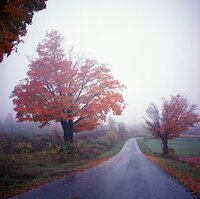
Rainy Day Trees

A
Rainy Day Trees

  • 5
  • 1
  • 79
One Way

A
One Way

  • 3
  • 1
  • 76

Recent Classifieds

Forum statistics

Threads
203,154
Messages
2,850,683
Members
101,703
Latest member
arrowactive
Recent bookmarks
0
Is it possible?

Yes
The norm in pro situations was a large internegative, off a 35mm Kodachrome.
Many people used direct positive paper (or transluency), latter prehistory now
Noel
 
The E6 duplicating films haven't been made for some years now, current films would boost the contrast in a copy. However there were duplicators that allowed a small background exposure (similar to pre-flashing B&W paper) to control the contrast.

Ian
 
Good question

I did this for years in the 80's and 90's but I am not sure if I can buy the same film today, I know that Toronto Image Works has stopped E6 in my city so I would be
hard pressed to find a place to process, I do have Jobo 16 x20 drums so if I really wanted to I could do it myself. I believe many here are doing their own E6 process
with varied success rates.

We use to make up to 16 x20 trans- mostly multiple imagery comps but in some cases singular images for the Advertising community going to press.

There is nothing more beautiful (other than my wife of course) than looking at an very large positive transparency - If I remember the Kodak code for this material
was 6121 ...

I would be interested to see how people are doing them today as I see some really nice applications for this now that we have the fantastic LED light boxes. Maybe we will see
a comeback.

If anyone knows , it would be David Wood at Dr5, pretty much the expert in large transparency production.

Bob
 
LVT output (not apug discussion, look it up) to 8x10 fuji film would be the way to do it today, me thinks.
I don't know of anyone doing it but there are plenty of LVT film recorders in use. Make sure your wallet is thick.

fwiw, I have a bunch of the kodak 6121 sheet film in the freezer. I don't know why.
 
As mentioned before it is difficult and expensive to enlarge color slides. I think E6 slide film is the only non-digital option left.

For black and white it is possible to manage the contrast either with inter-negatives or a direct reversal process. I enlarge negatives for carbon prints by a reversal process. (Of cause there I don’t care too much about base fog and I want rather high contrast)
 
By far the best duplicating film ever made was ordinary Fuji Astia 100F sheet film. You can no longer buy it in the US but it is available in Japan. It tungsten-balances well under an enlarger and has excellent recip characteristics. Any remaining inventory of official CDUII or EDupe film is probably way too old by now for reliable results without highlight crossover. Getting a good dupe requires some tricks. You need a precise vacuum sheet film holder and an enlarging or graphics lens suited to this kind of task. Then you need to know how to properly make an unsharp mask for the original to maintain the contrast and any potential color corrections in the enlarged dupe. I don't know any commercial labs that do this with film anymore, and very few did it well to begin with, because that requires a lot of effort and
expense. The modern option is to scan and output the result with a large format film recorder, which won't be cheap either.
 
Depending on what size transparent result one wanted and what the intended purpose was, it would be theoretically possible to make an interneg using Portra 160 and then print on to the display-transparency RA4 material Fujiflex. That route would be using materials that are all in-date and available, as the older interneg and direct-copy films (perhaps what the OP was thinking of) aren't made any more, unless someone knows of a hidden manufacturer somewhere. Thirty years ago the lab I worked at would enlarge 35mm on to 4x5" interneg film, rather than contact-print, and then use RA4 from that in the usual way.
 
Photrio.com contains affiliate links to products. We may receive a commission for purchases made through these links.
To read our full affiliate disclosure statement please click Here.

PHOTRIO PARTNERS EQUALLY FUNDING OUR COMMUNITY:



Ilford ADOX Freestyle Photographic Stearman Press Weldon Color Lab Blue Moon Camera & Machine
Top Bottom