
• Welcome to Photrio!
    Registration is fast and free. Join today to unlock search, see fewer ads, and access all forum features.
    Click here to sign up

Can discrete AgX grains develop into a single mass of silver?

feeling grey

A
feeling grey

  • 2
  • 0
  • 38
Inconsequential

H
Inconsequential

  • 2
  • 0
  • 48

Recent Classifieds

Forum statistics

Threads
201,802
Messages
2,830,420
Members
100,962
Latest member
DannyLarsen
Recent bookmarks
0

iandvaag

Subscriber
Allowing Ads
Joined
Oct 7, 2015
Messages
484
Location
SK, Canada
Format
Multi Format
Please don't be unhappy with me, I am not trying to destroy APUG by bringing up "grain clumping", but I have a question I'd like to find out about. I tried not to give this thread a clickbait title.

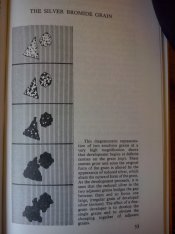
I understand that AgX crystals are fixed in place and cannot migrate in an emulsion, however I was just reading Kurt Jacobsen's book "Developing" (18th ed.) and on page 53 there is a diagram and explanation of what he calls grain clumping -- where the reduced silver between two adjacent AgX grains that are developing can form a bridge between each other, thus forming a single, irregularly shape large silver grain. Is this notion of "grain clumping" also incorrect? I'd be interested to learn more about it. I don't take Jacobsen's book to be an absolute authority on photographic science (such as Haist's or Mees'), but I was under the impression that his book was fairly reputable (at least the later editions). Has the meaning of grain clumping changed over the years from "an actually occurring process of discrete adjacent AgX crystals developing into a larger irregular mass of silver" to "a fictional process whereby AgX crystals can move throughout the emulsion"?

If adjacent developing AgX crystals can form a larger agglomerate of silver, can solvent developers prevent this from happening, and if so what is the mechanism?

I have more questions regarding covering power of developed masses of silver, and the effect of physical versus chemical development on this, but I'll try not to complicate things all at once.

Cheers,
Ian
 

Attachments

  • clumping.jpg
    clumping.jpg
    1.2 MB · Views: 129

Gerald C Koch

Member
Allowing Ads
Joined
Jul 12, 2010
Messages
8,131
Location
Southern USA
Format
Multi Format
NO Two developing silver grains can grow toward each other but they don't actually merge at least in the conventional sense of the word "merge." In other words they never become a single crystal. The Law of Entropy makes it energetically impossible. BTW Jacobson is an old book and a lot has changed with the understanding of the photographic process.
 

Alan Johnson

Subscriber
Allowing Ads
Joined
Nov 16, 2004
Messages
3,375
http://web.archive.org/web/20051017...hotosite/technical/Filmbasics/filmbasics.html
Here Erwin Puts describes how individual particles develop to filaments in chemical development, the term "grain clumps" applies to the overlap of such grain particles at different depths.
He apparently does not discuss any movement of grains through the emulsion or the agglomeration of grains so this is not a complete answer to your question.
 

Leigh B

Member
Allowing Ads
Joined
Jan 17, 2011
Messages
2,059
Location
Maryland, USA
Format
Multi Format
Perhaps our discussion should recognize the fact that an emulsion is a 3-dimensional space, not 2-dimensional.

When collimated light passes through an emulsion, it can be blocked by any silver grain at any height in the emulsion.
Thus, two silver grains need not be physically attached to be a single optical entity.

This is the whole reason diffusion enlargers and condenser enlargers render dense highlights differently.
The condenser light source produces collimated light. Diffused light can take multiple paths through the emulsion.

Think of trying to look through a sheet of cardboard with a hole in the middle. No problemo.
Now try looking through two such sheets, one atop the other. Unless the holes are aligned, problemo grande.

Some years ago I was chief engineer at a company that made equipment to measure "dirt" in hydraulic fluid.
We faced exactly this same problem when trying to count particles moving through an optical detector system.

- Leigh
 

Photo Engineer

Subscriber
Allowing Ads
Joined
Apr 19, 2005
Messages
29,018
Location
Rochester, NY
Format
Multi Format
You should think of the silver particles as growing outward from the grain of silver halide. As they grow outward they can overlap, entangle and obscure, but they do not merge.

If a silver halide solvent is present, the grains can be etched and this halide can be deposited elsewhere or result in development elsewhere, but there is still no merging or overlapping physically.

PE
 

piu58

Member
Allowing Ads
Joined
May 29, 2006
Messages
1,545
Location
Leipzig, Germany
Format
Medium Format
I am not a native English speaker, and it is rather hard for me to explain this process, although I understand it.

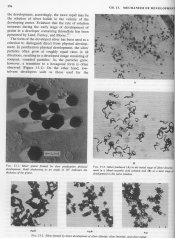
Developing starts at the edge of a crystal. You need four free electrons to start this process. From there there starts an grow of silver filaments, which takes its material form the developer: Every developer has the ability to dissolve silver halide and gives free silver ions. These filaments form the grain and not the primary crystals (which are in fact very small).

I own the 4th edition of The theory of the photographic process form T.H. James which explains this very fine.
 

piu58

Member
Allowing Ads
Joined
May 29, 2006
Messages
1,545
Location
Leipzig, Germany
Format
Medium Format
I have scanned a page of this book which shows the process quite clearly. We can see easily how the snarls of filaments form the "grain", and not the primary crystals.
 

Attachments

  • silber.jpg
    silber.jpg
    479.4 KB · Views: 127
OP
OP
iandvaag

iandvaag

Subscriber
Allowing Ads
Joined
Oct 7, 2015
Messages
484
Location
SK, Canada
Format
Multi Format
Thank you all very much. I consider myth busting a very important part of this community, and I am very glad for the members who have the knowledge to do so.

I would like to know if I understand things correctly. Sulphite can complex silver weakly (in alkaline solution), which is released, reduced, and deposited elsewhere. Sulphite and other AgX solvents promote physical development by releasing silver into solution where it is rapidly reduced and deposited on already developed filamentous silver. Developers containing very large amounts of AgX solvent (such as reversal first developers) can be thought of as a competition between chemical development (rapid process promoted by the activity of the developer) and physical development (slower process promoted by the activity of the solvent and restrainers).

How does the structure of physically developed silver compare to the structure of chemically developed silver? Haist mentions in his chapter on reversal processing (V2, p322) that silver that is physically developed is deposited on the filaments, thickening them slightly but this does not appreciably increase covering power. When considering emulsions as 3 dimensional, it makes sense how, for a given mass of silver, thickening filaments will not increase covering power as much as lengthening filaments. Is it generally true that chemical development primarily lengthens the filaments while while physical development mostly thickens the filaments? The James publication answered a lot of the questions I had, thanks for sharing it.

I guess I'm finding it frustrating trying to determine what information is true or not. For example, I have the first revised edition (1954) of Mees' Theory of Photographic Process. Therein, James wrote a chapter on the mechanism of development similar to the publication posted above. However, in this first revised edition of Mees, James writes about clumping saying:
"The tendency of a developer to form projections appears to be correlated with the tendency to form clumps of developed grains. [...] Apparently, a silver projection from a developing grain thrust into the lattice of an adjacent grain can initiate development of the latter." (p508)

I take it that this is now known to not occur. However, if there are two adjacent AgX grains which are in contact with one another, and one of them is developed, the second grain will also be developed, even if it had no latent image centers. The number of AgX grains that are touching each other can be decreased the etching action of sulphite. The grains can be reduced in size, and therefore the grains that previously touched can be made to no longer contact each other and the distance between adjacent grains may be increased. This results in an increased distance between masses of developed silver, yielding a more uniform distribution of silver filaments and appearance of lower graininess (Haist V1, p225-226).

I find James' "Fundamentals of Photographic Theory" fascinating. Do you know if there were any editions beyond the 2nd edition. Is the following a fair summary of what James describes? :
it is clear that physically developed silver can adopt filaments since the silver is mobile in solution. It is also clear that the chemically developed mass of silver is not the same size and shape as the AgX grain it originated from. This is to say that the reduced silver atoms do not occupy the same positions as the oxidized Ag+ ions originally occupied in the AgBr crystal lattice. During development the AgBr lattice is destroyed, and the Br- ion is released to solution. Somehow, the newly reduced Ag0 must adopt a new geometry. James seems to suggest two mechanisms that contribute to the movement of silver to the growing filament. 1: Oxidized Ag+ can move from the outside of the silver halide grain to the site where the silver is being reduced (without being dissolved, at least in my limited understanding of the word). 2: Silver can be reduced elsewhere on the crystal and can migrate to the growing filament. At the active reduction site, the newly reduced silver pushes a filament outward from the grain.

I've clearly got a lot more reading to do before I can ask more informed questions. Is the 4th Edition of Mees and James the most recent one?
 

Gerald C Koch

Member
Allowing Ads
Joined
Jul 12, 2010
Messages
8,131
Location
Southern USA
Format
Multi Format
Haist is the only book that describes the modern theory of development. All the others are quite dated. One need only look at the publication dates.
 
Last edited:

Photo Engineer

Subscriber
Allowing Ads
Joined
Apr 19, 2005
Messages
29,018
Location
Rochester, NY
Format
Multi Format
I would have to say that from observation, developed silver depends on the silver halide and on the developer as well as it does on the addenda added as modifiers. The latter include organic compounds and heavy metals.

Therefore, results may vary and can only be "firm" or "constant" with a known situation such as a known AgBr with only sulfur + gold and cubic grains as one "known" example. As you diverge, you can even get mixtures of silver metal types and this changes as a function of fixation and toning.

So, it comes down to the question then of "why is this important to you, what do you want to achieve?" Once you firm this up, then you find something that gives you that result. If the answer is "just for knowledge sake" then you become a seeker on a nearly infinite voyage into the nature of emulsions and their processing.

PE
 

Alan Johnson

Subscriber
Allowing Ads
Joined
Nov 16, 2004
Messages
3,375
3 cases could be suggested:
(1) Perception of clumps due to overlapping of grains when viewed through the depth of the emulsion.
(2) Agglomeration of grains - in a few cases grains do touch, this was at one time referred to as grain clumping, eg Mees,James 3rd Ed.
(3) Movement of grains through the emulsion - believed on APUG not to occur - original work or other source not identified.
 
OP
OP
iandvaag

iandvaag

Subscriber
Allowing Ads
Joined
Oct 7, 2015
Messages
484
Location
SK, Canada
Format
Multi Format
Thanks Gerald. I think I'll opt to reread Haist a few more times rather than some of these older books. The fourth edition of Theory of the Photographic Process is 1977, while Haist is 1979, so I would have expected the information to be comparable.

Those are very good questions, PE. As an undergraduate student studying chemistry and an amateur photographer, a part of me is very interested in the chemistry "just for knowledge's sake". I've read multiple times on this forum by very credible folks that grain clumping does not occur, and I wanted to have a better understanding of how developing silver adopts a particular structure. In my final year I will have an opportunity to do a small research project, possibly related to photographic chemistry. I'm trying to get a good background so I can ask relevant questions and formulate an interesting research project.

More narrowly, my favorite type of photography is medium format stereoscopic slides. I'm concerned about the future of color slides, and I enjoy black and white also, so I am particularly interested in generating positive images on film. I have been deterred by the availability and cost of suitable films for contact printing negatives. This has brought me to reversal processing. As a student, I can't really afford spending $12 CDN per roll on the Formulary's TMAX reversal developer, especially since I only get 6 stereoscopic pairs from a roll of 120. Besides, I am very interested in trying things out for myself and trying to get a better understanding. From my reading of Haist, the first developer is really the main concern for satisfactory reversal processing. I think that having an understanding of what happens on the microscopic scale would help to understand what function each component of the developer performs and how varying each component might affect the macroscopic results (dMax, CI, graininess, etc). I agree that there's a limit to how much theory will actually help me: I'm certainly getting distracted by the mechanism of atomic migration of silver to the growing filament. I realize that there are synergistic and inhibitory effects and that you can't really isolate the effects of one component without considering the entire developer formulation. I guess in this particular application of the theory, I was ultimately hoping there would be some generalizations that could be made about how dMax and CI are affected by the amount and type of AgX solvent would have in a reversal developer like D67 used with, say, TMAX 100 or Delta 100.

Thanks,
Ian
 

Diapositivo

Member
Allowing Ads
Joined
Nov 1, 2009
Messages
3,257
Location
Rome, Italy
Format
35mm
Ian,
I think you will find this document interesting:

http://cool.conservation-us.org/coo...itale/2007-04-vitale-filmgrain_resolution.pdf

There's plenty of microscopy photographs (also electron micrographs) and it shows clearly the different "grain" between non-chromogenic B&W film (which gives grain properly called, if I read the text correctly and correctly remember it) and colour film which gives "dye clouds".

The second part deals with resolution limits of various films, and lenses, and film-lens combinations. I suggest you don't stop there because at page 19 new microscope images show filaments at deep enlargement levels.

You can download the PDF document and save it locally.

Hope it helps
Fabrizio
 

Photo Engineer

Subscriber
Allowing Ads
Joined
Apr 19, 2005
Messages
29,018
Location
Rochester, NY
Format
Multi Format
To show how fast things can become obsolete, in the post by Fabrizio above, the grain sizes are rather obsolete as is the information. Grains today are as large as 10 microns and can range up to 10% iodide content with placement being controllable by the emulsion scientist.

As for Alan's comment #3, this has been verified as a non event. There is no migration. This was dispelled by Dickerson and Zawadski in an article in Darkroom Techniques quoted much earlier on APUG, and also by Ross and others of EK who showed that if grain migration took place, then Astronomical Photography as a science would be impossible. A double star system can have the distance between stars determined accurately only because the silver image does NOT migrate. However, they use plates for this type of work. The myth may have arisen when using bad film allowed the images to move due to the change in the film size during aging or processing. IDK. I do know that someone or several individuals have promoted this myth.

Proof of the fact of the myth was said to exist but no evidence has been forthcoming.

PE
 

Diapositivo

Member
Allowing Ads
Joined
Nov 1, 2009
Messages
3,257
Location
Rome, Italy
Format
35mm
The Vital document says that the grain scale is 10 - 30 micron but it also says:

Although the viewer sees a granular pattern, the eye is not necessarily seeing the individual silver particles, which range from about 0.002 mm down to about a tenth of that size.


That would mean a "silver particle" ranging from 0.2 to 2 microns, and the 10 - 30 microns grain would be, if I get it right, the "granular pattern" as shown at the microscope, which is the result of various silver particles along the thickness of the emulsion.
 

Photo Engineer

Subscriber
Allowing Ads
Joined
Apr 19, 2005
Messages
29,018
Location
Rochester, NY
Format
Multi Format
Different grains make different grains! AgX vs Ag. And this is what I mean by differing by developer, emulsion and etc....

It is different in each case.

PE
 
Photrio.com contains affiliate links to products. We may receive a commission for purchases made through these links.
To read our full affiliate disclosure statement please click Here.

PHOTRIO PARTNERS EQUALLY FUNDING OUR COMMUNITY:


Ilford ADOX Freestyle Photographic Stearman Press Weldon Color Lab Blue Moon Camera & Machine
Top Bottom