• Welcome to Photrio!
    Registration is fast and free. Join today to unlock search, see fewer ads, and access all forum features.
    Click here to sign up

Calculating aperture width

100 years ...

A
100 years ...

  • 0
  • 0
  • 7
Mapleton

H
Mapleton

  • Tel
  • Mar 27, 2026
  • 2
  • 2
  • 90

Recent Classifieds

Forum statistics

Threads
202,986
Messages
2,848,452
Members
101,582
Latest member
LtDave
Recent bookmarks
0

Sherkin

Member
Allowing Ads
Joined
Mar 26, 2008
Messages
9
Format
35mm
When calculating aperture widths using the formula Focal Length/F Stop, should the focal length actually be the flange plate to focal plane distance?

The reason I ask is that I'm doing a Nimslo panoramic conversion, using a Bronica 40mm lens, and the flange plate to focal plane distance is 76.5mm. I used 40mm in the aperture width calculation and have ended up with a roll of underexposed film.

It would seem that I should use 76.5mm as the focal length (possibly?), but I've not been able to find any information about this.

Anybody had any experience of this?
 
The 40 is a retro focus lens so the effective FL is 40mm. Flange to FP is to clear the mirror in the Bronica camera. What kind of linkage are you using to control the aperture? Stopping it down or opening it?
 
Why calculate the aperture width?
For exposure, only the f-stop matters.

If you used the results of, say, 40/8 = 5 to set your exposure, i.e. chose a shutterspeed to match 5, you would indeed be more than 1 stop (1.36 in fact) stop off (underexposed) from what it should be.

If you set the lens to f/8, use the shutterspeed to match f/8. Nothing else.
 
When calculating aperture widths using the formula Focal Length/F Stop, should the focal length actually be the flange plate to focal plane distance?

The reason I ask is that I'm doing a Nimslo panoramic conversion, using a Bronica 40mm lens, and the flange plate to focal plane distance is 76.5mm. I used 40mm in the aperture width calculation and have ended up with a roll of underexposed film.

It would seem that I should use 76.5mm as the focal length (possibly?), but I've not been able to find any information about this.

Anybody had any experience of this?

What John said. Also, if that would be true all your lenses would have the same focal length. The focal length is the distance from the rear nodal point to the focal plane at the lens' infinity setting. Finding the rear nodal point is complex and depends on lens design.
 
I've taken the lens elements out of the Bronica lens housing and fitted them onto a compur rapid shutter, which is positioned to use hyperfocal distance rather than manual focussing. Now of course, I have to recalculate the aperture widths and re-mark the shutter, which I did using 40mm in the calculation. Since I've ended up with underexposed frames, I'm guessing that I should have used the measured 76.5mm flange plate to focal plane distance, but I can't find any information to support this assumption.
 
If your iris is in the same position as the original, can you measure the factory one? Is the bore of the new shutter iris assembly the same as the original iris?

Instead of measuring diameters, try putting a piece of white paper on the film plane and measure the brightness fully open, then close the iris and mark the full stop increments. May not be perfect, but it should be closer than what you have now.
 
You should indeed not use the flange to film plane distance.
What you should use however is the pupil diameter, i.e. how big the physical hole size appears when magnified by the glass.
 
I'd follow Q.G.'s suggestion with a retrofocus lens and just measure the entrance pupil--the size of the aperture as it appears at the front of the lens. Put a ruler or calipers across the front filter threads of the lens and measure it, and you'll be close enough, and then use that value to calculate f:stops using the formula, focal length/entrance pupil diameter=f:stop (or more likely, you'll want to know the normal stops and use the formula to determine what the entrance pupil diameter will be for each stop).

If you hunt around on photo.net, Noah Schwartz used to have some illustrations demonstrating how to do this. It may still be there.
 
Hope it works out well this time.

For those of us who like messing around converting and building things, can you post some pictures of the camera?


Steve.
 
Hi Steve, here's a photo of the finished camera - it just needs a viewfinder which I'm waiting for. I'm off out now with my test film inside, having just recalculated the f stop markings.
set-72157623047873869
 
I'll try to upload that photo again...
set-72157623047873869
 
Looks good.

I was going to do a Nimslo conversion a while ago but instead I did a 6x12 format camera with a 65mm Super Angulon. Link in my signature line.

I was going to use the 6x12 format Holga pinhole camera as a basis for this but after a while I decided I could build all of it.

What are you going to use for a viewfinder? I ended up making mine as I couldn't afford to buy one.


Steve.
 
Last edited by a moderator:
Neat conversion!
 
Thanks David. Steve, I've sent off for a Gaoersi viewfinder, the 90mm fixed viewfinder for 6x17 should cover the same area as I need for the Nimslo.

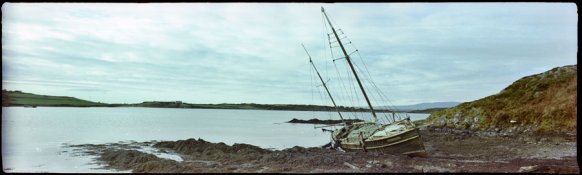
I've developed the second test film and all the exposures are looking good, so thanks to everyone for their help. Heres a rough scan of one of the frames...
set-72157623047873869
 
Try again with an attachment
 

Attachments

  • Nimslo Panoramic Conversion test film.jpg
    Nimslo Panoramic Conversion test film.jpg
    82.2 KB · Views: 150
Photrio.com contains affiliate links to products. We may receive a commission for purchases made through these links.
To read our full affiliate disclosure statement please click Here.

PHOTRIO PARTNERS EQUALLY FUNDING OUR COMMUNITY:


Ilford ADOX Freestyle Photographic Stearman Press Weldon Color Lab Blue Moon Camera & Machine
Top Bottom