• Welcome to Photrio!
    Registration is fast and free. Join today to unlock search, see fewer ads, and access all forum features.
    Click here to sign up

Bulk Tri-X Film Speed

Sprung

H
Sprung

  • 2
  • 2
  • 33
Hensol woods

A
Hensol woods

  • 4
  • 0
  • 45

Recent Classifieds

Forum statistics

Threads
202,962
Messages
2,848,164
Members
101,557
Latest member
finishthat
Recent bookmarks
0

JohnMatters

Member
Allowing Ads
Joined
Jul 26, 2014
Messages
10
Format
35mm
Hi All -

New apug user here. I just picked up a bulk loader that has film and is labeled 'tri-x'. In looking around, it seems most likely (based on what looks for sale these days) that it would be 400tx 35mm. But the label does look old, and I was wondering if there might have been other common speeds for bulk tri-x previously? I am more than happy to shoot a test roll or two when I've narrowed down what the possibilities might be.

I did throw about 10 inches of unexposed film into developer and got 'Kodak Tri-X Pan Film' printed on the film itself.

Also on that test strip was labeling for #s 26, 25,24. Does anyone know if that is a countdown towards the end of the spool (as in, I have length for only 24 shots)?
I am hoping that it is labeled to recount every 36 shots or something ....

Thanks!
-john
 
There is 320 ISO and a 400 ISO Trix and some bulk film is edge numbered.
 
Welcome John,

Even fairly old TX in my experience works very nicely at 400.
 
And the numbering sequence recycles over and over again... It just helps you know relative position of shots, since you would hardly expect the series to start at 1

Extremely old Tri-X sometimes rates for me at 64 so as you experiment with the film be sure to try a few shots at speeds ranging between 100, 200, 400 and see what works for this roll.
 
I don't think the 320 flavor Tri-X was ever done in 35mm. Tri-X box speed has been 400 for a very long time, that's most likely what you have. That said, if it's more than a few years old, you may want to expose it at something more like 200, depending on what your favorite developing brew is.
 
Thanks for all the quick feedback, everyone!
And a totally novice follow-up question. When you say shoot it at 200, I know that means exposure as it if were 200 and not 400 .... but then do I keep the development the same as it would be for fresh 400?
 
Develop the same (at least for now). Expose with the meter/camera set at 200, and the extra exposure will bring the negative densities above any fog.

It may be necessary to develop longer to achieve normal contrast with aged film. But that decision (how long to develop to get the right contrast) is somewhat independent of how much to expose. And I think the "loss of contrast" is slight, while the "loss of speed" is more significant.

So you can develop normally to begin with.
 
Develop the same (at least for now). Expose with the meter/camera set at 200, and the extra exposure will bring the negative densities above any fog.

It may be necessary to develop longer to achieve normal contrast with aged film. But that decision (how long to develop to get the right contrast) is somewhat independent of how much to expose. And I think the "loss of contrast" is slight, while the "loss of speed" is more significant.

So you can develop normally to begin with.

Since the John has developed a test strip he should know if the fog level is high enough to justify not shooting it at box ISO - if box speed is his norm?
 
Since the John has developed a test strip he should know if the fog level is high enough to justify not shooting it at box ISO - if box speed is his norm?

Exactly, if the film is very foggy, (Much more gray than normal) then more effort is required.

If it does say "Kodak Tri-x" it is the previous version so the OLD development times "for Tri-x Pan" should be used, although they are not all that different from the ones for the current film which is labelled "Kodak 400TX"

The numbers on any of the Bulk Tri-x go between 1 and 44 and then repeat.
 
Exactly, if the film is very foggy, (Much more gray than normal) then more effort is required.


cmacd123 and Xmas are both right.

JohnMatters,

Can you fix a small strip of the film without developing and compare to the strip you developed? The fixed-only film would be "Base" and the developed strip clear areas would be "Base+Fog".

Now any way to evaluate the difference in density between the two can tell you what your "Fog" is. For example if you have a spotmeter and can see 1/3 stop differences... 0.10 is "1/3 stop" and a good baseline of Fog. If that's all the Fog you have (the meter shows only one mark difference between fixed-only film and developed unexposed film), you can shoot closer to 400. If the Fog is more... then you would use a lower speed like 200 to overcome it...
 
100,200,800,50 I use the same "normal" development as if 400.
 
Thanks for all the feedback. I would never have come up with the idea of fixing a separate strip and spot-metering to see what amount of fog there is. But, I will do that in the next couple of days and see what I'm working with !!
 
In very rough terms, one stop of fog is about two stops of speed loss.
 
I had a 'fog factor' of 1.66 when I tested a developed vs. fixed strip a couple different times. I think, then, that that means shooting around 50 and developing as if 400. I am going to try at, as well as pushing to 100 and developing as if 800.

Thanks, again, for all the advice !
 
So about 1 2/3 f/stops of metered difference between the clear fixed and the clear developed film?

Your logic and plan makes sense.

When you get a chance, the same kind of test with spotmeter can tell you the average gradient... Shoot two different shots of something gray, two f/stops exposure apart... Then if you get one f/stop of metered difference on the two negatives... your gradient is about 0.50, which is what the plan fits.

You'll know from the gradient, whether you have "pushed" or not, based on the f/stop metered difference of the two gray shots.

(Not a lot of people have adopted this strategy for testing, but I've been recommending it recently and think it's a good simple way to get process control details that you can discuss on APUG).
 
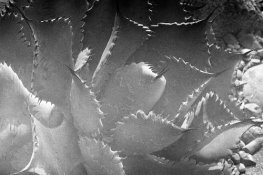
Thanks Bill. I'll try that, too (so far I am having a lot of fun playing around with this old spool of film!). I don't have a spot meter, but used a macro lens and my DSLR's internal meter to do the measurements, which I am fairly confident in. I did some test shooting and think that things are in the right ballpark. Although a little grainy here on the scans (possibly due to the scanner? I'll know when I have more time to spend w/ my enlarger), here are a couple quick shots I took with the film, both at 50 & pushed to 100.

1.jpg

2.jpg
 
I am sure your meter technique is up to the challenge.

Scanning can make negatives look grainier than they are, a major reason to avoid talking about it here.

But yes, that fog contributes a lot to graininess and will be a central "look" that you get with this old roll of film. Something to embrace and expect.

Looks like you might not have used enough chemistry liquid in the tank for the full view agave... Do you use Patterson plastic tanks? They take more than a pint to cover two rolls (always for some reason, the top roll slips up on the pipe)... So always use enough developer to fill the tank completely to avoid the "top half under-developed" look.
 
Photrio.com contains affiliate links to products. We may receive a commission for purchases made through these links.
To read our full affiliate disclosure statement please click Here.

PHOTRIO PARTNERS EQUALLY FUNDING OUR COMMUNITY:


Ilford ADOX Freestyle Photographic Stearman Press Weldon Color Lab Blue Moon Camera & Machine
Top Bottom