
Anyone know if there's anyone who actually sells bulk rolls of 120 film to consumers? It would be nice to be able to bulk roll my medium format film, but I cannot seem to find anyone who actually sells 100' lengths of the stuff, or even backing paper
-
Welcome to Photrio!Registration is fast and free. Join today to unlock search, see fewer ads, and access all forum features.Click here to sign up
You are using an out of date browser. It may not display this or other websites correctly.
You should upgrade or use an alternative browser.
You should upgrade or use an alternative browser.
Bulk rolling 120/220 film
-
A
- Thread starter garpet
- Start date

Recent Classifieds
-
For Sale Bestwell Microsight Grain Focusing Scope - Super Quality
- Started by davela
-
For Sale Gralab Model 300 Darkroom Timer - Works Great!
- Started by davela
-
For Sale 14.5" f:4 Wollensak Verito Diffused Focus Lens on Sinar board
- Started by David A. Goldfarb
Forum statistics

gbroadbridge
Subscriber
Anyone know if there's anyone who actually sells bulk rolls of 120 film to consumers? It would be nice to be able to bulk roll my medium format film, but I cannot seem to find anyone who actually sells 100' lengths of the stuff, or even backing paper
Rolling 120 onto reels with backing paper is so bloody difficult not many people bother,
especially now that film is easy to find again even in the local shops.
Backing paper itself is so tricky to get right chemically and mechanically, so it is mostly reused.
There are some folks who slit down from larger film sizes and I'm sure they'll chip in.

Yep, just did it today as a matter of fact!
You can get the film from a few places if you’re willing to buy an entire master roll, but as of right now, Astrum is the only place I can find 61.5mm rolls at reasonable quantities. After shipping and tariffs a roll of FN-64 in 61.5mm costs around $180, ≈$5/roll.
Backing paper is also possible to get, Shanghai sells it for $4/roll, although I bought some for 127 and it was awful so I’m not sure if I’d recommend them.
I have also gotten giant rolls of red/black paper from Astrum, but you need to cut them and mark them yourself. I do this for 220, not for 120 though.
I usually just ask people for used backing paper.
As far as bulk rolling film goes, I honestly wouldn’t recommend it to many people. Can it be done cheaper? Yes, but it takes a lot more time and effort than 35mm.
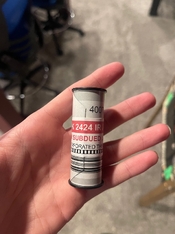
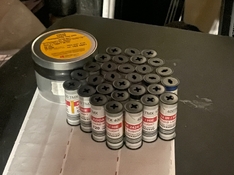
To put this in perspective, I just rolled about 30 rolls of 2424 infrared film and it took me about 4-5 hours just to roll already slit film into pre-prepared backing paper. including the time it took to prepare the paper and slit the film, it probably took closer to 10 hours.
Meanwhile, I think it takes me maybe 30-45 minutes to break up a 100 foot roll of 35mm in my darkroom without a loader.
You can get the film from a few places if you’re willing to buy an entire master roll, but as of right now, Astrum is the only place I can find 61.5mm rolls at reasonable quantities. After shipping and tariffs a roll of FN-64 in 61.5mm costs around $180, ≈$5/roll.
Backing paper is also possible to get, Shanghai sells it for $4/roll, although I bought some for 127 and it was awful so I’m not sure if I’d recommend them.
I have also gotten giant rolls of red/black paper from Astrum, but you need to cut them and mark them yourself. I do this for 220, not for 120 though.
I usually just ask people for used backing paper.
As far as bulk rolling film goes, I honestly wouldn’t recommend it to many people. Can it be done cheaper? Yes, but it takes a lot more time and effort than 35mm.
To put this in perspective, I just rolled about 30 rolls of 2424 infrared film and it took me about 4-5 hours just to roll already slit film into pre-prepared backing paper. including the time it took to prepare the paper and slit the film, it probably took closer to 10 hours.
Meanwhile, I think it takes me maybe 30-45 minutes to break up a 100 foot roll of 35mm in my darkroom without a loader.
Attachments
OP
OP

TYSM!! This was extremely helpful! How is rolling 220 vs 120? I imagine you can use one 120 backing paper for two 220 rolls since you just need it for the ends, but is it annoying to find a place that will develop it?Yep, just did it today as a matter of fact!
You can get the film from a few places if you’re willing to buy an entire master roll, but as of right now, Astrum is the only place I can find 61.5mm rolls at reasonable quantities. After shipping and tariffs a roll of FN-64 in 61.5mm costs around $180, ≈$5/roll.
Backing paper is also possible to get, Shanghai sells it for $4/roll, although I bought some for 127 and it was awful so I’m not sure if I’d recommend them.
I have also gotten giant rolls of red/black paper from Astrum, but you need to cut them and mark them yourself. I do this for 220, not for 120 though.
I usually just ask people for used backing paper.
As far as bulk rolling film goes, I honestly wouldn’t recommend it to many people. Can it be done cheaper? Yes, but it takes a lot more time and effort than 35mm.
To put this in perspective, I just rolled about 30 rolls of 2424 infrared film and it took me about 4-5 hours just to roll already slit film into pre-prepared backing paper. including the time it took to prepare the paper and slit the film, it probably took closer to 10 hours.
Meanwhile, I think it takes me maybe 30-45 minutes to break up a 100 foot roll of 35mm in my darkroom without a loader.

Cholentpot
Member
- Joined
- Oct 26, 2015
- Messages
- 7,106
- Format
- 35mm
I bulk roll my own 120 just like MCB18 over here. It's not for everyone but if you're only shooting a few dozen roll of 120 a year it can be worth it.
I shoot near about 150 rolls of film year. Some years more some less. Out of those rolls I'm shooting maybe 30 rolls of a 120. It takes me a few nights in the dark room in the winter to roll my entire years worth of film. I do slit it down from 70mm and I'm generally using iffy expired stuff. I've never rolled fresh 70mm or 120. This makes it worth it for me because its cheap and worth my time.
I shoot near about 150 rolls of film year. Some years more some less. Out of those rolls I'm shooting maybe 30 rolls of a 120. It takes me a few nights in the dark room in the winter to roll my entire years worth of film. I do slit it down from 70mm and I'm generally using iffy expired stuff. I've never rolled fresh 70mm or 120. This makes it worth it for me because its cheap and worth my time.
gbroadbridge
Subscriber
Huh, guess I'll remove foot from mouth ...
Cholentpot
Member
- Joined
- Oct 26, 2015
- Messages
- 7,106
- Format
- 35mm
Huh, guess I'll remove foot from mouth ...
Oh no, you're absolutely right. It's bloody difficult and backing paper has to be reused. Some of us though have done it enough times that we're good enough at it to make it work. I wouldn't recommend someone getting into it blindly though.

blee1996
Subscriber
There are tons of film choices in 120, so there is less incentive to hand roll 120. Unless you have some unique emulsion, like Kodak Aerochrome and the Astrum high speed infrared B&W stocks that @MCB18 got a while ago.
220 is a different story, since there is hardly any offering at reasonable cost.
220 is a different story, since there is hardly any offering at reasonable cost.

lt_col_gordon_tall
Member
I recently dipped my toes into hand rolling 120 film. I bought 36"x14" sheets of Fujifilm Super HR-U green x-ray film. It's orthochromatic so can be cut, rolled, and developed under a safelight. With a little practice, it's not that big of a pain, but it does require lots of prep and working carefully. The drawback is that it scratches very easily and of course it's a quirky film stock to begin with. In terms of price, if I use all of the film and there's no waste, each roll is like a $1.25 USD.
I'm still beta testing so we'll have to see if I like the results enough to buy more x-ray film and do this again in the future. It's been a fun experiment at the very least.
I'm hoping to source other film stocks and to try more hand rolling in the future.
I'm still beta testing so we'll have to see if I like the results enough to buy more x-ray film and do this again in the future. It's been a fun experiment at the very least.
I'm hoping to source other film stocks and to try more hand rolling in the future.
Cholentpot
Member
- Joined
- Oct 26, 2015
- Messages
- 7,106
- Format
- 35mm
I recently dipped my toes into hand rolling 120 film. I bought 36"x14" sheets of Fujifilm Super HR-U green x-ray film. It's orthochromatic so can be cut, rolled, and developed under a safelight. With a little practice, it's not that big of a pain, but it does require lots of prep and working carefully. The drawback is that it scratches very easily and of course it's a quirky film stock to begin with. In terms of price, if I use all of the film and there's no waste, each roll is like a $1.25 USD.
I'm still beta testing so we'll have to see if I like the results enough to buy more x-ray film and do this again in the future. It's been a fun experiment at the very least.
I'm hoping to source other film stocks and to try more hand rolling in the future.
I'll echo that prep is very important. I have it down to how many rubber bands go on each wrist and pre slit pieces of tape.
lt_col_gordon_tall
Member
I'll echo that prep is very important. I have it down to how many rubber bands go on each wrist and pre slit pieces of tape.
Yes exactly. Anything you can do with the lights on, do it. Have everything you're going to need ready to go at your side, so that you can just focus on rolling and securing the film.
If you're planning to do 5 rolls, have 6 backing papers ready, for when you inevitably drop one on the ground. Same with rubber bands, pieces of tape, etc
Cholentpot
Member
- Joined
- Oct 26, 2015
- Messages
- 7,106
- Format
- 35mm
Yes exactly. Anything you can do with the lights on, do it. Have everything you're going to need ready to go at your side, so that you can just focus on rolling and securing the film.
If you're planning to do 5 rolls, have 6 backing papers ready, for when you inevitably drop one on the ground. Same with rubber bands, pieces of tape, etc
And don't do too many at once. Limit yourself. You push too hard you mess up.
@MCB18 thanks for chiming in! Others, too, of course, but I was particularly looking forward to your response since I knew you are deeply involved in this.
Now, of course I understand that there are other motives involved. From the financial perspective, the hourly rate I mentioned is of course fictive/hypothetical and it doesn't represent an out-of-pocket cost. If you're in a position where you want to save every penny, evidently, the value of your time drops in relation to the pennies saved. Also, what @MCB18 does is making available (to himself as well as others) types of film otherwise not accessible to photographers; for someone rolling for themselves, this can of course be a motive. And I can imagine someone enjoys the DIY spirit and having been manually involved in as much of the process as possible (consider wet plate on a DIY camera!)
I guess this brings me to the question:
As with many of these things, much depends on whether/how much one values their own time. Of course, when speaking of a hobby, it's difficult to determine an hourly rate. Still, if we do so for amusement's sake and put a very modest $25/hr to your labor, we arrive at $100-$250 in labor. Across 30 rolls, let's say $3.25 to $8.25. Add to this the base price of $5 for the film itself, bringing the total up to $8.25 to $13.25. As I understand, Arista 120 film retails for ca. $6.50 (e.g. B&H).about 30 rolls of 2424 infrared film and it took me about 4-5 hours just to roll already slit film into pre-prepared backing paper. including the time it took to prepare the paper and slit the film, it probably took closer to 10 hours.
Now, of course I understand that there are other motives involved. From the financial perspective, the hourly rate I mentioned is of course fictive/hypothetical and it doesn't represent an out-of-pocket cost. If you're in a position where you want to save every penny, evidently, the value of your time drops in relation to the pennies saved. Also, what @MCB18 does is making available (to himself as well as others) types of film otherwise not accessible to photographers; for someone rolling for themselves, this can of course be a motive. And I can imagine someone enjoys the DIY spirit and having been manually involved in as much of the process as possible (consider wet plate on a DIY camera!)
I guess this brings me to the question:
Why exactly would it be nice? Decide accordingly. It may seem nice, but if the economic perspective prevails, I expect you're better off buying the commercial product, provided you approach the matter rationally.It would be nice to be able to bulk roll my medium format film
OP
OP
Honestly I'd like to be able to shoot 220, which is nonexistent as far as I can tell. As far as the time commitment, to me, this has a positive value, since it lets me spend more time working on photography when it's too dark to shoot. Lower out of pocket cost is nice, and is one of the main reasons I was looking at it (I've averaged a bit under three quarters of a roll per day, so lowering costs wherever possible is a HUGE bonus) but the other thing that was drawing me to it was just that I kind of just enjoy everything about the photographic process and wanted to be as involved in it as I can, start to finish (I'd give it a year before I'm shooting dry-plates and making my own emulsions). Also as a general rule, there is nothing about this hobby that I do because it's rational. I am, it seems, an extremely irrational person.@MCB18 thanks for chiming in! Others, too, of course, but I was particularly looking forward to your response since I knew you are deeply involved in this.
As with many of these things, much depends on whether/how much one values their own time. Of course, when speaking of a hobby, it's difficult to determine an hourly rate. Still, if we do so for amusement's sake and put a very modest $25/hr to your labor, we arrive at $100-$250 in labor. Across 30 rolls, let's say $3.25 to $8.25. Add to this the base price of $5 for the film itself, bringing the total up to $8.25 to $13.25. As I understand, Arista 120 film retails for ca. $6.50 (e.g. B&H).
Now, of course I understand that there are other motives involved. From the financial perspective, the hourly rate I mentioned is of course fictive/hypothetical and it doesn't represent an out-of-pocket cost. If you're in a position where you want to save every penny, evidently, the value of your time drops in relation to the pennies saved. Also, what @MCB18 does is making available (to himself as well as others) types of film otherwise not accessible to photographers; for someone rolling for themselves, this can of course be a motive. And I can imagine someone enjoys the DIY spirit and having been manually involved in as much of the process as possible (consider wet plate on a DIY camera!)
I guess this brings me to the question:
Why exactly would it be nice? Decide accordingly. It may seem nice, but if the economic perspective prevails, I expect you're better off buying the commercial product, provided you approach the matter rationally.
That sounds like a perfectly reasonable set of motivations!
One thing I would put up for debate:
One thing I would put up for debate:
You could also work on printing/editing technique. In the end, rolling film doesn't do much for the photo as such. But here, too, it depends on what you're after. If this is more about doing something with your hands and the photographic results isn't the primary objective, evidently it's fine to spend time with this kind of thing.lets me spend more time working on photography when it's too dark to shoot
OP
OP
This is true, and I plan to start printing soon, the issue is my schedule is insane due to my job (graveyard shift) and does not mesh well with most of the places offering dark rooms for rent in my area, so short of setting up my own dark room (something some friends and I have been talking about and may possibly be doing eventually) I'm a bit limited there. Ideally, I'd be doing everything myself, entirely analog, and only scanning selected prints if I wanted to post them, but that's a while aways at the moment, so I'm kind of just trying to do what I can as I get the ability to do it. Right now, I'm focusing more on getting the image as close to what I want straight out of the camera, which I know is severely limiting, but until I can edit prints in a darkroom, it seems like a fun experiment and is about the best I can do.That sounds like a perfectly reasonable set of motivations!
One thing I would put up for debate:
You could also work on printing/editing technique. In the end, rolling film doesn't do much for the photo as such. But here, too, it depends on what you're after. If this is more about doing something with your hands and the photographic results isn't the primary objective, evidently it's fine to spend time with this kind of thing.
Last edited:
That's only sensible in the analog world if you're making slides/positives. With negatives, there's no such thing as "straight out of the camera" unless you want to look at an un-inverted negative. I'm saying this because this is a notion/conception that still pops up from time to time and IMO it doesn't make any sense. There's no objective merit to the "straight out of the camera" thing. The negative is an intermediate product; it needs to contain the image information required for the final image; nothing more, nothing less.getting the image as close to what I want straight out of the camera
Much of the fuss about how the negative comes out still carries over from many decades ago when printing papers or processes were effectively a single grade and you had to tailor the negative to the process. It's a different world now; embrace it.
I hope one day you'll have your own darkroom; it takes away a lot of barriers and really helps in the learning process if you can just hop in to do a print or two if you have a spare hour.
OP
OP
For me it's mostly just a surrogate metric for technical ability. If I know I can consistently get negatives that could all be printed without adjusting anything about the printing process to get the desired result (basically, the contact print results in images that have all the same characteristics as the image I had in my head for every frame, other than size), then I know I have reached a high level of technical proficiency and really understand what I'm doing. Also since I don't have a dark-room, If I wanted to get enlargements of my negatives made I do have to trust whoever is making the enlargements to make it work. Minimizing the amount of work they have to do would also mean less guesswork on my end as to how the prints should turn out. That being said, I am not very knowledgable on the subject so I may be completely off base with that assumption.There's no objective merit to the "straight out of the camera" thing.
Last edited:
Evidently, it's sensible to practice until you can consistently make printable negatives. However, there's quite a bit of leeway there. A good negative has sufficient separation in shadows and highlights, and its contrast range is in the ballpark to work well with the target printing process, or suitable for scanning. With today's materials, this is a very broad target and with a little practice it's easy to hit consistently. In the end, it doesn't matter a whole lot whether your negatives print well on average on grade 1, 2 3 or 4. It's to a large extent a matter of taste.
Also, a technically compromised negative will indeed increase the amount of work or simply reduce the possibilities for the printer/post-processor to achieve the desired end result. However, within the larger bandwidth that I highlighted above, it really doesn't matter too much if you hand a competent printer a grade 3 or a grade 1 negative. If you hand them a negative with no differentiation in important shadows, there's no amount of work anyone can put in to recover those shadows. As long as the negative contains the differentiation, there's usually a way (or, in fact, endless ways) to get them onto paper.
If you have the opportunity, see if you can get your hands dirty on some printing. You'll notice that it's a universe unto itself and that awareness of that universe is essential in understanding what is (and what isn't) required from a negative.
Sorry for the long and offtopic rant.
Much of the artistic choice is made in the printing stage. You're not just relying on the person who makes the print to make it work in a basic sense, you're relying on them to interpret your image. There's a fun exercise we did not too long ago; perhaps you noticed it: https://www.photrio.com/forum/threads/lets-all-print-or-maybe-scan-one-negative-2025.215648 We all had the same negative (roughly speaking) and the same set of scans to work with. No two prints were the same - and that was a fairly straightforward scene to begin with.If I wanted to get enlargements of my negatives made I do have to trust whoever is making the enlargements to make it work
I would offer for consideration to look at it from the other side: the guesswork would really be on the side of who makes the print; they have to figure out what you went for when you photographed the scene. In the world of fine art photographers and printers, it's common for photographers and printers (or post-processors) to have long-standing relationships that involve a great degree of co-specialization. They know each others work and vision and the printer/processor knows (after a while) how to interpret the instructions or comments they receive from the photographer. There will often be several versions of the prints/final images based on initial samples and iterative adjustments leading up to the end result.Minimizing the amount of work they have to do would also mean less guesswork on my end as to how the prints should turn out.
Also, a technically compromised negative will indeed increase the amount of work or simply reduce the possibilities for the printer/post-processor to achieve the desired end result. However, within the larger bandwidth that I highlighted above, it really doesn't matter too much if you hand a competent printer a grade 3 or a grade 1 negative. If you hand them a negative with no differentiation in important shadows, there's no amount of work anyone can put in to recover those shadows. As long as the negative contains the differentiation, there's usually a way (or, in fact, endless ways) to get them onto paper.
If you have the opportunity, see if you can get your hands dirty on some printing. You'll notice that it's a universe unto itself and that awareness of that universe is essential in understanding what is (and what isn't) required from a negative.
Sorry for the long and offtopic rant.
This is exactly why I started doing it, and although most folks are interested in 120 for various reasons, I do still make 220 for myself and others when they ask. I can even make my own backing paper now!Honestly I'd like to be able to shoot 220, which is nonexistent as far as I can tell.
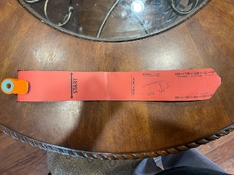
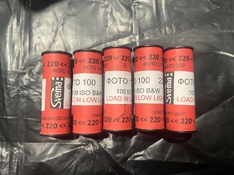
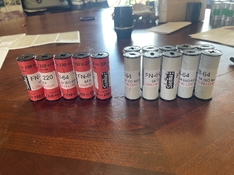
Exactly right! In no this case though, for 2424 I am doing it in exchange for the rest of the roll. I’d definitely rather have the rest of the film than the ≈$350 I’d charge for making all of it 120. And I will say, if I did sell any of it (and tbh I probably won’t), it would definitely be more than $15.As with many of these things, much depends on whether/how much one values their own time. Of course, when speaking of a hobby, it's difficult to determine an hourly rate. Still, if we do so for amusement's sake and put a very modest $25/hr to your labor, we arrive at $100-$250 in labor. Across 30 rolls, let's say $3.25 to $8.25. Add to this the base price of $5 for the film itself, bringing the total up to $8.25 to $13.25.
Last edited:
lt_col_gordon_tall
Member
Honestly I'd like to be able to shoot 220, which is nonexistent as far as I can tell. As far as the time commitment, to me, this has a positive value, since it lets me spend more time working on photography when it's too dark to shoot. Lower out of pocket cost is nice, and is one of the main reasons I was looking at it (I've averaged a bit under three quarters of a roll per day, so lowering costs wherever possible is a HUGE bonus) but the other thing that was drawing me to it was just that I kind of just enjoy everything about the photographic process and wanted to be as involved in it as I can, start to finish (I'd give it a year before I'm shooting dry-plates and making my own emulsions). Also as a general rule, there is nothing about this hobby that I do because it's rational. I am, it seems, an extremely irrational person.
This is basically my mindset.
Part of it definitely is cost savings. I originally got interested in the idea of handrolling 120 when I saw those big boxes of Aviphot on eBay and calculated the theoretical cost per roll. However, I couldn't resolve (at least not yet) a way to easily and safely breakdown a 9.5" x 250' roll in the dark. It would probably require a custom built jig. Happy to hear any suggestions about this project though

The other big thing you mentioned is just giving me more to do in the photographic space. I like this hobby (and that's what it is for me) because it gives opportunities for me to get involved in many stages of the process... composing , shooting, developing, scanning, printing. Finding bulk film, cutting it, and handrolling adds to the process. And if I get one really good photo from something I handrollled myself, that'll just add to the satisfaction I feel.
Throw in the opportunity to shoot films (such as x-ray) or formats (220 as you mentioned) that are not readily available on the consumer market.
Cholentpot
Member
- Joined
- Oct 26, 2015
- Messages
- 7,106
- Format
- 35mm
@MCB18 thanks for chiming in! Others, too, of course, but I was particularly looking forward to your response since I knew you are deeply involved in this.
As with many of these things, much depends on whether/how much one values their own time. Of course, when speaking of a hobby, it's difficult to determine an hourly rate. Still, if we do so for amusement's sake and put a very modest $25/hr to your labor, we arrive at $100-$250 in labor. Across 30 rolls, let's say $3.25 to $8.25. Add to this the base price of $5 for the film itself, bringing the total up to $8.25 to $13.25. As I understand, Arista 120 film retails for ca. $6.50 (e.g. B&H).
Now, of course I understand that there are other motives involved. From the financial perspective, the hourly rate I mentioned is of course fictive/hypothetical and it doesn't represent an out-of-pocket cost. If you're in a position where you want to save every penny, evidently, the value of your time drops in relation to the pennies saved. Also, what @MCB18 does is making available (to himself as well as others) types of film otherwise not accessible to photographers; for someone rolling for themselves, this can of course be a motive. And I can imagine someone enjoys the DIY spirit and having been manually involved in as much of the process as possible (consider wet plate on a DIY camera!)
I guess this brings me to the question:
Why exactly would it be nice? Decide accordingly. It may seem nice, but if the economic perspective prevails, I expect you're better off buying the commercial product, provided you approach the matter rationally.
When it's -5 and blowing outside and the sun sets at 4:15pm I stop calculating how much I'm making an hour and just go into the dark(er) room and roll film.
There used to be thousands of feet of it in 70mm on there, which is what I bought. Much easier to handle. I have been thinking about how to make a 9.5 inch roll slitter, but that is a very big project so I have yet to make much progress besides saying “This is the concept for how it should work.” If I can get that made then I can offer many more old and obscure film sizes to folks.Part of it definitely is cost savings. I originally got interested in the idea of handrolling 120 when I saw those big boxes of Aviphot on eBay and calculated the theoretical cost per roll. However, I couldn't resolve (at least not yet) a way to easily and safely breakdown a 9.5" x 250' roll in the dark. It would probably require a custom built jig. Happy to hear any suggestions about this project though

destroya
Subscriber
i have all the stuff to do it. tried a few rolls and it is much more labor intensive then I thought. lots of time, patience and a steady hand are needed. its the little things that add up that make it harder. 35mm bulk rolling is very easy and i know many who do. I have been saving all my backing paper for this reason. I did get a lot of the aviphot film as I love shooting B&W slides and that film works great for it. having 220 rolls of that makes travel a lot easier, especially in my mamiya 6, my fav travel camera.
this thread has me wanting to get back at it. Its a fun project but dont expect perfect results the first time. cut a few lengths of practice rolls to do trial runs in the light so you can get an idea of whats involved. for me, the hardest part is/was setting up a repeatable way to get the proper film length and then getting the backing paper secured properly (straight and tight)! my bulk film really curls and makes getting it flat a lot harder then I thought. there are a few 70mm bulk roller things, like what I use for 35mm that people 3d print and im tempted to get one of those
john
this thread has me wanting to get back at it. Its a fun project but dont expect perfect results the first time. cut a few lengths of practice rolls to do trial runs in the light so you can get an idea of whats involved. for me, the hardest part is/was setting up a repeatable way to get the proper film length and then getting the backing paper secured properly (straight and tight)! my bulk film really curls and makes getting it flat a lot harder then I thought. there are a few 70mm bulk roller things, like what I use for 35mm that people 3d print and im tempted to get one of those
john
| Photrio.com contains affiliate links to products. We may receive a commission for purchases made through these links. To read our full affiliate disclosure statement please click Here. |
PHOTRIO PARTNERS EQUALLY FUNDING OUR COMMUNITY:  |