• Welcome to Photrio!
    Registration is fast and free. Join today to unlock search, see fewer ads, and access all forum features.
    Click here to sign up

Building a Camera Obscura

Forum statistics

Threads
202,623
Messages
2,843,183
Members
101,413
Latest member
USMC46
Recent bookmarks
1

jasonclements

Member
Allowing Ads
Joined
Jun 10, 2013
Messages
9
Format
Medium Format
Hello all,

I am building a camera obscura that will be used as a screening room as opposed to making large images with. My brightness needs to be superior because the imagery being captured in the camera will be a live performance that viewers observe from inside the camera. The obscura is going to have an 11 foot focal depth. I am curious to see if anyone has any insight on what kind of lens might help with this. I have contacted an artist who is doing something similar but he is taking some time to get back to me. He seems to be using something that exceeds 1000mm. Any ideas would be greatly appreciated!
Thanks.
 
A photo group I'm part of did a camera obscura a couple of years ago. We ordered a simple positive meniscus lens with the help of an opthamologist member of the group. If you're saying that the wall of the obscura will be 11 feet (3353mm) from the lens and we estimate the performers are also 11 feet from the lens--you'd need a focal length of 1676mm. That's a diopter of +0.60. The largest blanks we could order were 75mm, so that would be f/22--acceptable for a darkened camera obscura (as long as the performers are brightly lit). The diopters are available in increments of 0.12, so you'd round off to whatever multiple of 0.12D is closest to the diopter you need.

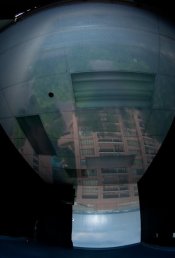
camera obscura.jpg
 
You can cheaply make very long focal lengths by combining plus and minus dioptre spectacle lens with the same numerical power but with opposite signs (of course). When the lenses are in contact they cancel and the focal length is infinite. When the lenses are separated slightly a positive power appears. Gullstrand's Equation explains the underlying calculations.
 
Maybe ask Reinhold to make you a massive fast meniscus lens?
 
They make these things called projectors :tongue: I think they call the room you're talking about a "moving picture theater" :devil:

Pay no attention to me... Carry on...
 
All of these ideas have helped greatly. I have a good understanding now of what I might need. Had a few questions via research discoveries:

would I be able to make something useful out of an darkroom enlarger condenser lens?
what resources are available for information on lenses/custom lenses?
Where might I find spectacle lenses?

thank you all so much for your help
 
also, what about fresnel lenses? do they create large or small image circle diameter?
 
Where might I find spectacle lenses?

I order mine from my local optometrist. I got 75mm +2 dioptre and a 75mm -2 dioptre spectacle lenses for $20 each and now can make any focal length from infinity to 500mm by arrangingly them appropriately. I assured the optometrist that the lenses were for experimental purposes and not for vision correction or medical purposes.
 
I order mine from my local optometrist. I got 75mm +2 dioptre and a 75mm -2 dioptre spectacle lenses for $20 each and now can make any focal length from infinity to 500mm by arrangingly them appropriately. I assured the optometrist that the lenses were for experimental purposes and not for vision correction or medical purposes.

Hi Maris.
Im trying this technique. I have basic reading glasses purchased at a drugstore a pair of +3.00 and a pair of -3.00. Are these sufficient as the Diopters you describe? if so, what is the correct way to place them together? to make a larger Convex shape? does the +3.00 face towards the subject or towards the image being formed? or are they placed together in a different combination? i might not be using the correct style lenses to begin with. I am trying to create an extremely long focal length camera obscura.

thanks
 
Put the lenses together with curves parallel and leaving minimal or no air space between them. Then increase the separation until the desired focal length appears. I've used the sun as a light source to confirm focus because its image stays bright even at very long focal lengths. It doesn't matter which lens +3 or-3 faces the subject.
 
I made a large exhibit space into a walk-in camera obscura roughly 15 years ago.

I had purchased 10 or so 4000 mm (13 feet) lenses 40 mm in diameter from Surplus Shed in Pennsylvania. I think they were described as 0.25 diopter also.

Unfortunately, that is f/100. The live projection of outside events like people and cars & a soon-boring flapping flag were the most interesting. There was a 2nd window, some portable dividers and a bench. A portable wall was placed where one lens would project onto a movable white wall, and the bench moved nearby. On the back of that wall, a second identical lens used the side window to project a distorted view due to the angle of the wall.

Michigan weather provided many overcast days, and viewers didn't have the patience to let their eyes acclimate to the dim room & often got up & left in boredom. But no burning lens effects luckily.

The next year, I purchased 4000 and 2500 mm meniscus lenses 150 mm diameter from Surplus Shed. I only set up the 4000 mm lens, which was f/26.7. No side window angled projection this time. The lens and some black matboard Waterhouse stops were placed in a Viennese Sacher Torte wooden box (a gift from visiting Austrians).

Never used the Waterhouse stops, but the image was bright enough people could see the purpose of the room immediately upon entry. The inversion and moving cars leaping between walls at the corners, eventually distorting and disappearing were the most interesting part...things one usually doesn't use a camera for.

Unfortunately, that year, the owner of the building decided to use that room for an event space (with black plastic curtains we set up for room 'convertibility'). Every time I referred a tourist to check it out, they stopped back in my shop to tell me the curtains were open & the room lights were on. I shipped the lens/hinged box to someone in Florida who had more sunlight (warning him to not point it at the sun or only use it for 'macro' projection distance so the sun could not be focussed).
 
I made a large exhibit space into a walk-in camera obscura roughly 15 years ago.

I had purchased 10 or so 4000 mm (13 feet) lenses 40 mm in diameter from Surplus Shed in Pennsylvania. I think they were described as 0.25 diopter also.

Unfortunately, that is f/100. The live projection of outside events like people and cars & a soon-boring flapping flag were the most interesting. There was a 2nd window, some portable dividers and a bench. A portable wall was placed where one lens would project onto a movable white wall, and the bench moved nearby. On the back of that wall, a second identical lens used the side window to project a distorted view due to the angle of the wall.

Michigan weather provided many overcast days, and viewers didn't have the patience to let their eyes acclimate to the dim room & often got up & left in boredom. But no burning lens effects luckily.

The next year, I purchased 4000 and 2500 mm meniscus lenses 150 mm diameter from Surplus Shed. I only set up the 4000 mm lens, which was f/26.7. No side window angled projection this time. The lens and some black matboard Waterhouse stops were placed in a Viennese Sacher Torte wooden box (a gift from visiting Austrians).

Never used the Waterhouse stops, but the image was bright enough people could see the purpose of the room immediately upon entry. The inversion and moving cars leaping between walls at the corners, eventually distorting and disappearing were the most interesting part...things one usually doesn't use a camera for.

Unfortunately, that year, the owner of the building decided to use that room for an event space (with black plastic curtains we set up for room 'convertibility'). Every time I referred a tourist to check it out, they stopped back in my shop to tell me the curtains were open & the room lights were on. I shipped the lens/hinged box to someone in Florida who had more sunlight (warning him to not point it at the sun or only use it for 'macro' projection distance so the sun could not be focussed).

The 2600/150 lens would have resulted in f/16.7 but the 4000 mm lens was more practical.
 

Attachments

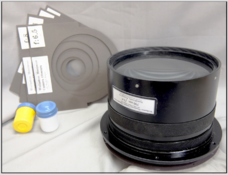
  • 790 Camera Obscura lens s:n 1322.PNG
    790 Camera Obscura lens s:n 1322.PNG
    849.7 KB · Views: 189
Photrio.com contains affiliate links to products. We may receive a commission for purchases made through these links.
To read our full affiliate disclosure statement please click Here.

PHOTRIO PARTNERS EQUALLY FUNDING OUR COMMUNITY:


Ilford ADOX Freestyle Photographic Stearman Press Weldon Color Lab Blue Moon Camera & Machine
Top Bottom