
• Welcome to Photrio!
    Registration is fast and free. Join today to unlock search, see fewer ads, and access all forum features.
    Click here to sign up

Bowens Illumitran 3S

Flooded woodland

Flooded woodland

  • 6
  • 0
  • 52
Babylon

D
Babylon

  • 2
  • 1
  • 57

Recent Classifieds

Forum statistics

Threads
202,836
Messages
2,846,239
Members
101,557
Latest member
IshKabibble
Recent bookmarks
0

wschraml

Member
Allowing Ads
Joined
Aug 29, 2009
Messages
6
Format
35mm
Hello,

Trying to rig up an older Illumitran 3S for slide digitizing. It switches on and charges but then makes a "clicking" noise about once a second. The neon ready light is also slightly changing intensity at the same rate.
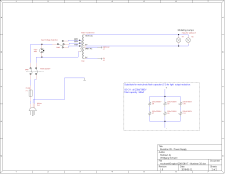
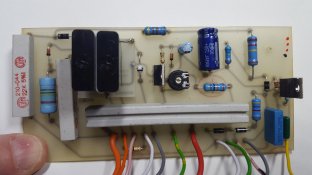
I have a schematic for an Illumitran 3 but the 3S has an additional circuit board that is not covered there. That's where the clicking seems to originate.
I connected an oscilloscope parallel to the flash bulb to observe the high voltage and sure enough, it goes down and up about every second in a range of approx. 20V.
- Wanted to verify - is this behavior normal?
- Does anyone have service info/schematic for a 3S?

If the behavior is not normal, I suspect one or both of the capacitors (trigger and main photoflash) need replacement.
Any thoughts?

Thank you.
 
Thanks ... that gives me a starting point.
I did run a first test and the flash fires. The constant clicking is just annoying ... will probably replace the main cap first.
 
Probably a faulty (leaky) capacitor.
 
After countless hours of troubleshooting, reverse engineering (I even redrew the schematic as best as I could), I came to the conclusion that the "clicking" of the relay may actually be normal. I tried a new main capacitor, replaced several other components I suspected to no avail.
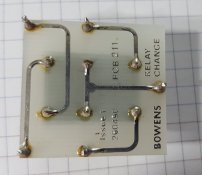
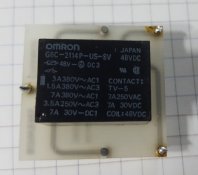
My specific unit also seem to have received a factory modification for the relay used. It has a small Omron relay on a separate PCB that looks like it was created to take the place for an older, larger model.
The way I interpret the schematic:
- Initially, the relay is set to charge the main capacitor
- Once the capacitor is charged, the MOSFET will switch on the relay which in turn now switches off the main capacitor charging path and instead activates the trigger circuit
- Once the flash has been triggered, the MOSFET shuts the relay down which starts the cycle all over again

The clicking comes from the relay switching back and forth between the two main states aforementioned before the flash is triggered. The main capacitor loses enough charge once disconnected from power (probably through the relay coil itself) after approx. 1.5 seconds to make the MOSFET block and thus top of its charge again. So the two states toggle every 1.5 seconds.

Since I had the unit open and disassembled, I replaced the main capacitor with newer photoflash caps of only 375 uF in total. Hope this will reduce the flash output enough so I won't need as many opal glasses to reduce the light output enough for use of my Sony NEX-7. Haven't fully reassembled and tested it yet.

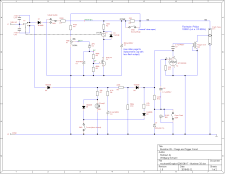
Attached a copy of my redrawn schematic and a few pics of the main PCBA and the relay modification (without the spark quenchers) that my specific unit received.

2016-06-17 - Illumitran 3S -pg1.png 2016-06-17 - Illumitran 3S -pg2.png 2016-06-17 - Illumitran Main PCBA.jpg 2016-06-17 - Illumitran Relay PCBA - Solder Side.jpg 2016-06-17 - Illumitran Relay PCBA.jpg
 
I don't know enough to help other than to tell you I used a Bowens Illumitran for 3-4 years and it didn't inadvertently click any relays as you describe. Maybe a bad solder joint?
 
Was that a "3" or a "3S"? I also have a "3" and it doesn't have the PCBA with the enhanced electronics and the relay. Thus no clicking. The main capacitor remains always connected to the charging circuit in the "3".
 
I don't remember but it was an all black model, not an older gray/silver one.
 
After countless hours of troubleshooting, reverse engineering (I even redrew the schematic as best as I could), I came to the conclusion that the "clicking" of the relay may actually be normal. I tried a new main capacitor, replaced several other components I suspected to no avail.
My specific unit also seem to have received a factory modification for the relay used. It has a small Omron relay on a separate PCB that looks like it was created to take the place for an older, larger model.
The way I interpret the schematic:
- Initially, the relay is set to charge the main capacitor
- Once the capacitor is charged, the MOSFET will switch on the relay which in turn now switches off the main capacitor charging path and instead activates the trigger circuit
- Once the flash has been triggered, the MOSFET shuts the relay down which starts the cycle all over again

The clicking comes from the relay switching back and forth between the two main states aforementioned before the flash is triggered. The main capacitor loses enough charge once disconnected from power (probably through the relay coil itself) after approx. 1.5 seconds to make the MOSFET block and thus top of its charge again. So the two states toggle every 1.5 seconds.

Since I had the unit open and disassembled, I replaced the main capacitor with newer photoflash caps of only 375 uF in total. Hope this will reduce the flash output enough so I won't need as many opal glasses to reduce the light output enough for use of my Sony NEX-7. Haven't fully reassembled and tested it yet.

Attached a copy of my redrawn schematic and a few pics of the main PCBA and the relay modification (without the spark quenchers) that my specific unit received.

View attachment 159263 View attachment 159264 View attachment 159265 View attachment 159266 View attachment 159267
 
Whoops, didn't mean to post the above!

wschrami, did you ever get to the bottom of the endless clicking? I have bought an illumitran with exactly the same problem. It all works ok, just the recycling and clicking shouldn't be happening. I know it's been quite a while since your original post, but was hoping you ( or someone else ) could shed some light.
 
Same problem here. A clicking machine. the 3S
Hopefully someone found the solution?
 
Same problem here. A clicking machine. the 3S
Hopefully someone found the solution?
Perhaps the clicking is normal. Is there someone out there with a 3S who could confirm whether it should click or not?
 
Has anyone ever turned off the lights and looked for a arc or discharge to ground from some electrical component? Wonder if some insulation in the flash circuit has a break and is arcing to the cabinet?
 
Hi Kino,

It's nothing like that, the unit just clicks when it reaches full charge. The clicking is repetitive though, every few seconds. It may actually be normal - just need someone who has one which doesnt click to say so!
 
Hi Kino,

It's nothing like that, the unit just clicks when it reaches full charge. The clicking is repetitive though, every few seconds. It may actually be normal - just need someone who has one which doesnt click to say so!
Perhaps all of them click but good ones don't click as often? Your unit may have some leakage somewhere that causes the capacitor to discharge rather quickly without firing the flash?
 
After countless hours of troubleshooting, reverse engineering (I even redrew the schematic as best as I could), I came to the conclusion that the "clicking" of the relay may actually be normal. I tried a new main capacitor, replaced several other components I suspected to no avail.
My specific unit also seem to have received a factory modification for the relay used. It has a small Omron relay on a separate PCB that looks like it was created to take the place for an older, larger model.
The way I interpret the schematic:
- Initially, the relay is set to charge the main capacitor
- Once the capacitor is charged, the MOSFET will switch on the relay which in turn now switches off the main capacitor charging path and instead activates the trigger circuit
- Once the flash has been triggered, the MOSFET shuts the relay down which starts the cycle all over again

The clicking comes from the relay switching back and forth between the two main states aforementioned before the flash is triggered. The main capacitor loses enough charge once disconnected from power (probably through the relay coil itself) after approx. 1.5 seconds to make the MOSFET block and thus top of its charge again. So the two states toggle every 1.5 seconds.

Since I had the unit open and disassembled, I replaced the main capacitor with newer photoflash caps of only 375 uF in total. Hope this will reduce the flash output enough so I won't need as many opal glasses to reduce the light output enough for use of my Sony NEX-7. Haven't fully reassembled and tested it yet.

Attached a copy of my redrawn schematic and a few pics of the main PCBA and the relay modification (without the spark quenchers) that my specific unit received.

View attachment 159263 View attachment 159264 View attachment 159265 View attachment 159266 View attachment 159267

Sorry to revive this dead thread but I would really like to know how your modifications turned out for you? Especially how satisfied were you with the power of the flash with the 375uF Capacitor? I want to build a custom xenon flash unit for digitising and I am trying to figure out how much power I need.
 
  • presch
  • Deleted
  • Reason: Image not displayed properly
After countless hours of troubleshooting, reverse engineering (I even redrew the schematic as best as I could), I came to the conclusion that the "clicking" of the relay may actually be normal. I tried a new main capacitor, replaced several other components I suspected to no avail.
My specific unit also seem to have received a factory modification for the relay used. It has a small Omron relay on a separate PCB that looks like it was created to take the place for an older, larger model.
The way I interpret the schematic:
- Initially, the relay is set to charge the main capacitor
- Once the capacitor is charged, the MOSFET will switch on the relay which in turn now switches off the main capacitor charging path and instead activates the trigger circuit
- Once the flash has been triggered, the MOSFET shuts the relay down which starts the cycle all over again

The clicking comes from the relay switching back and forth between the two main states aforementioned before the flash is triggered. The main capacitor loses enough charge once disconnected from power (probably through the relay coil itself) after approx. 1.5 seconds to make the MOSFET block and thus top of its charge again. So the two states toggle every 1.5 seconds.

Since I had the unit open and disassembled, I replaced the main capacitor with newer photoflash caps of only 375 uF in total. Hope this will reduce the flash output enough so I won't need as many opal glasses to reduce the light output enough for use of my Sony NEX-7. Haven't fully reassembled and tested it yet.

Attached a copy of my redrawn schematic and a few pics of the main PCBA and the relay modification (without the spark quenchers) that my specific unit received.

View attachment 159263 View attachment 159264 View attachment 159265 View attachment 159266 View attachment 159267

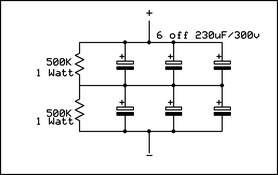
Electrolytic capacitors leak slightly, usually getting worse as they age.
Adding resistors as shown helps balance out unequal voltages across the capacitors preventing the voltages across them possibly exceeding their maximum voltage rating when one or more leak more than the others.
 

Attachments

  • Modified Replacement caps Circuit.png
    Modified Replacement caps Circuit.png
    1.8 KB · Views: 104
Photrio.com contains affiliate links to products. We may receive a commission for purchases made through these links.
To read our full affiliate disclosure statement please click Here.

PHOTRIO PARTNERS EQUALLY FUNDING OUR COMMUNITY:


Ilford ADOX Freestyle Photographic Stearman Press Weldon Color Lab Blue Moon Camera & Machine
Top Bottom