• Welcome to Photrio!
    Registration is fast and free. Join today to unlock search, see fewer ads, and access all forum features.
    Click here to sign up

Boosting print contrast

Recent Classifieds

Forum statistics

Threads
201,946
Messages
2,832,481
Members
101,029
Latest member
5000Kelvin
Recent bookmarks
0

gbenson

Member
Allowing Ads
Joined
Jun 1, 2010
Messages
13
Format
35mm
Hi all,

I have a picture I want to print, but unfortunately I underexposed it and the negative is very thin. I did a low-contrast print and there is detail everywhere, but to print with a proper black almost the whole print is black, even with my enlarger set at maximum contrast. I got a better print by underexposing the paper and then developing it for four times the regular time, but I could still use more contrast and I've done all the dodging and burning I can.

I've only ever used Paterson Acugrade and Ilford Multigrade paper. Are there other papers/developers I could use to seriously boost contrast? I probably need an extra grade. The picture is important to me, and can't be re-shot.

Thanks,
Gary
 

Athiril

Subscriber
Allowing Ads
Joined
Feb 6, 2009
Messages
3,062
Location
Tokyo
Format
Medium Format
I cant remember off the top of my head on tricks to do to the paper to get more contrast than grade 5.

What you can do is selenium tone the neg - (there was a url link here which no longer exists)

You can also bleach the neg (ferricyanide + bromide bleach) and re-develop in a staining developer, and potentially repeat this process as needed.

I would prefer to use techniques done to the paper only on an important neg though. Especially if you haven't done that kind of stuff before.

edit: there is also chromium intensifier.
 

bsdunek

Member
Allowing Ads
Joined
Jul 27, 2006
Messages
1,611
Location
Michigan
Format
Multi Format
I think Athiril has pretty much covered it. The only thing I might add, is to try Beers developer with the grade 5 paper. Might punch it up a little more.
Check this out: (there was a url link here which no longer exists)
 

David Allen

Member
Allowing Ads
Joined
Nov 6, 2008
Messages
991
Location
Berlin
Format
Med. Format RF
I probably need an extra grade

To achieve an extra grade I would recommend the following:
  1. Develop you paper in Dokumol diluted at 1 + 6 for a minimum of 2 minutes for RC paper and a minimum of 3.5 minutes for Fibre-based paper.
  2. If that doesn't give you enough contrast and you are printing on Fibre-based paper, then mix up this extremely punchy developer: Water at 50C+ 1500 ml | Metol 7.5 grammes | Sodium Sulphite (anhydrous) 142 grammes | Hydroquinone grammes | Sodium Carbonate 283 grammes | Potassium Bromide 3.5 grammes | add 1500 ml Water (18-20C) to total volume 3000 ml | Mix chemicals in order and dilute 1:2 for working strength
  3. If 1 or 2 don't do the trick, then Selenium tone the negative is a strong dilution (1 + 2) for 6 minutes and follow this with a Hypo Clear bath and your normal washing procedure.
  4. Once Selenium toned, washed and dried then use either 1 or 2 when next making your print.

Bests,

David
www.dsallen.de
 

pdeeh

Member
Allowing Ads
Joined
Jun 8, 2012
Messages
4,770
Location
UK
Format
Multi Format
Daevid you missed out the weight of hydroquinone required
 

David Allen

Member
Allowing Ads
Joined
Nov 6, 2008
Messages
991
Location
Berlin
Format
Med. Format RF
Whoops! - Hydroquinone should be 39 grammes

So the full ingredients of Defender developer are: Water at 50C+ 1500 ml | Metol 7.5 grammes | Sodium Sulphite (anhydrous) 142 grammes | Hydroquinone 39 grammes | Sodium Carbonate 283 grammes | Potassium Bromide 3.5 grammes | add 1500 ml Water (18-20C) to total volume 3000 ml | Mix chemicals in order and dilute 1:2 for working strength
 

snapguy

Member
Allowing Ads
Joined
Jan 1, 2014
Messages
1,287
Location
California d
Format
35mm
"My enlarger set at maximum contrast." This does not mean anything. I presume you are presuming that you can get maximum contrast out of whatever brand of variable contrast paper you have on hand. I've been toiling in film darkrooms since before 1960 and have found variable contrast papers to be handy but severely limited. There used to be, and perhaps still are, single grade enlarging papers for #4, #5 and #6 grades. And the #4 and up papers will give you much more contrast than a of the arbitrary numbers the variable papers give. Most variable contrast papers won't go much above a real #3.5. For #4 or harder you need single grade paper.
 
OP
OP

gbenson

Member
Allowing Ads
Joined
Jun 1, 2010
Messages
13
Format
35mm
David, I will definitely try Dokumol, I've been meaning to try cool tones for a while and one site I looked at said Dokumol was one of the coldest developers available--perfect :smile:

snapguy, I've never seen graded paper for sale other than grades 2 and 3 :sad:
 

nworth

Member
Allowing Ads
Joined
Aug 27, 2005
Messages
2,228
Location
Los Alamos,
Format
Multi Format
It is very hard t get a good print from negatives like this. If the above approaches don't work, there are a couple of others to try. One is intensification. It sometimes works. The choice of intensifier depends a bit on the negative. Selenium toner works remarkably well. Another is to print the negative to another piece of film, an interpositive that you then print to film to get a duplicate negative, or that you reversal process to get a duplicate negative. You have quite a bit of control with the film route, but it can be a lot of work.
 

David Allen

Member
Allowing Ads
Joined
Nov 6, 2008
Messages
991
Location
Berlin
Format
Med. Format RF
David, I will definitely try Dokumol, I've been meaning to try cool tones for a while and one site I looked at said Dokumol was one of the coldest developers available--perfect :smile:

snapguy, I've never seen graded paper for sale other than grades 2 and 3 :sad:

Yes, in addition to being a high contrast and hard working developer, Dokumol does produce neutral to cool tones.

Another possibility that I forgot is to use Slavich FB Unibrom 160 Gloss Grade 4 in the Defender developer - a 'kick ass' combination if you want buckets of punch (however, you MUST use only red safe-lighting with the Slavich).

Bests,

David
www.dsallen.de
 

MattKing

Moderator
Moderator
Joined
Apr 24, 2005
Messages
55,273
Location
Delta, BC Canada
Format
Medium Format
Selenium toning and intensification might help a bit, but they are really only fully effective if your negative is under-developed, rather than under-exposed.

If your have access to some separate variable contrast filters, you may find that the highest number filter in a set will give more contrast than the variable contrast/colour head you are using.

Depending on the paper you are using, you might find some benefit in partially bleaching the print, re-fixing, re-washing and then selenium toning. This works best with a moderately dark print.

Sepia or brown toning can often make low contrast prints look more pleasing.

Good luck!
 

snapguy

Member
Allowing Ads
Joined
Jan 1, 2014
Messages
1,287
Location
California d
Format
35mm
Single grade #4 paper

Freestyle Photo in Los Angeles has ten different sizes and finishes (glossy, etc.) of Foma Fomabrom single grade #4 printing paper for sale. The Foma company has been in business since 1921.
 
Joined
Sep 10, 2002
Messages
3,676
Location
Eugene, Oregon
Format
4x5 Format
I've had good luck with both selenium intensification and bleach/redevelop.

The former is great for negatives developed in non-staining developers. It is easy and adds about one grade of contrast to the negative. Use selenium toner 1+2 for 5 minutes, wash and dry as usual.

If you have used a staining developer (pyrogallol or pyrocatechin based), then be aware that selenium toner will remove the stain, effectively negating the intensification. In this case I'd use bleach/redevelop. I had good results with:

Potassium ferricyanide 5g (50ml 10% solution)
Potassium bromide 1.75g (50ml 3.3% solution) (I have the ferri and bromide solutions on hand at all times)
Water to make 250 ml

Bleach the negative with the lights on until there is nothing but a very faint stain image (or no stain image if you didn't use a staining developer).
Redevelop the negative fully in a staining developer (this is important - using a non-staining developer will just get you back to where you started from). I would use your normal time plus a few minutes to make sure the negative has developed to completion. The rehalogenated silver will develop to the original contrast, but you'll get extra contrast from the stain image, effectively giving you about a grade more.

Although some say you can repeat this, I wouldn't do it more that twice, since it makes the emulsion a bit brittle and breakage is a danger.

Of course, you should exhaust all the printing variations first: Use a new #5 filter instead of your dichroic head (if that is what you are using). Often the filter will get you a bit more contrast. Print on a condenser enlarger if you can; that will get you some more contrast too.

Hard-working developers like those David Allen posted above will help too.

Printing a bit dark and then bleaching back with a ferricyanide/bromide bleach will get you more contrast too. I start with 10ml 10% ferricyanide solution and 30ml 3.3% potassium bromide solution (I have these on hand always) to 1 liter water. That equals 1 gram of each per liter if you're mixing from scratch. If it isn't strong enough, then add more ferri and bromide in equal amounts. This method is often quite gratifying.

And, of course, you can use many these techniques together if you like! If none of this works, then making internegatives is the next step. And dare I suggest that you could also make one d****ally? Not here on APUG...

Edit: I've cross-posted with some of the ones above -- sorry for the duplicate information.

Best of luck,

Doremus
 

snapguy

Member
Allowing Ads
Joined
Jan 1, 2014
Messages
1,287
Location
California d
Format
35mm
three brands

B&H Photo has single grade #4 printing paper for sale from three different companies. I am told if you look around you can find litho paper that will give you grade #5 results. I will be looking around. I have a few negatives that need some extra contrast.
 

bernard_L

Member
Allowing Ads
Joined
Feb 17, 2008
Messages
2,135
Format
Multi Format
(...) selenium intensification (...) The former is great for negatives developed in non-staining developers. It is easy and adds about one grade of contrast to the negative. Use selenium toner 1+2 for 5 minutes, wash and dry as usual.

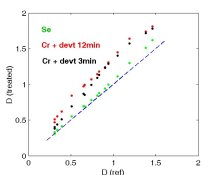
Time and again one can see Se toner recommended on photo forums to increase negative contrast. I was dubious from my previous attempts. So I made actual measurements. Neopan 400. Plot shows density (after) versus density (before). Disregard the points for Cr intensification, part of ongoing work. Se curve shows that for initial D=1, the density of Se-treated film is at most 1.05, being generous. I call that less than 1/4 paper grade; hardly worth the trouble. Treatment was Se toner 1+2 20min(!).
Sens_Neo400_20140216_D(D0).jpg
 

David Allen

Member
Allowing Ads
Joined
Nov 6, 2008
Messages
991
Location
Berlin
Format
Med. Format RF
All that I can say is that I have found it to be very effective in practical use. On the one occassion that it produced less than expected increase in contrast was when I was in an area with somewhat acidic water. The solution there was to mix 1 part Selenium to two parts HCA (AA recommended mix) and this solved the problem.

Bests,

David
www.dsallen.de
 
Joined
Sep 10, 2002
Messages
3,676
Location
Eugene, Oregon
Format
4x5 Format
Time and again one can see Se toner recommended on photo forums to increase negative contrast. I was dubious from my previous attempts. So I made actual measurements. Neopan 400. Plot shows density (after) versus density (before). Disregard the points for Cr intensification, part of ongoing work. Se curve shows that for initial D=1, the density of Se-treated film is at most 1.05, being generous. I call that less than 1/4 paper grade; hardly worth the trouble. Treatment was Se toner 1+2 20min(!).
View attachment 85146

Bernard,

I don't doubt your results. As different papers tone differently in selenium, so will different films. Obviously, Neopan doesn't tone well in selenium. I've used this technique with Tri-X 320 sheet film (both old and new versions) with gratifying results however.

Good to know this about Neopan. Have you tested other films? I'm curious now.

Best,

Doremus
 

bernard_L

Member
Allowing Ads
Joined
Feb 17, 2008
Messages
2,135
Format
Multi Format
David, Doremus,

Granted, my data is valid only for Neopan400 (developed in D-76 1+1 9:30). Sorry, I don't have data for other films; some future time maybe. For the moment my priority is to find and verify a process to increase the contrast of three important (to me) Neopan400-120 films that appear to have been developed to CI~0.45, and do so preserving the tonal scale.
 
Joined
Sep 10, 2002
Messages
3,676
Location
Eugene, Oregon
Format
4x5 Format
About conflicting/puzzling results concerning selenium toner intensification:
http://www.largeformatphotography.i...?2082-Selenium-Toner-for-Negs-It-Doesn-t-Work
We might all be right, in a way.

It would seem that different films tone differently, just like different papers do. Intensification using selenium would therefore be film-specific.

Maybe some enterprising soul with lots of test negatives on different film and a densitometer will do a series of tests for us?

FWIW, I use Kodak selenium toner 1+2 for five minutes when I selenium intensify. The toning goes pretty much to completion. I've had luck with Tri-X, and both T-Max films.

Best,

Doremus
 
Photrio.com contains affiliate links to products. We may receive a commission for purchases made through these links.
To read our full affiliate disclosure statement please click Here.

PHOTRIO PARTNERS EQUALLY FUNDING OUR COMMUNITY:


Ilford ADOX Freestyle Photographic Stearman Press Weldon Color Lab Blue Moon Camera & Machine
Top Bottom