• Welcome to Photrio!
    Registration is fast and free. Join today to unlock search, see fewer ads, and access all forum features.
    Click here to sign up

Bleaching Fuji-100C

Recent Classifieds

Forum statistics

Threads
202,673
Messages
2,843,929
Members
101,458
Latest member
Alex_ette
Recent bookmarks
0

Jeff Canes

Member
Allowing Ads
Joined
Jun 27, 2006
Messages
34
Location
Hollywood, F
Format
35mm
Retrieving negative from Fuji peel-apart film: I have seen a lot of videos on the web demonstrating on how the process works. The results in the videos are always color negatives. But I am only getting BW negatives. Has the film changed? Am I doing something wrong? :unsure:
 
The negs never go completely clear. Once all the black has come off the back side no matter how many more times you apply more bleach no more will come off. So flip it over and clean the emulsion side and you are ready to scan. As far as BW instant fil. Just each emulsion side with water, dry, scan, invert and you are good.
 
You should be getting colour negatives - are you sure you arent bleaching the BW equivalent of FP100c?
 
yeah I'm with analoguey does the box say FP-100c ? Or FP-100b ?
I've done this to nice effect. Negative appears a lot sharper than the print. I also tried shooting it at 400 with limited success :-D

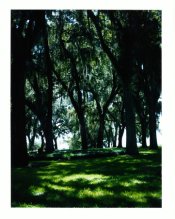
4987302044_69a8dd9996_o.jpg
 
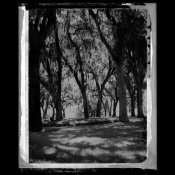
2014-033-M.jpg 2014-035-bw-M.jpg

Definitely color. But I've been scared to touch the emulsion side, I do not recall any of the video showing to clean the emulsion off. Will try that.

I'm scanning them on an all-in-one home printer scanner using an ipad as the back light.

Also should I but the negative in fixer to harden them?
 
Last edited by a moderator:
View attachment 94276 View attachment 94277

Definitely color. But I've been scared to touch the emulsion side, I do not recall any of the video showing to clean the emulsion off. Will try that.

Should I but the negative in fixer to harden them?

from what I remember there's some whitish gloop on the emulsion side as well, though my memory could be serving me ill here, but it came off with light pressure from a finger under running water. It's probably also caustic or something. I never fixed them.
 
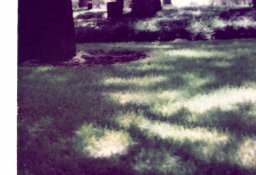
Well it seem that the problem is with the scanning, below is a detail scan of the same negative in a MF film scanner

2014-02-fpco--L.jpg
 
Hmm.
But dont you see the colour in the negative itself? Quite easily spotted - like a c41 without mask.

Sent from Tap-a-talk
 
The FP-100B doesn't behave the same (e.g. the black back will not clear with bleach) as the FP-100C, so there's no way this could be the b&w film.
 
Ah, I see -havent used the bw version - I thought they'd be similar.

Sent from Tap-a-talk
 
Hmm.
But dont you see the colour in the negative itself? Quite easily spotted - like a c41 without mask.

Sent from Tap-a-talk

Short answer is no. My negatives do not seem to have the same bold colors of the sample I have seen on the web. Or the mask free films I have used before.
 
Last edited by a moderator:
I think you washed it to warm Jeff, I've had the same issue before.
Be sure to use only the coldest water in your tap.
Lukewarm made mine green, and warmer washed the emulsion right off :smile:

EDIT: Sorry about the necro, I didn't check the date, and didn't realize how slow this part of the board is.
 
I think you washed it to warm Jeff, I've had the same issue before.
Be sure to use only the coldest water in your tap.
Lukewarm made mine green, and warmer washed the emulsion right off :smile:

EDIT: Sorry about the necro, I didn't check the date, and didn't realize how slow this part of the board is.

Welcome to APUG. No need to be sorry. Any information about this process is welcome and likely to be seen and considered by folks researching the topic at any time. This is as good a place to put it as any.

I've played around with this process myself and find the resulting color negatives to be very dense. They scan easily enough and with a little adjustment can be made very pretty. But this is an analog board, of course, and my experience making color contact prints (RA-4 process) was not a good one. The colors don't balance very well, and it's impossible to get good contrast. I could be doing something wrong. Maybe I'll try again someday...
 
I think you washed it to warm Jeff, I've had the same issue before.
Be sure to use only the coldest water in your tap.
Lukewarm made mine green, and warmer washed the emulsion right off :smile:

EDIT: Sorry about the necro, I didn't check the date, and didn't realize how slow this part of the board is.

I definitely think bumping an old thread to add new information is better than to have 10 different threads from the past decade all discussing the same topic in different places.
 
Welcome to APUG. No need to be sorry. Any information about this process is welcome and likely to be seen and considered by folks researching the topic at any time. This is as good a place to put it as any.

I've played around with this process myself and find the resulting color negatives to be very dense. They scan easily enough and with a little adjustment can be made very pretty. But this is an analog board, of course, and my experience making color contact prints (RA-4 process) was not a good one. The colors don't balance very well, and it's impossible to get good contrast. I could be doing something wrong. Maybe I'll try again someday...

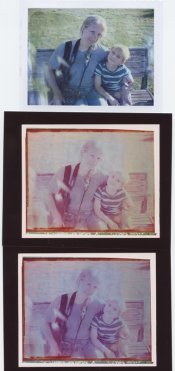
To follow up, below is a print from FP-100c and two attempts to contact print the bleached negative using traditional RA4 materials. My notes from the time suggest this was as close as I could get to matching the original colors, but now I'm wondering if the magenta isn't way off (the two prints shown are 40M+80Y followed by 40M+90Y). I was more frustrated with the lack of contrast, and just gave up. A second image that I tried didn't work out any better.

In any case, this is our good friend winger (Bethe) and her son from a get together last summer.
 

Attachments

  • img031.jpg
    img031.jpg
    99 KB · Views: 282
Last edited by a moderator:
when people started tinkering with this a few years back there were a lot of alarmist warnings about scratching negs oven cleaners and other esoteric toxic nonsense which literally scared users away.
As you can see from the videos its no harder or extensive than clearing and fixing New55 NEW 55 film.
this negative does not have an orange base as other color negatives so when scanning and printing for color
in an usual range you must have a blank orange negative( no image) or an 85 b/c written and you may play with nd filters if you like or add a layer in photoshop if you are sufficiently skilled.CROSS PROCESSING
without adding the orange base what you have is a very high end cross process tonal range of a 3x4 inch HD neg. compare at 10 dollars per shot if you were to cross process a 4x5 negative either way.
Technical pan.
It may surprise you to know that when scanned for use as black and white this negative can approximate technical pan in a big way but less harsh on the skin tones and having a higher iso.
Im all for alternatives. New 55 New55 is a mid to low contrast very rich mid and dark tones panchromatic.
and this other fp 100c option is a highest contrast obtainable when used as a black and white neg .
 
So I'm new to shooting this peel apart polaroid film and I've just been binning the negatives. I watched the FPP video and it seems really easy and rewarding but I have two questions; do I have to do this before the negative 'dries'? Which bleach is closest to 'Clorox' in the UK? Can I just use any old bleach?
 
I use one of the thick domestos bleaches as it stays where it should be and doesn't run off the neg. Make sure you don't get any on the front though as it will very quickly destroy the image.
 
It's a good idea to let the neg dry first. I have bleached ones that I had saved (dried) some years ago, and they still came out fine even after all that time. Agreed, any thick bleach will work fine. Tape the neg down on glass to prevent it getting on the emulsion side. Clean the emulsion goop with plain water after the bleaching step. Then rinse in photoflo/water and hang to dry.
 
Photrio.com contains affiliate links to products. We may receive a commission for purchases made through these links.
To read our full affiliate disclosure statement please click Here.

PHOTRIO PARTNERS EQUALLY FUNDING OUR COMMUNITY:


Ilford ADOX Freestyle Photographic Stearman Press Weldon Color Lab Blue Moon Camera & Machine
Top Bottom