
• Welcome to Photrio!
    Registration is fast and free. Join today to unlock search, see fewer ads, and access all forum features.
    Click here to sign up

Black & White capture of snow landscape

Forum statistics

Threads
203,275
Messages
2,852,204
Members
101,755
Latest member
andescapes
Recent bookmarks
0

Willie Jan

Member
Joined
Jun 11, 2004
Messages
950
Location
Best/The Netherlands
Format
4x5 Format
Last 3 weeks we had a lot of snow here (that happens not that often here...) and we shot a lot of landscape photos of trees that are covered in snow. Mostly we go out very early before the sun rises or on cloudy days so the contrast does not burn into the film.

After development we found out that the photo looks disappointing if I remember the scene from my memory. My film is exposed/developed correctly.
Playing with contrast does not help a lot.

It's hard to explain but it looks like it's hard to catch the real scene.
Are there others finding out the same problem?
 
If you take a reading from the snow, you will get the texture of the snow and all else will be very dark. The snow will print gray.

Wilde's fifth edition of the Hasselblad book recommends taking the snow scene reading and opening the aperture two stops [one? I do not have the book with me] and process normally.

When I took photographs of skiing with slide film, I too a reading off my hand, either with the Sun on the palm or shade depending of the subject of interest, and got people or trees with some of the snow texture and form. Black & white film will do much better.

Steve
 
Here in New England we get a fair amount of time to shoot snow scenes. As Steve said meter the snow and open up two stops and process normally. This will give you the white snow with some texture. I find new students frequently have the same problem of gray snow so you are not alone.

Paul
 
The usual problem is overexposure. Snow is very bright, even on a cloudy day. Allow 2 to 3 stops less exposure than you would normally use. Bracket.
 
What Steve said. Light meters are like firearms; they have to be pointed at the right target, and used with discernment. Your meter wants to render as middle gray whatever you point it towards, if reflective; or whatever light falls upon it, if incident. Snow, OTOH, is at least two stops, if not more, above middle gray.
 
The usual problem is overexposure. Snow is very bright, even on a cloudy day. Allow 2 to 3 stops less exposure than you would normally use. Bracket.
If you meter the snow, the meter will assign it to medium gray and underexpose. You want to add exposure(open aperture or slow shutter)by at seast two stops.
 
Another method is to meter an 18% grey card making sure that you angle it so it is receiving the same light as the snow. This is a good time to try bracketing until you learn what works best for you. The wasted film will soon be forgotten if one of the bracketed shots is better than what you thought the setting should be.

John Powers
 
I would also recommend getting some reading on the Zone System it would help out a lot. The Ansel Adams book the "Negative" is a really good place to start.
 
I find the answer to metering snow scenes is the same as it is for most scenes: meter for the shadows. A spot meter can be a help but you can shove any old meter into the tree roots or rocks. Or, as ralnphot suggested, take an averaging reading and open up two stops (or knock the ASA dial on the camera down by 4x) and hope for the best - it usually works. If shooting color slide film then meter the snow highlights (not the scene average) and open up two stops.

TMax-100 or Tech Pan or other film with a long straight line in its response curve keeps the highlight detail from getting lost.

Example: Metered for the dark patch in the rocks at lower left, closed down 2 1/2 stops. Normal development, printed at grade 2 1/2. No dodging, no burning, no problems... (there was a url link here which no longer exists)
 
Last edited by a moderator:
I've been setting my EV comp. dial to +1 and waiting to see how it works. If the scene doesn't contain too much snow, that will be all that's necessary. You can also find a sidewalk, road, or any other grayish, non-snowy surface. There's a ton of resources devoted to shooting in the snow.
 
Snow makes a wonderful subject for black and white photographs. You state that you are disappointed with the resulting photograph. It may be that you don't have enough contrast in the snow itself. Try shooting with the snow in sun. Meter as recommended by others. One trick I use is to meter the north sky and use that as a base setting, comparing it to the sunny f/16 rule as a check. (An incident meter makes getting the right exposure a snap).

Snow without sun on it will in all probability come out as a white, lifeless mass with little or no detail. Personally, I don't photograph snow on cloudy days, unless it is incidental to the scene. Waiting for the sun adds that sparkle to the snow. It adds definition to the mass of white. The shadows on snow are actually blue light, even though we tend to see them as black. A yellow filter will pump up the local contrast and make each bump in the snow stand out. To my eye, a red filter is overkill. But I know some people use red filters for their snow photographs. Try waiting for the sun to clear the horizon and see if you like the results.
 
What Allen said. Snow without shadows, even faint ones, can be boring. The yellow filter works well to bring out details in the snow (if there is at least some sun), and if you've got an incident meter, try that. If not, open up two stops.
 
am I doing it right?

it's been yuck in the fog all week
sun is just a semi-bright orb in the gray sky
class was cancelled due to imminent freezing rain
used 30x in 30 minutes driving around town shooting trees and icicles hanging from roofs
camera EV set at +2 delta 400 typical exposure 1/20 at f5.6

tomorrow will try AEB

it's not like everything will melt anytime soon :D
 
I am sure, Willie-Jan knows how to find the right exposure in the presence of snow. He also mentioned that the film is correctly exposed. I think he is troubled by something else. Unfortunately, I cannot help.
 
I am very confident that i do not make mistakes with taking readings. (I use a pentax digital spotmeter).
The negs are not under or overexposed. Total is under 5 stops in the morning before the sun is comming up.

What I mean is that I am not sure that snow is reflecting the same frequency of light or is there a different thing to take into account.
Does snow comes out a little gray in a b&w picture when it does not have direct light on it (blue light)?
My photos look ok, but they miss the effect I see with my eyes...
As paul says, we also have a very small part of the year with snow (sometimes none), so testing takes a long time (years)....

I am dedicated to landscapes and trying to create images that have the right atmosphere.
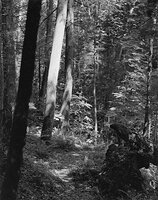
This is an example which I beleave shows what I saw there with my eyes.
photo12.jpg
 
Does snow comes out a little gray in a b&w picture when it does not have direct light on it (blue light)?
My photos look ok, but they miss the effect I see with my eyes...

I think it's easy to overexpose at the printing stage, resulting in grey snow. When I'm printing a snow scene I find I get the best results using a harder paper grade and printing so the brightest snow is just on the paper. If it's not in direct sun a snow scene can have surprisingly little contrast so a harder paper grade helps. I just added an example to the (there was a url link here which no longer exists). This was printed at grade 3.5 or 4 even though there was hazy sun about.
 
I just added an example to the (there was a url link here which no longer exists).

Even on a monitor that looks nice. It's exactly how I would want a snow scene to look if that makes any sense.

I bet the print looks really good.


Steve.
 
I see what you mean with a little detail in the snow. Nice pic.

I did not have any direct sun in my situation. Indeed the contrast is probably low and am I affraid of blocking the snow by increasing contrast.
I will have to do some tests with it.
 
Living in the middle of England, I also have few opportunities to practice shooting in the snow. Hesitant to upload this as I'm awful at scanning prints. But this is Neopan 400 with an orange filter, printed at around grade 3.5 I think:

snow-2.jpg


You'll have to take my word for it that the print isn't so grey in reality (the borders are white in my print, greyish on my laptop screen).
 
I'd read online a few posts here and there saying that it helps to retain the texture in the snow. The photo above I shot twice, one with and one without the filter and there is a very subtle difference in the amount of detail in the snow. I don't want to draw any conclusive opinions about the benefit of an orange filter without using it more in the snow, mind.
 
At this picture (there was a url link here which no longer exists) taken a few weeks back i measured the light at the tyre on the car, and placed that in sone III. Then shortended the development too about 2 sones. I also used a red filter.

Kent
 
Last edited by a moderator:
I always use a filter with snow scenes

The filter colour depends on the lighting

Very flat lighting gets a deep red filter - at the opposite end of the scale - brilliant clear blue skies may only need a pale yellow filter

I find its worth shooting the chosen scene through a range of filters and take careful notes, if you are unsure

My aim is to bring some texture out of the snow, print the highlights at Z VII~Z IX and then choose a fairly hard grade of paper to bring out the snows texture

However, care is needed as the dark tones will disapear into black with the harder paper grades without lots of dodging and burning

The delicate balacing of micro contrast of texture in the snow and macro contrast of the whole picture is among the most challanging of darkroom tasks

My 0.02$

Martin
 
Photrio.com contains affiliate links to products. We may receive a commission for purchases made through these links.
To read our full affiliate disclosure statement please click Here.

PHOTRIO PARTNERS EQUALLY FUNDING OUR COMMUNITY:


Ilford ADOX Freestyle Photographic Stearman Press Weldon Color Lab Blue Moon Camera & Machine
Top Bottom
