
• Welcome to Photrio!
    Registration is fast and free. Join today to unlock search, see fewer ads, and access all forum features.
    Click here to sign up

BIG Camera -- Ideas on use?

Cool as Ice

A
Cool as Ice

  • 0
  • 0
  • 22
Pond

H
Pond

  • 2
  • 0
  • 47

Recent Classifieds

Forum statistics

Threads
202,701
Messages
2,844,451
Members
101,478
Latest member
The Count
Recent bookmarks
0

Kino

Subscriber
Allowing Ads
Joined
Jan 20, 2006
Messages
8,093
Location
Orange, Virginia
Format
Multi Format
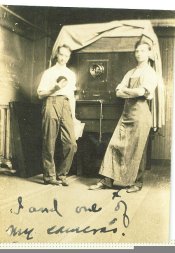
A friend, who is also a cinema historian, sent me a photo of a person he is researching. This photo, reproduced below, shows him standing next to a camera he ran in the 1905 ish era.

One of the companies he worked in that era was for Dodd-Rogers in Cleveland, Ohio making halftones, but he is unsure of the pedigree of the camera or if this was taken there or in San Antonio, Texas.

I told him I would post the photo here for comments -- any comments?

Whatever you come up with, might help him ID the location and process being used in this photo.

Thanks in advance.
 

Attachments

  • greg_5.jpg
    greg_5.jpg
    66.5 KB · Views: 551
It's for portraits, a little man sits inside the camera and with a paint set and easel, paints a picture on canvas while the person poses.
 
Oh, its an early Paint-a-roid...
 
maybe 1:1 full size copies of things to go to press (copywork) ?
like a "stat camera" ...
 
Dear Kino,

I'd be 99 per cent sure it's a repro camera for making screened negs. To clues: the rails on the floor (the camera moves ONLY to and fro) and the narrowness of the 'studio' behind the rail to the left (no room for 'creative' lighting).

Wet plates remained popular for a surprisingly long time for repro, but eventually all went over to conventional film.

Formats were vast, typically up to 30x40 inches with endless reducing backs. I've used one at the studio where I started as an assistant: we used it for making liths for masks, etc., not for repro.

Cheers,

Roger
 
Dear Kino,

I'd be 99 per cent sure it's a repro camera for making screened negs. To clues: the rails on the floor (the camera moves ONLY to and fro) and the narrowness of the 'studio' behind the rail to the left (no room for 'creative' lighting).

Wet plates remained popular for a surprisingly long time for repro, but eventually all went over to conventional film.

Formats were vast, typically up to 30x40 inches with endless reducing backs. I've used one at the studio where I started as an assistant: we used it for making liths for masks, etc., not for repro.

Cheers,

Roger

Would completely agree, the fact that one operator is wearing an apron I think further supports the wet plate idea. The plateholder is, I believe, lying on the floor to the left of the camera.
 
I salvaged a repro camera from a dumpster a few years ago. The camera was really junk, I just wanted chassis that the camera rolled on, thinking someday it could be used in building an 8x10 or larger horizontal enlarger. Like Roger's camera, this one had a back that had ever reducing sizes for plates or film. The back was also in good shape.
 
Isn't that Jim Galli on the right?
 
Thanks everyone, I will inform him of your learned opinions!

Thanks again!
 
Don't know if this is pertinent at all, but Dodd Camera has the only remaining pro photo shop in Cleveland that I'm aware of. They have a web page and you may be able to contact someone knowledgable there.

Lee
 
Robertson made big wooden copy cameras, I haven't seen one THAT big, but it could well be. Nice table and rails if you like that sort of thing.
 
Wet plates remained popular for a surprisingly long time for repro, but eventually all went over to conventional film.

That's a fact that has always pricked my curiosity: why indeed would repro shop do the unwieldy job of coating 30x40 wet plates? Better sharpness at that time compared to gelatin emulsion?
 
That's a fact that has always pricked my curiosity: why indeed would repro shop do the unwieldy job of coating 30x40 wet plates? Better sharpness at that time compared to gelatin emulsion?

Because the collodion process (wet plate) made the best repro negatives. It is as simple as that. A wet-plate negative is practically grain-free, thus the grain does not produce inteference with the dot pattern screen. You state "coating 30x40 wet plates". I assure you that even though newspapers were larger than they are today, there would be very very few repro negatives coated at 30x40... The text of newspapers was not printed by offset, the linotype slugs were either printed directly, or a stereotype mat was made and a plate was poured (lead metal) to fit on the press. The photos would have been screened with a camera such as this, but even those were made into relief plates for printing.

It is only much later that whole pages of typesetting were photographed with a repro camera for making plates for offset printing.
 
Because the collodion process (wet plate) made the best repro negatives. It is as simple as that. A wet-plate negative is practically grain-free, thus the grain does not produce inteference with the dot pattern screen. You state "coating 30x40 wet plates". I assure you that even though newspapers were larger than they are today, there would be very very few repro negatives coated at 30x40... The text of newspapers was not printed by offset, the linotype slugs were either printed directly, or a stereotype mat was made and a plate was poured (lead metal) to fit on the press. The photos would have been screened with a camera such as this, but even those were made into relief plates for printing.

It is only much later that whole pages of typesetting were photographed with a repro camera for making plates for offset printing.

Still, based on the photo of the repro camera Kino posted, and if it is indeed using wet-plate, it must have been quite a job when big negatives were needed.
 
Still, based on the photo of the repro camera Kino posted, and if it is indeed using wet-plate, it must have been quite a job when big negatives were needed.

Oh, absolutely, no doubt. My point was that even though the camera was BIG, most of the work was probably smaller in scope.
 
Big Camera using glass plates

Glass plates have the best film flattness - big film bends and sags etc.
Robert:wink:
 
Glass plates have the best film flattness - big film bends and sags etc.
Robert:wink:

and it was for this reason that tmax was sold in plates upto just a few years ago - aerial and scientific photography requires this sort of thing ...
 
I also can add nothing, however Roger and phototone have hit the nail square on the head. I back their explanation
100%.
 
Don't know if this is pertinent at all, but Dodd Camera has the only remaining pro photo shop in Cleveland that I'm aware of. They have a web page and you may be able to contact someone knowledgable there.

Lee
I buy all my supplies at Dodd in Cleveland. Maybe I should take this image in sometime and see if anyone has any info.
 
Any way to tell who, or what, is reflected in the taking lens on that bebby?
 
Couldn't say; the scan sent to me was very low res. I doubt the original has much more resolution.
 
Photrio.com contains affiliate links to products. We may receive a commission for purchases made through these links.
To read our full affiliate disclosure statement please click Here.

PHOTRIO PARTNERS EQUALLY FUNDING OUR COMMUNITY:


Ilford ADOX Freestyle Photographic Stearman Press Weldon Color Lab Blue Moon Camera & Machine
Top Bottom
